The progressive dinner ran on a clean premise: each house on the block took one course, and guests moved door to door across the whole evening. Appetizers at the first stop, soup at the next, the main course at the house with the big dining table, dessert wherever there was room to spread out. By the time anyone sat down for coffee, the whole street had fed them.
Each family only had one course to get right, and that changed what people cooked. The appetizer house wanted something that could sit on a card table for an hour without suffering, while the soup house had a pot simmering before the first guests knocked and the main-course house had to time its oven to the minute. Dessert was usually made that morning and left to chill until the group finally arrived. These seven dishes show how those evenings were built, in the late 1960s and through the 1970s, when the progressive dinner was a neighborhood fixture in a lot of American towns.
1. Little smokies in grape jelly and chili sauce
The hostess who drew the appetizer course at a progressive dinner had a particular kind of pressure. Everyone arrived at her door first, still stamping their feet from the walk between houses, and she had to get the evening going with something warm in their hands before the group moved on to the next stop. Little smokies in grape jelly and chili sauce were made for that job. The sausages stayed hot without her standing over them, and the sweet-savory glaze on each one gave people something to reach for while the wine got passed around.
A hostess could mix up the sauce midweek and let it sit in the refrigerator until Saturday afternoon, when it went into a chafing dish or one of the new Crock-Pots. By the time the neighbors filed in and coats were piled on the bed, the kitchen smelled right and nothing needed tending. It was a dish that let the hostess be a hostess instead of a cook, which mattered when the whole group would be heading down the block again before long.
Ingredients (Serves about 12 as an appetizer)
-
2 pounds cocktail smoked sausages (little smokies)
-
1 tablespoon Worcestershire sauce
Instructions
1. Combine the grape jelly and chili sauce in a medium saucepan over low heat. Stir until the jelly melts into the sauce and the mixture is smooth, about 3 minutes.
2. Stir in the Worcestershire sauce and dry mustard.
3. Add the cocktail sausages and stir to coat them evenly.
4. Raise the heat to medium and bring to a bare simmer, stirring occasionally. Reduce to low and cook for 20 to 25 minutes, until the sauce has thickened slightly and clings to the sausages.
5. Transfer to a slow cooker set on WARM or LOW to hold until serving. Serve directly from the pot with toothpicks alongside.
2. Marinated mushrooms with garlic and herbs
The first house had to hold a crowd for forty-five minutes while stragglers arrived, and a bowl of marinated mushrooms on the coffee table handled that job without any help. They didn’t require a plate, didn’t leave grease on shirt fronts, and the hostess had made them the night before. They sat in the back of the refrigerator while she got ready. Button mushrooms, briefly blanched and then left overnight in olive oil, red wine vinegar, garlic, and dried herbs, came out of the jar looking dark and glossy, and they tasted sharper and more particular than anything you’d get from a can.
Whatever didn’t disappear before the group moved on to the next house was the real prize. A jar of leftover marinated mushrooms could go into a green salad the following day, get chopped and folded into scrambled eggs, or go alongside cold roast beef for a quick lunch. The marinade itself, once the mushrooms were gone, made a decent salad dressing if you shook it up with a splash more vinegar. Most families figured this out without being told, which is why the bowl at the first stop was often set out only half-full.
Ingredients (Makes about 2 cups, serves 6 to 8 as an appetizer)
-
1 pound small button mushrooms, cleaned and stems trimmed
-
3 tablespoons red wine vinegar
-
3 cloves garlic, thinly sliced
-
1/4 teaspoon black pepper
-
2 tablespoons fresh flat-leaf parsley, roughly chopped
Instructions
1. Bring a large pot of water to a boil. Add the mushrooms and blanch for 3 minutes, then drain thoroughly.
2. While the mushrooms are still warm, whisk together the olive oil, red wine vinegar, garlic, oregano, thyme, sugar, salt, and pepper in a medium bowl.
3. Add the drained mushrooms to the bowl and toss well to coat. Let them cool to room temperature, about 20 minutes.
4. Transfer the mushrooms and all the marinade to a jar or lidded container. Refrigerate for at least 8 hours or overnight, turning the jar or stirring once or twice so the mushrooms marinate evenly.
5. Before serving, stir in the parsley and let the mushrooms sit at room temperature for 15 minutes. Serve with toothpicks.
3. Cream of asparagus soup
At a progressive dinner, the soup-and-salad house had a specific pressure: you couldn’t serve something people would fill up on, but you couldn’t serve something forgettable either. Cream of asparagus hit the right note. Pale green and smooth, it looked deliberate on a good soup plate in a way that canned soup never could, and the hostess could finish it from a nearly completed base hours after she’d prepped the kitchen.
The base is a roux: 3 tablespoons each of butter and flour, cooked together before the broth goes in. At 3 tablespoons of flour per 4 cups of liquid, the result holds together without thickening into something you’d pour over chicken. The cream goes in entirely off the heat. Take the pot off the burner, stir in the cream and lemon juice, and leave it there. Residual warmth carries it the rest of the way without any risk of curdling.
Plenty of those kitchens did the pureeing with a food mill, a hand-cranked bowl with a perforated plate and a rotating blade. The asparagus cooked soft in the broth, the whole pot went through the mill, and what came through the holes was a smooth puree with the stringy fibers left behind. A blender works too, as long as the soup goes through a fine-mesh strainer afterward, because a blender chops those fibers small instead of holding them back.
Ingredients (Serves 6)
-
2 pounds fresh asparagus (about 2 bunches), woody ends snapped off
-
3 tablespoons unsalted butter
-
1 medium yellow onion, roughly chopped (about 1 cup)
-
2 stalks celery, roughly chopped
-
3 tablespoons all-purpose flour
-
1/2 teaspoon kosher salt, plus more to taste
-
1 tablespoon fresh lemon juice
-
1/4 teaspoon ground white pepper
Instructions
1. Snap the woody ends off the asparagus and discard them. Cut the trimmed stalks into 1-inch pieces.
2. Melt the butter in a large saucepan over medium heat. Add the onion and celery. Cook, stirring occasionally, until softened but not browned, about 7 minutes.
3. Sprinkle the flour over the vegetables and stir to coat. Cook for 1 minute, stirring constantly.
4. Pour in the chicken broth gradually, whisking as you add it. Bring to a simmer over medium-high heat, whisking until smooth.
5. Add the asparagus and 1/2 teaspoon salt. Reduce the heat to medium-low and simmer, uncovered, until the asparagus is completely tender, about 20 minutes.
6. Puree the soup in batches in a blender until completely smooth, then pass it through a fine-mesh strainer back into the pot, pressing the solids to extract all the liquid; discard the solids. (If using a food mill instead, run the soup through the fine plate directly back into the pot; no straining needed.)
7. Set the pot over medium heat and warm the soup until it just begins to steam, about 3 minutes.
8. Remove the pot from the heat. Stir in the heavy cream, lemon juice, and white pepper until fully combined. Do not return to the burner. Taste and adjust salt.
4. Green goddess salad
Green goddess dressing got its name at the Palace Hotel in San Francisco in 1923, when chef Philip Roemer built a recipe around fresh herbs to honor George Arliss, who was starring in the play of the same name in the city at the time. It spread east in the 1950s through newspaper food columns and women’s magazines, and by the late 1960s it carried enough cachet to be the sophisticated choice at the salad stop of a self-respecting progressive dinner. The full tablespoon of anchovy paste below is where the dressing gets its backbone, and I’d keep all of it even though it sounds like a lot. Running the herbs through a food processor instead of chopping them by hand turns the whole thing a uniform pale green instead of white flecked with herbs.
Ingredients (Serves 8 as a salad course)
-
1 tablespoon anchovy paste
-
1 tablespoon fresh lemon juice
-
3 tablespoons chopped fresh tarragon
-
3 tablespoons chopped fresh chives
-
3 tablespoons chopped fresh flat-leaf parsley
-
1/4 teaspoon freshly ground black pepper
-
2 heads butter lettuce, torn into pieces (about 10 cups)
-
1 cup cherry tomatoes, halved
-
1 English cucumber, halved lengthwise and sliced 1/4 inch thick
Instructions
1. Combine the mayonnaise, sour cream, anchovy paste, lemon juice, garlic, tarragon, chives, parsley, and black pepper in a food processor or blender. Process until smooth and uniformly green, about 30 seconds. Taste and add salt if needed.
2. Transfer the dressing to a jar or bowl, cover, and refrigerate for at least 30 minutes.
3. When ready to serve, combine the butter lettuce, cherry tomatoes, and cucumber in a large salad bowl.
4. Pour half the dressing over the salad and toss to coat. Serve immediately and pass the remaining dressing at the table.
5. Seafood Newburg
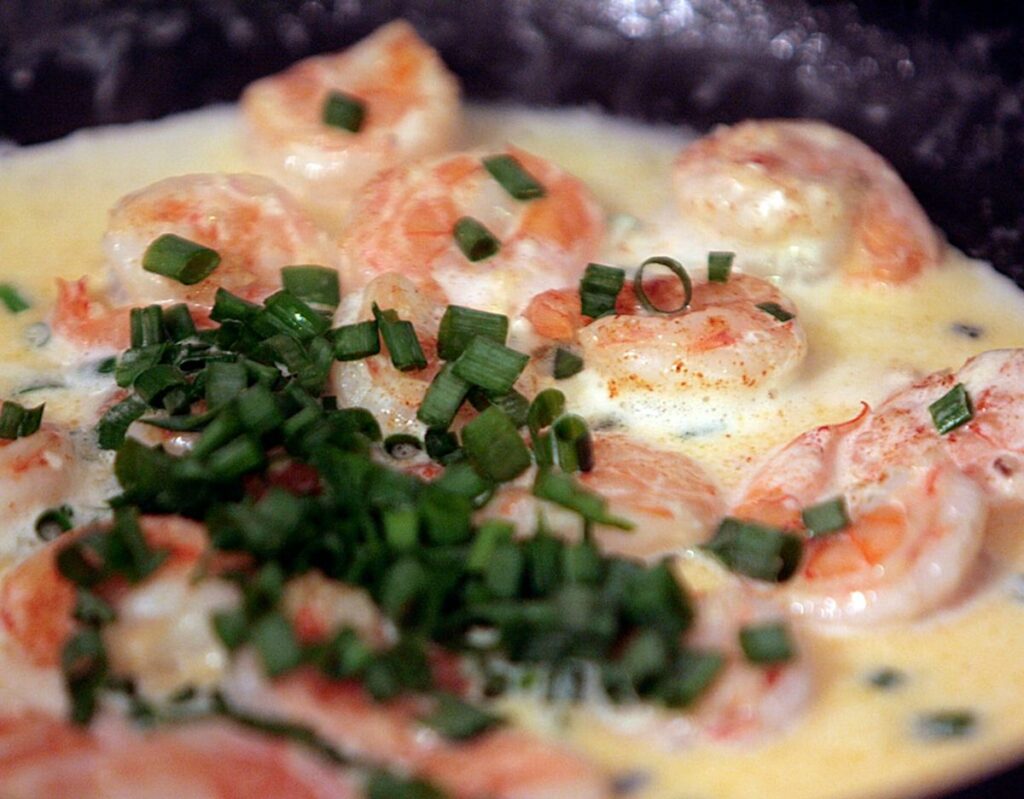
Seafood Newburg was the kind of main course a hostess pulled out when she wanted the table to go quiet. The sauce is butter, heavy cream, sherry, and egg yolks, and the yolks are the part that requires attention: they curdle if the cream mixture ever reaches a full boil, so once the eggs go in, the heat stays low and the sauce never comes to a simmer. Shrimp, crab, and scallops all work well together; if you use precooked crabmeat, add it last so it just warms through rather than toughening. The whole thing comes together in under twenty minutes, served over toast points cut into triangles on the good china. The story goes that the original dish, Lobster Wenberg, was introduced at Delmonico’s in New York in the 1870s by sea captain Ben Wenberg. After a falling-out, the restaurant reportedly flipped the first syllable, and “Newberg” stuck (it is usually spelled Newburg today).
Ingredients (Serves 6)
-
1 pound large shrimp, peeled and deveined
-
8 ounces lump crabmeat, picked over for shells
-
4 tablespoons unsalted butter, divided
-
1/2 teaspoon sweet paprika
-
1/4 teaspoon cayenne pepper
-
12 slices white sandwich bread, toasted and cut into triangles
-
2 tablespoons fresh flat-leaf parsley, chopped
Instructions
1. Pat shrimp and scallops dry with paper towels.
2. Melt 2 tablespoons of the butter in a large skillet over medium heat. Add shrimp and scallops and cook, stirring, until shrimp are pink and scallops are just opaque, about 3 minutes. Transfer to a plate. Add crabmeat to the same plate.
3. Reduce heat to medium-low. Melt the remaining 2 tablespoons butter in the skillet. Pour in the sherry, stir to scrape up any browned bits, and let it reduce for 1 minute.
4. In a bowl, whisk together the egg yolks and heavy cream until fully combined.
5. Reduce the heat to low. Slowly pour the egg yolk mixture into the skillet, stirring constantly. Cook over low heat, stirring continuously, until the sauce thickens enough to coat the back of a spoon and reads at least 160°F on an instant-read thermometer, 6 to 8 minutes. Do not let the sauce boil.
6. Stir in the paprika, cayenne, and salt. Fold in the shrimp, scallops, and crabmeat and cook gently until just heated through, about 2 minutes.
7. Arrange toast triangles on warmed plates and spoon the seafood and sauce over them. Scatter parsley over the top and serve immediately.
6. Duchess potatoes (pommes duchesse)
Duchess potatoes showed up at the main-course house looking like they came out of a hotel kitchen. The hostess had piped them into neat rosettes on a sheet pan, and the oven had turned their ridged tips a pale, spotted gold. Guests assumed something complicated had happened. What had actually happened was mashed potatoes, a pastry bag, and a good measure of butter.
The cost was the point. Russet potatoes were one of the cheapest things in the grocery cart, and butter, a few egg yolks, and a splash of cream didn’t add much, so a whole sheet pan of rosettes cost very little. That mattered because the main-course stop carried the highest expectations of the evening, and a hostess who also had to buy a protein, a centerpiece, and a bread basket could not spare real money on a side dish. Duchess potatoes solved that cleanly and left her looking like she’d taken cooking classes.
Ingredients (Makes about 18 rosettes, serves 6 to 8)
-
2 pounds russet potatoes, peeled and cut into 2-inch chunks
-
4 tablespoons unsalted butter, cut into pieces
-
1/4 cup heavy cream, warmed
-
1 tablespoon plus 3/4 teaspoon salt, divided
-
1/4 teaspoon white pepper
-
1/8 teaspoon ground nutmeg
-
1 tablespoon unsalted butter, melted, for brushing
Instructions
1. Preheat the oven to 400°F. Line a large baking sheet with parchment paper.
2. Put the potato chunks in a large pot and cover with cold water by about an inch. Add 1 tablespoon of the salt. Bring to a boil over high heat, then reduce to a steady simmer and cook until a fork meets no resistance at the center of the largest piece, 18 to 22 minutes. Drain thoroughly.
3. Return the empty pot to low heat for about 1 minute, then add the drained potatoes and shake the pot gently until the surface of each piece looks dry and floury. Remove from heat.
4. Pass the potatoes through a ricer or food mill into a large bowl. Stir in the 4 tablespoons of cut butter until completely melted and absorbed.
5. In a small bowl, whisk together the egg yolks and warm cream. Pour the mixture over the potatoes and fold in quickly. Add the remaining 3/4 teaspoon salt, the white pepper, and the nutmeg. The mixture should be thick and stiff enough to hold piped ridges without slumping.
6. Spoon the potato mixture into a pastry bag fitted with a large star tip. Pipe rosettes or tall swirls about 2 to 3 inches across onto the prepared baking sheet, leaving at least 1 inch between them.
7. Brush the piped rosettes lightly with the melted tablespoon of butter.
8. Bake until the tips and ridges are light golden brown, 18 to 22 minutes. Serve hot.
7. English trifle
The trifle arrived at the last house, after the soup and the main course had already passed, and it looked like effort. A deep glass bowl showed off the layers: pale sponge soaked with sherry, a red stripe of jam and fruit, a thick yellow-gold custard, and a white cap of whipped cream. It was cold. On a November evening, walking house to house in the neighborhood, cold and sweet and faintly boozy went down exactly right.
Each layer does something different in your mouth. The sponge at the bottom is soft and wet from the sherry, with almost no resistance. The custard above it is dense and smooth, not pourable, more like a set cream. The raspberries stay tart against all that sweetness. On top, the whipped cream is light and it melts before you even chew. There is no salt to speak of, nothing sharp until the fruit cuts through, which is what keeps you going back to the bowl.
The custard gets made before anything else and needs at least an hour in the refrigerator before the bowl is assembled. A warm custard poured over already-soaked sponge turns the base to mush; a cold, set custard sits cleanly on top and the layers stay distinct when you serve it. The recipe uses two-thirds of a cup of sherry to a pound of sponge, because the cake should be saturated rather than just touched.
Ingredients (Serves 8 to 10)
-
1 teaspoon pure vanilla extract
-
1 pound plain sponge cake or ladyfingers, cut or torn into roughly 1-inch pieces
-
2/3 cup cream sherry or medium sherry
-
2 cups fresh raspberries, or frozen raspberries thawed and well drained
-
2 tablespoons powdered sugar
-
1/4 cup sliced almonds, toasted
Instructions
1. Whisk the egg yolks, granulated sugar, and cornstarch together in a medium saucepan until the mixture is pale and completely smooth. Add the milk gradually, whisking as you pour, then set the pan over medium heat. Cook, whisking constantly, until the custard thickens and comes to a boil, about 8 to 10 minutes, then let it bubble gently for 1 minute while you keep whisking. The cornstarch keeps the yolks from curdling, and the full boil keeps the custard from thinning out in the refrigerator. Remove from heat and stir in the vanilla extract.
2. Press a piece of plastic wrap directly onto the surface of the hot custard so a skin does not form. Refrigerate until fully cold, at least 1 hour.
3. Arrange the sponge cake or ladyfinger pieces in an even layer covering the bottom of a 3-quart glass trifle bowl or other deep, straight-sided serving bowl.
4. Drizzle the sherry evenly over the sponge and let it soak in for 5 minutes. Dollop the raspberry jam over the soaked sponge and spread it loosely across the surface. Scatter the raspberries over the jam in an even layer.
5. Spoon the cold custard over the fruit and spread it to the edges of the bowl, pressing gently so it seals the fruit beneath. Smooth the top flat.
6. Beat the heavy cream and powdered sugar with a hand or stand mixer on medium-high speed until the cream holds soft peaks, about 2 to 3 minutes. Spoon it over the custard and spread gently to the edges.
7. Refrigerate the assembled trifle for at least 2 hours before serving, or overnight. Scatter the toasted sliced almonds across the top just before you bring it to the table.
Seven dishes, four houses, one long walk between them. That was the whole deal.