
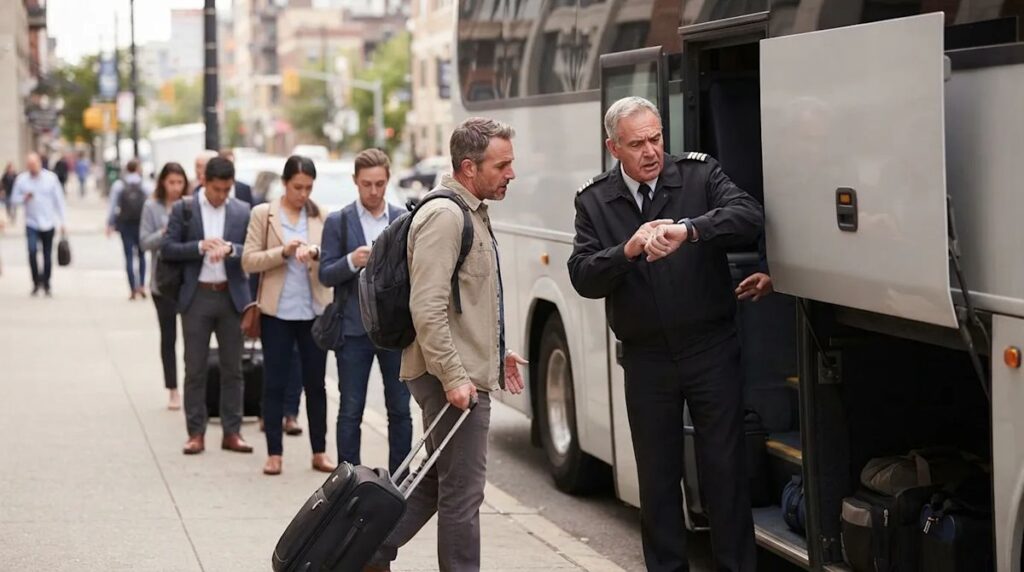


You’d think boarding a coach is the easy part: walk up, find a seat, sit down. Ask the people behind the wheel and you get a very different story. The first ten minutes at the curb, with the closed door, the packed luggage bay and one passenger frozen in the aisle, often decide whether the whole trip feels calm or tense.
Most of us never see the plan running underneath that scene. Some of the rules drivers follow look backwards until you hear the reasoning, and one of them has nothing to do with manners at all. Stick with the countdown, because #1 changes what that slow-moving line really means.
#15 – Your Bag Probably Goes In Backwards
#15 – Your Bag Probably Goes In Backwards (Image Credits: Gemini)
The first suitcase in the bay is rarely the first one you’ll want back. Drivers generally load with the later stops in mind, so bags for the final destination go in first. Bags for the earliest stop go in last, where they’re easiest to reach. Guidance for group transfers says the same thing: stow items for the first stop where they can be grabbed fast.
Advertisement
Advertisement
That’s why a driver may wave you off when you try to slide your bag in “just anywhere.” It can feel like favoritism, but it’s logistics. Where your bag lands depends on where you get off, not when you arrived. The system keeps one stop from turning into a bag excavation.
Quick Compare
Loaded first: bags headed to the final stop, tucked deep in the bay
Loaded last: bags for the earliest stop, sitting right at the opening
The payoff: early exits grab their bags in seconds without unpacking the whole stack
#14 – Showing Up an Hour Early Won’t Get You the Best Seat
#14 – Showing Up an Hour Early Won’t Get You the Best Seat (Image Credits: Gemini)
Plenty of people believe that arriving super early guarantees the best seat. Drivers and tour operators see something different. One coach tour company asks passengers to arrive at least 30 minutes before the itinerary time to allow for seating and luggage loading. It also notes that passengers who show up an hour early end up standing on the pavement.
The driver is often still prepping the bay, checking paperwork or waiting to open the door. Turning up long before departure usually just means waiting with your bags and no place to sit. “Early” only pays off up to a point. Being on time and ready beats being first and bored.
Advertisement
Advertisement
Insider Tip: Check your ticket or tour notice for its own arrival window. Companies set it around bag loading and seat checks, so it’s the number that counts, not your own guess.
So who decides when the door opens? That answer is next.
#13 – That Closed Door Is Deliberate
#13 – That Closed Door Is Deliberate (Image Credits: Gemini)
You may stand at the curb watching a driver wander around with the door shut. It can look like they’re ignoring you. Professional driver training actually tells drivers to keep the door closed and secured until they’re ready to begin the boarding process.
An early-open door lets people drift onto the steps while the driver is at the luggage bay or checking the vehicle. A passenger already on board while the driver is outside is exactly the situation drivers try to avoid. The shut door is a safety step, not a snub. Once it opens, the driver generally stays close to the entrance, and there’s a rule about who goes first that surprises people.
#12 – People Getting Off Go Before People Getting On
#12 – People Getting Off Go Before People Getting On (Image Credits: Gemini)
At a pickup stop, the crowd can surge forward the second the doors fold open. Transit guidance is blunt about this: let passengers exit before you begin boarding. That advice comes from a bus agency’s rider tips, but coach drivers see the same scene.
Advertisement
Advertisement
A surge creates a head-on jam in a narrow doorway. The people stepping down are watching their feet, and the people stepping up are watching for seats. Two streams in one doorway is where trips and fumbles happen. A short wait for the exit flow to clear is quicker than untangling a pileup.
Why It Works: Doors and steps handle one direction at a time far better than two. Clearing the exit first usually shortens the whole boarding rather than slowing it.
And yet some passengers don’t have to race for a seat at all.
#11 – On Some Tours, Your Seat Was Decided Before You Arrived
#11 – On Some Tours, Your Seat Was Decided Before You Arrived (Image Credits: Gemini)
Some travelers sprint down the aisle for a window. On certain organized tours, that race is pointless. One operator says seats are allocated based on the boarding pass with the seat numbers, following the order in which passengers registered for that tour.
Advertisement
Advertisement
That means a booking date can matter more than a fast walk. The driver or guide may simply point you to the number on your ticket. Your place in the seating chart can be locked in weeks before you ever see the coach. Open-seating services work differently, so the ticket and the staff are your guide.
At a Glance
Assigned-seat tours: follow the number on your boarding pass
Registration-order systems: an earlier booking can mean a better spot
Open seating: no number to follow, so listen for the driver’s instructions
#10 – Some Passengers Board First on Purpose
#10 – Some Passengers Board First on Purpose (Image Credits: Gemini)
You might see a driver step down and help one person before the line moves. That’s by design. Driver training materials say drivers should be willing to assist passengers with boarding as needed, especially older passengers and anyone who needs extra help.
Passengers with mobility needs, small children or lots of gear may get extra time. Pushing past them usually makes things slower for everyone. A rushed boarding is a bigger risk than a slow one. Drivers say the best lines let that help happen without grumbling.
Advertisement
Advertisement
Did You Know: Federal motorcoach safety tips for passengers specifically mention taking care when boarding and exiting. Coach steps are steeper than many people expect, which is why the driver stays near the door.
But the real traffic jam isn’t at the door. It’s a few feet farther in.
#9 – The Aisle Is Not a Storage Closet
#9 – The Aisle Is Not a Storage Closet (Image Credits: Gemini)
Everyone has met the person who stops in the middle of the aisle to rearrange a bag. Drivers watch the line freeze behind them. A boarding that should take minutes drags on because one passenger is choosing between two overhead racks.
Coach steps are steep, and one travel writer notes that people hurry down them with a coffee in one hand. The same hurry happens going up. One stalled passenger can freeze a full coach. Many drivers say the simplest habit is to find your seat first and sort your bag second.
Worth Knowing
The aisle is a single lane, so one pause blocks everyone behind you
Sit down first, then rearrange your bag from your seat
Keep one hand free for the rail on those steep steps
A quick “go ahead” to the people behind you can clear a jam in seconds
Advertisement
Advertisement
Back outside, the other big boarding job is happening at the side of the coach.
#8 – Handle-Out Is a Real Rule
#8 – Handle-Out Is a Real Rule (Image Credits: Gemini)
Luggage bay etiquette has actual training behind it. Instructional material for drivers says that placing bags in the luggage bay handle-out will ease retrieval. It’s one of those small details that saves minutes at every stop.
Drivers also learn to place bags at the edge of the bay and push them in rather than overreaching, partly to protect their backs. A bag shoved in sideways can be hard to pull out without moving others. Handle position can decide whether a stop takes two minutes or ten. That’s why a driver may quietly reposition your suitcase.
Try This: Put a bright tag or ribbon on your bag’s handle. A bay full of black rolling cases is hard to read, and a marker helps you and the driver spot yours quickly.
Advertisement
Advertisement
The next one involves something many travelers assume doesn’t exist on a coach.
#7 – Standing Around Isn’t an Option Once You’re Rolling
#7 – Standing Around Isn’t an Option Once You’re Rolling (Image Credits: Gemini)
Some passengers treat the aisle like a lounge until the wheels turn. Then they’re surprised when the driver asks them to sit. Driver guidance notes that drivers generally can’t allow anyone to stand while the coach is moving.
Seat belts are part of it too. A travel piece on coach drivers notes that federal rules require lap and shoulder belts on new motorcoaches built since late 2016. Many people still assume coaches have no belts at all. Drivers say a quick click when you sit down saves a reminder later.
The Psychology Behind This: People relax once they’re “on board” and treat the coach like a waiting room. A clear first-minute routine of sit, buckle and settle helps the whole group switch into travel mode.
Advertisement
Advertisement
Still, the next thing drivers notice has nothing to do with seats.
#6 – Drivers Notice How You Treat Your Bag
#6 – Drivers Notice How You Treat Your Bag (Image Credits: Gemini)
This one sounds odd, but it’s a real part of the job. Federal training material for motorcoach drivers says that passengers who are overly protective of luggage stored in the bay may be a sign something is wrong with what’s inside. It frames this as something to keep in mind, not a reason to panic.
In practice, most bags are full of ordinary things. A cooler, a gift or a fragile laptop can make anyone clingy. The loading process doubles as a quiet screening moment. Drivers say a relaxed, open attitude when your bag goes under the coach makes everything smoother.
Meanwhile, the bay itself has limits that surprise a lot of groups.
#5 – The Bay Is Big, but It Isn’t Bottomless
#5 – The Bay Is Big, but It Isn’t Bottomless (Image Credits: Gemini)
Coach luggage bays look huge from the curb. Drivers say they still fill faster than people expect. One travel piece puts it plainly: luggage bays are big, but they aren’t bottomless, and every driver has a story about a last-minute oversized bag.
Advertisement
Advertisement
That’s why some drivers ask organizers for a rough count in advance. Group-transfer advice suggests asking for a bag count and whether any items are unusually large. A single band case or surprise cooler can force a whole reshuffle. Late arrivals with big items are a classic source of curb stress.
The Science Behind This: A bay is a fixed box, and a solid stack of bags is stable only when it’s packed in layers. Dropping a bulky item in late can disturb the layers beneath it.
Next comes something drivers say they can’t handle alone.
#4 – Every Big Group Needs One Point Person
#4 – Every Big Group Needs One Point Person (Image Credits: Gemini)
On a large group trip, a driver can’t answer twenty people at once. Transfer advice says to let the group know early who should handle any baggage issues. A single contact means fewer repeated questions at the curb.
When no one is in charge, the driver ends up fielding every seat swap, missing bag and “are we waiting for Dave?” question. One organized person can cut the confusion dramatically. Many drivers quietly wish every school trip, wedding party and reunion picked a point person before the day started.
Insider Tip: If you’re organizing a group, send the driver or operator a rough passenger count and any oversized items ahead of time. It’s the easiest way to make curb loading calmer.
The next one happens long after that first boarding is over.
#3 – Rest-Stop Boarding Is a Second Boarding
#3 – Rest-Stop Boarding Is a Second Boarding (Image Credits: Gemini)
The curb isn’t the only place order matters. At rest stops, a full coach can empty out all at once. A travel writer notes that seasoned riders lock in the exact departure clock time, because “about twenty minutes” means something different to everyone.
Luggage matters at stops too, since bags get shuffled when passengers get off at intermediate stops. One quick glance at the bay can catch a wrong-bag mix-up before the coach pulls away. Drivers also point out that the restroom line grows fast, so many experienced riders go there first and shop afterward.
By The Numbers: One operator says drivers need to strategically load around 50 suitcases in the half-hour before departure. That’s why they ask passengers to arrive 30 minutes early.
Now, what the driver notices before anyone says a word may surprise you.
#2 – Your First “Good Morning” Is a Forecast
#2 – Your First “Good Morning” Is a Forecast (Image Credits: Gemini)
Drivers say the boarding greeting works like a weather report. One travel piece describes how a group that looks up, nods and says hello usually keeps that energy all day. It’s an informal observation, not a scientific one, but many drivers say it holds up.
A quiet, phone-scrolling boarding can make a long drive feel longer. Drivers don’t expect speeches, just a nod. The shortest interaction at the door can set the tone for the whole day. Professional driver training also describes drivers as the face of the company, which is part of why they care how those first moments go.
And the last entry is the one that ties the whole boarding order together.
#1 – Every Minute Lost at the Curb Comes Out of the Driver’s Day
#1 – Every Minute Lost at the Curb Comes Out of the Driver’s Day (Image Credits: Gemini)
Here’s what most passengers never realize. A late boarder or a mid-line argument doesn’t just cost the group a few minutes. A driver’s schedule is bound by federal limits on driving and on-duty time, and those hours can’t be stretched to make up for a slow start.
Under federal rules, passenger-carrying drivers generally can drive up to 10 hours after eight consecutive hours off duty, and can’t drive after the 15th hour on duty. The on-duty clock keeps running while the coach sits at the curb. A delay at the start can leave less time for the road later. That’s why drivers care so much about boarding order, bag placement and punctual returns from stops.
Fast Facts
Driving limit: up to 10 hours after 8 consecutive hours off duty
On-duty cutoff: no driving after the 15th hour on duty
Weekly caps: 60 hours in 7 days or 70 hours in 8 days, depending on the carrier’s schedule
Curb time counts: waiting at the door still uses on-duty hours
A smooth line isn’t about being strict. It’s about protecting the trip, one quiet minute at a time.
Next time you’re standing at the curb watching the driver walk around a closed door, remember that it isn’t a test of manners. It’s the first mile of the journey, and everyone on board is already traveling it together.
Source link


