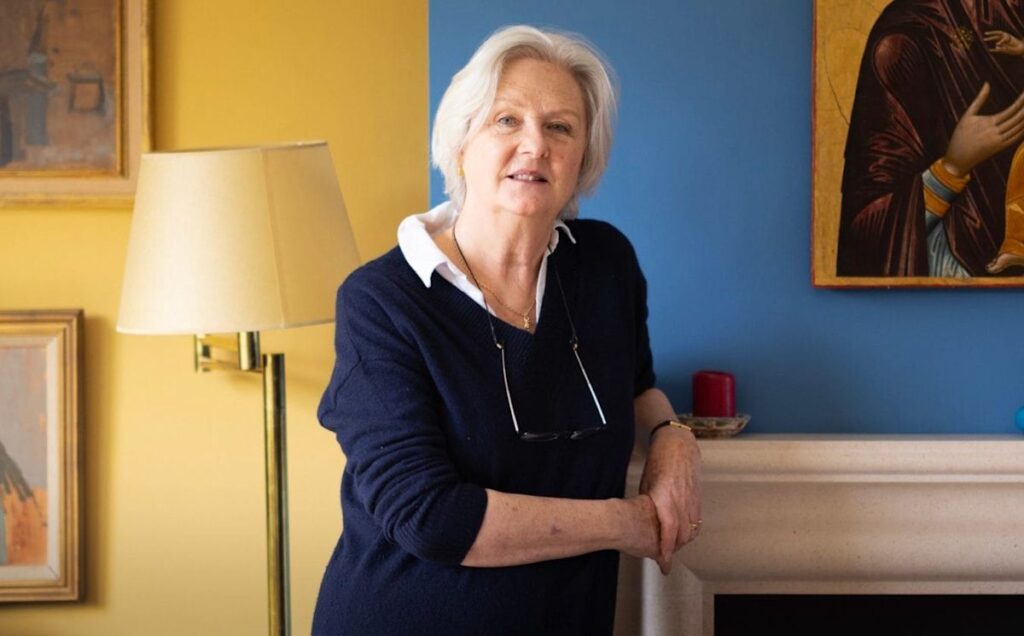


Artemis Cooper has just returned home from Italy to her central London flat, which is full of books and paintings. If you crane your neck from its small terrace, you can just about catch a glimpse of a murky River Thames, but that is small consolation for Cooper because she had been staying next to a canal in peerless Venice.
The acclaimed biographer, 73 – who, with her husband, the award-winning military historian, Sir Antony Beevor (best known for Stalingrad), makes up one of the literary world’s power couples – was in the city for the unveiling of a memorial to her late father, John Julius Norwich, the diplomat, writer, documentary maker and well-loved radio presenter. In the wording on the plaque, he “devoted his boundless energy and enthusiasm to preserving and celebrating” Venice.
Her visit came as Venice marked the 60th anniversary of the devastating flood of Nov 4, 1966. The combination of a strong southerly wind, extreme high tides and torrential rain caused the canals to overflow, leaving the city inundated with shoulder-high water. It was cut off for 24 hours, with thousands left homeless, businesses and shops wrecked, and millions of pounds’ worth of damage done to its artistic treasures and buildings.
Advertisement
Advertisement
“The flooding was as bad as they had ever seen it,” emphasises Cooper of the incident 60 years ago. “Venice is used to having regular acqua alta, but that means two to three feet of water in the piazza outside St Mark’s Cathedral. This was very different. A hell of a lot of damage was done.”
The world-famous San Marco Square in Venice was covered with more than six feet of floodwater on Nov 8, 1966 – AP Photo
So much so that the Italian government issued an appeal for international assistance to save the city, with Britain being among the first to respond. A debate in Parliament led to the formation of the charity, Venice in Peril, with her father as its chairman. He remained in post until 2000, but continued as honorary chairman until his death in 2018. “It was always his thing,” Cooper explains, “but in recent years, I have become more involved.
“[My late father] had always loved Venice,” she recalls. “In his memoirs, he describes walking around the city for the first time in his teens, just after the Second World War, with his father [Duff Cooper, the Conservative politician, who resigned from the Cabinet in 1938 over the Munich Agreement].”
Their day-long trek began at St Mark’s, involved getting lost and ended at Harry’s Bar, a favourite watering hole for the great and good since the 1930s. It was the first of many trips and extended stays. Norwich’s special connection with the city was later celebrated in two companion volumes, Venice: The Rise to Empire in 1977 and Venice: The Greatness and Fall in 1981. But that lifelong bond was cemented by his work at the head of Venice in Peril.
Advertisement
Advertisement
Fittingly, his new memorial in the Church of Saint George sits directly beneath a window that celebrates Ashley Clarke, a former UK ambassador to Rome, who first recruited Norwich to Venice in Peril. The two worked hand in hand to raise and channel £11m towards 80 restoration projects covering artworks, buildings and monuments, which continues to this day.
But perhaps the best-known fundraising ruse the charity deployed was pairing up with Pizza Express, which donated 25p to Venice in Peril for every Pizza Veneziana sold. “[My late father] really enjoyed the company of Peter Boizot [who founded Pizza Express in Soho in the 1960s], and over the years, it alone has raised more than £2m,” says Cooper.
‘[My late father] had always loved Venice,’ says Cooper, pictured with John Julius Norwich, the former chairman of Venice in Peril – Shutterstock/Darryn Lyons
Cooper’s own relationship with Venice is similarly longstanding. “I must have been eight or nine when I first went with my grandmother to a performance of Verdi’s Otello being given in the courtyard of the Doge’s Palace. I was given a little silver filigree fan with bits of coral to shut me up.”
Her grandmother, Lady Diana Cooper, a celebrated beauty and silent-film actress, also had a strong link with Venice, being a leading light in the city’s high society in the 1920s. In 1983, she was also Cooper’s first subject when she published a collection of her letters, launching her own literary career that has since included well-received biographies of Elizabeth David, Patrick Leigh Fermor and Elizabeth Jane Howard.
Advertisement
Advertisement
As a young woman between school and university, Cooper went to live in Venice in the early 1970s to learn Italian and try her hand at picture restoration just as Venice in Peril was getting into its stride. “My parents just assumed I’d get married, so they didn’t take much notice,” she says.
In the decades that have followed, Venice has continued to draw her towards it. “There is always the joy of being back, the incredible miracle that it is still there, but also the dull ache of knowing how precarious and vulnerable it is.”
She describes it as “a city that has died in its reality”. She explains: “Today the twin threats it faces are over-tourism and rising sea levels – and both are growing. There used to be a lot more real people there [its population has dropped by two-thirds in recent decades to 50,000], and a lot more little shops selling mozzarella and vegetables.”
But, she corrects herself, it is not just happening in Venice. “You see it in cities all over Europe. Everywhere is an Airbnb. It wrecks it for people living there.” With 30 million people visiting the city each year, local authorities are trying to reduce the numbers by charging tourist taxes for overnight stays, and a £4 fee for day-trippers during the peak months. It has so far had little effect.
With 30 million people visiting Venice each year, local authorities are trying to reduce the numbers – Getty Images Europe/Stefano Mazzola
Nonetheless, Cooper is a fan of the city’s new mayor, Simone Venturini, a centre-Right politician elected in May. He has spoken of raising the daily entry fee to £43 to reduce footfall.
Advertisement
Advertisement
Another of Cooper’s concerns is the damage being caused by the number of modern motor vessels on the canals of Venice. “When I was living here in the 1970s, you would still see people punting around in flat-bottomed sandolos. Now, every boat has an outboard motor.”
Isn’t that just progress? “They are only meant to go at a certain speed but, if you are at ground level, you can see the damage the wake that they leave behind does – compared, say, to a gondola. It’s constantly eroding the walls of the buildings next to the canals.”
It makes me think of the flotilla of flash motorboats that crowded Venice’s canals last year, ferrying back and forth the 200 celebrity guests at the wedding of Jeff Bezos, Amazon’s billionaire founder, and Lauren Sánchez. What does Cooper think her father would have made of the whole spectacle?
“He loved going to big parties on the Grand Canal in Venice, but I think he might have considered that one rather too over the top.”
Cooper says her father might have considered the Bezos-Sanchez wedding ‘too over the top’ – Reuters/Guglielmo Mangiapane
Her recent trip was much quieter. “We were in a fabulous apartment at the junction of two canals, but it had to be on the ground floor because Anthony has got cancer and can’t do stairs very well.”
Advertisement
Advertisement
Beevor revealed in February 2022 that he had been diagnosed with multiple myeloma, a type of bone marrow cancer. He has continued working during chemotherapy, regularly speaking in public, especially around the war in Ukraine. The couple met at a function in the early 1980s and married in 1986. Their literary partnership has included collaborating on Paris After the Liberation 1944-1949.
They have two grown-up children, Adam and Nella (whose severe childhood illness and recovery at eight months old were the subject of Cooper’s 1992 book, Watching in the Dark: A Child’s Fight for Life). Both accompanied the couple on their recent trip to Venice.
Cooper and her husband, Sir Antony Beevor, make up one of the literary world’s power couples – Getty Images/Nick Harvey
Paris is also the subject of Cooper’s next book, an as-yet-untitled history of the city that explores how its cultural and political life is intertwined. Next up in her diary, though, is judging the annual Duff Cooper Prize for non-fiction, set up in memory of her father. It is her 30th year on the panel.
She casts a keen eye on what is going on in the publishing industry, including the recent furore over Sally Rooney, the author of Normal People, after Faber announced it would no longer supply her books in the UK to comply with anti-terrorism legislation, as a result of Rooney’s support for Palestine Action.
Advertisement
Advertisement
“It is ridiculous”, says Cooper, “because it is not being prompted by people caring. It is publishers being fearful and virtue-signalling. What you feel doesn’t matter and can’t be argued about because there is no argument allowed. If you argue against me, you are a fascist. It is part of a bigger trend that is far more dangerous.”
What would she like to see happen? “Publishers should be allowed to publish, and writers should be allowed to write.”
Cooper believes censorship in publishing is ‘part of a bigger trend that is far more dangerous’ – Geoff Pugh
However, it is the future of Venice that is playing on her mind right now, with the 60th anniversary of the Great Flood fast approaching, and her visit fresh in her mind. Just as overtourism is one risk, so are rising sea levels. The imminence of this threat, she points out, has been masked in recent years by the advent of huge steel gates installed on the seafloor at a cost of £5.2bn. They rise to seal off the lagoon in which Venice stands from the sea.
But effective as they are, she notes that they have been closed over the past six years much more often than was originally envisaged. “If it gets to a point where they are closed more often than open, it will damage both the fragile ecosystem of the lagoon and the wooden posts on which the city stands, as well as stop the sewage being discharged into the sea.”
Advertisement
Advertisement
An academic study published earlier this year in Scientific Reports predicted that engineered embankments (or dykes) will be needed in the medium term to protect the city, with some estimates warning of a 4.5m rise in sea levels by 2300. With a £25bn price tag, they are the cheaper of two options outlined, with the other being a complete relocation of the city to higher ground at almost four times the cost.
“I remember my father once telling me that Africa was moving northwards at about an inch a year. Now, the sea is rising and so the barriers can only be seen as a temporary solution. I don’t like to think where Venice will be in 20 years.
“It is all daunting”, she warns, “but in other low-lying places like the Netherlands, there is a plan. Venice has no plan. Everybody is still talking and they are muddling through. Will it take some new massive acqua granda like the 1966 for it to be taken seriously? I really hope not.”
She also feels helpless. “Venice in Peril is a British charity, and we can’t be too bossy about this. If Venice is going to be saved, it’s got to be the Italians. All we can do is support them in their efforts, as well as invest in the Venice that does exist by saying: ‘Yes, we believe in you, and we are carrying on restoring the things that are there.'”
Advertisement
Advertisement
To donate to Venice in Peril, visit the website
Try full access to The Telegraph free today. Unlock their award-winning website and essential news app, plus useful tools and expert guides for your money, health and holidays.
Source link