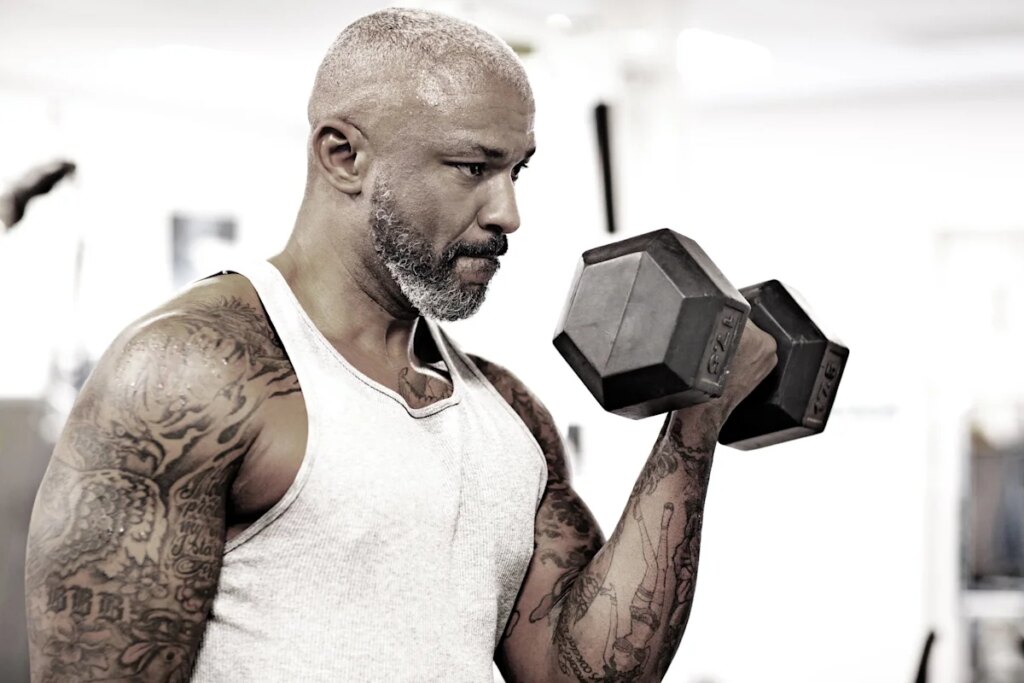
A new study made the rounds recently what was conveniently engineered for a midlife crisis. According to a recent study, strength peaks at 35. While the research behind it is genuinely impressive, tracking men and women for almost 50 years is no small feat; the headline is incomplete.
The study is worth taking seriously precisely because good long-term human data is so rare. Let’s do two things: report what it found, then walk through the caveats that turn “it is all downhill after 35” into a to-do list.
Researchers at Karolinska Institutet published a 47-year study tracking several hundred Swedish men and women from age 16 in the 1970s to 63, with repeated physical testing at 16, 27, 34, 52, and 63. Instead of comparing people of different ages at a single moment, it followed the same bodies over nearly half a century. That matters because snapshot studies that compare a 30-year-old to a 60-year-old tend to understate how steep the real within-person decline is.
Advertisement
Advertisement
They measured three things: aerobic fitness, muscular endurance, and muscle power (explosive, rate-of-force output).
What they found
Aerobic fitness and muscular endurance peaked somewhere between the mid-20s and mid-30s, then began a decline around age 35 that accelerated with increased age. Muscle power peaked even earlier.
Two findings deserve a spotlight. First, people who were physically active in their teens carried higher fitness, endurance, and power the whole way through. Second, and more useful if you did not do that, people who only became active as adults still improved their physical capacity by 5 to 10 percent.
Why “peaks at 35” is incomplete
The study measured specific laboratory capacities in a general population, and “muscle power” in particular means explosive, rate-of-force output. Muscle power fades earliest in everyone. That is not the same as maximal strength, the raw ability to produce force against a heavy load. Maximal strength peaks later, responds enormously to training, and can keep climbing well into your 30s, 40s, and beyond.
Advertisement
Advertisement
So “power peaks at 27” does not mean “you will never be stronger than you were at 27.” Plenty of people hit lifetime bests in the squat, deadlift, and press in their late 30s and 40s, because strength is a skill. Skill plus consistent training can often outrun early age-related decline.
Exhibit A: some of the strongest humans alive are over 35
If physical capacity simply fell off a cliff at 35, the podiums of the strength world would be full of 25-year-olds. They are not. Analyses of world-class lifters show that elite weightlifters and powerlifters, men and women alike, typically reach their competitive peak in their late 20s to mid-30s and sustain world-class performance for years on either side of it. Maximal strength is simply a later-maturing, more trainable quality than explosive power, which fades first.
Zydrunas Savickas winning the World’s Strongest Man title in 2014. Strongwoman and masters powerlifting are full of athletes posting elite numbers well into their 40s and 50s, and the raw-strength world records in many weight classes are held by lifters nowhere near 25. None of that contradicts the study. It just underlines what the study measured and what it did not. A population average for certain capacities.
Advertisement
Advertisement
The most important thing a population average hides is variation. Training shifts the entire curve upward. A trained 55-year-old can be fitter and stronger than an untrained 30-year-old.
It also helps to notice that the early decline is slow. Losing a few tenths of a percent a year from 35 is not a cliff; it is a gentle grade you have decades to walk. The frightening part of the curve is the later acceleration, and that steep phase is driven largely by the loss of muscle and power that resistance training is specifically built to counter. Masters world records in power events show how high the ceiling stays for people who keep training hard.
It is never too late to start
The study’s own hopeful finding, that adults who started exercising improved 5 to 10 percent, actually undersells how trainable the human body stays, because it was not a structured strength program. Put older adults on actual resistance training and the gains are larger and more reliable. Meta-analyses of older adults show resistance training produces substantial strength increases, and trials in very elderly adults, people in their 80s and beyond, show they still build meaningful muscle and strength. The machinery that responds to training does not switch off at 35, or at 65. It just needs a reason to stay.
What the study can and cannot tell you
A It is observational, so it describes what happened to these people rather than proving exactly what causes what. It followed one Swedish cohort, which may not generalize perfectly to everyone everywhere. Physical activity was largely self-reported, which is always imperfect. And the much-quoted line that decline begins around 35 “regardless of training volume” refers to the timing of the downturn. Lifelong exercisers still declined from a far higher starting point, which is the main point.
The bottom line
Yes, the raw physiology of fitness and power starts slipping around 35, it speeds up with age, and no amount of training makes you biologically immortal. But the same body of evidence says the decline is slow for a long time, that maximal strength peaks later and stays trainable for decades, that some of the strongest people alive are well past 35, and that even people who start in old age build real strength.
This story was originally published by Men’s Fitness on Oct 15, 2026, where it first appeared in the News section. Add Men’s Fitness as a Preferred Source by clicking here.