



Mobility is critical to quality of life and helps to prevent falls and injuries, particularly as we age.
About one in four older adults experiences a fall each year, with 10 percent of those falls resulting in an injury that restricts activities for a day or more, according to the Centers for Disease Control and Prevention.
Having a full range of motion is key to staying safe while performing daily tasks, and people can improve their mobility through exercise. But some workouts are better than others.
While running is one of the most popular fitness activities in the U.S., it can actually make muscles stiffer and moving harder.
Researchers have pinpointed yoga as a far better exercise for flexibility, finding that two sessions a week helped to enhance athletic performance in just a couple of months.


A man runs in Mount Tamalpais State Park in Mill Valley, California, in June 2020. Running is great for heart and respiratory health – but can leave muscles feeling stiff (Getty Images)
“There are so many different types of stretch and flexibility training, but static stretches – where you move into a pose until you feel the stretch sensation and then hold it still – are the best at deeply improving flexibility,” yoga and pilates instructor Shannon Nichols told Marie Claire.
“These are the types of movements you will find in a traditional yoga class where you sit and breathe into postures.”
Speed – but stress
Running can improve heart, brain and respiratory health, elevate mood and strengthen muscles and bone density. But, it can also lead to muscle tightness, stress on the back and joints and an increased chance for injury as you pound the pavement, according to Cedars-Sinai.
“The injury rates for running are not necessarily high, but they are real,” Dr. Carlos Uquillas explained.
Stiffer muscles and injuries are enemies of flexibility. Running doesn’t actually require a lot of mobility, according to Petersen Physical Therapy. But, if we don’t regularly use some muscle groups, we become less flexible over time, too.
Still, flexibility may not benefit runners all that much, either.
“When it comes to running, flexibility is overrated,” Steve Magness, a cross-country coach at the University of Houston, told The Washington Post in 2017. “Research shows that if you are too flexible, you are a less efficient runner.”
Fast flexibility
Yoga has similar benefits to running: boosting heart, lung, brain and mental health, as well as helping to ease back pain. But, yoga practice also boasts improvements to flexbility and mobility over time that running does not.
Yoga incorporates stretching of multiple joints simultaneously that can lengthen muscles, reducing stiffness and increasing elasticity – even to joints that have lost it.
Adults who had never practiced yoga before had greater flexibility, muscle strength and endurance after two months of 180 minutes of yoga at least twice a week, according to Harvard Health.
It also focuses on the mind and breath, helping people to relax their muscles by relaxing their minds. That’s especially the case during restorative yoga, a gentle type that aims to reduce stress with deeper and fewer poses, while still providing the physical benefits of other forms.
“It gives you the ability to consciously relax, and it’s a very meditative practice,” yoga instructor Brittany Teems told the Cleveland Clinic.
“There should be no discomfort in your poses. You’re not trying to push your limits and make it so your body tightens. Instead, you’re focusing more on mindfulness, staying in the present moment and letting your body remain still.”
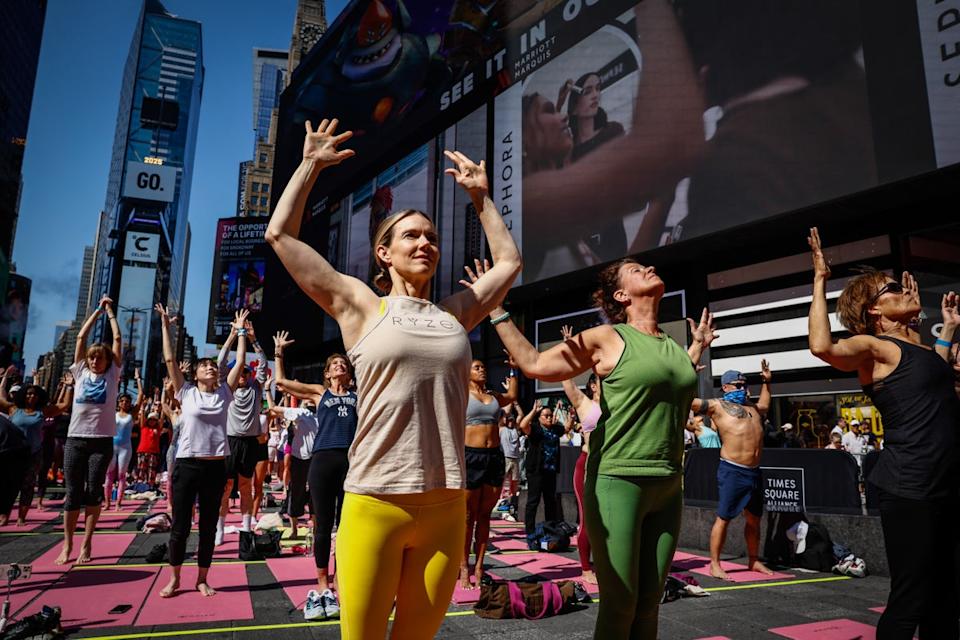
People taking part in a yoga session in New York City in June 2025. Yoga can help improve mobility, with benefits as we age (AFP via Getty Images)
One size doesn’t fit all
In general, the best way to improve your flexibility is exercising twice a day, exercise physiologist Katie Lawton told the Clinic. That can be yoga or other gentle exercises such as stretching, doing tai chi or pilates.
UC Davis Health recommends that you stretch for between 20 and 30 minutes several times a week for better flexibility, holding each stretch for at least 30 seconds.
“Consistency is the big piece here,” Lawton said.
Still, every body is different and genetics, surgeries, injuries and posture all play a role.
People who are in their sixties and seventies will have different levels of movement than people in their thirties and forties.
“The bottom line is that you have to tailor physical activity to your health status and also your mobility status,” Northwell Health cardiologist Dr. Aeshita Dwivedi, told the American Medical Association, “because the number of steps that might be good for a 50-year-old is different from a 70-year-old, which is different from a 20-year-old.”