Getting some gray hairs (okay, a lot of gray hairs) is no surprise as you get older. But what many of us aren’t prepared for is a change in how our hair feels. If your strands seem to be a lot drier and thinner lately, it’s not all in your head. The fact is that your texture changes as you get older, too—and not in a good way. The lush, smooth hair you had in your youth may become wiry, frizzier, and brittle. Curly hair can even become straighter over time, and vice versa. These unexpected changes are annoying, but they are perfectly normal.
Meet the expert: Mona Gohara, M.D., a board-certified dermatologist in Connecticut and an associate clinical professor of dermatology at Yale School of Medicine
“Hair may become drier and less shiny, and curls can loosen, or straight strands may develop a wave,” says Mona Gohara, M.D., a board-certified dermatologist in Connecticut and an associate clinical professor of dermatology at Yale School of Medicine. “These shifts often become more noticeable in your 40s and 50s, especially around menopause, although genetics set the timeline.”
Advertisement
Advertisement
Ahead, learn why hair texture transforms over time from soft to straw-like or from full to fine, and what you can do about it.
How does hair texture change as you get older?
Have you noticed that since you hit midlife, your hair is more, er, shall we say, problematic? It may be frizzier, drier, duller, and thinner. So what gives? “With age, individual hair strands become finer, and fewer actively growing hairs can reduce overall fullness,” Dr. Gohara explains. “Less natural oil means less shine and softness, while damage to the strand’s protective outer layer increases frizz and breakage.”
In a surprising plot twist, curly hair may gradually morph into straighter waves, and straight hair can begin to bend. “Curls depend partly on shape and curvature of the hair follicle, and how evenly keratin, the hair’s structural protein, is distributed as a strand forms,” Dr. Gohara says. “Changes in that growth pattern can make curls loosen, or straight hair develop a wave over time.” That process is partially influenced by aging and the hormonal shifts that come with it, but repeated chemical damage and heat styling may also play a role.
What causes hair texture to change as you get older?
“Changes happen both at the root and along the hair strand,” says Dr. Gohara. “Some hair follicles shrink with age and produce finer hairs with shorter growth cycles, while declining oil production in the skin and on the scalp leaves strands less lubricated.”
Advertisement
Advertisement
Years of taking a curling iron or straightener to your strands aren’t helping either. “Heat styling and environmental exposure can wear down the cuticle, like shingles lifting off a roof,” Dr. Gohara explains. “This allows moisture to escape, leaving a rougher and more fragile surface.”
And some of this is just the cumulative effect of daily wear and tear. “Bleach, permanent hair color, relaxers, and repeated heat styling can damage the cuticle and alter the bonds that help give hair its shape, leaving strands brittle or curls less defined,” she says. “Harsh shampoos can strip oil, while product buildup can weigh down waves.”
How does hair texture change when you go gray?
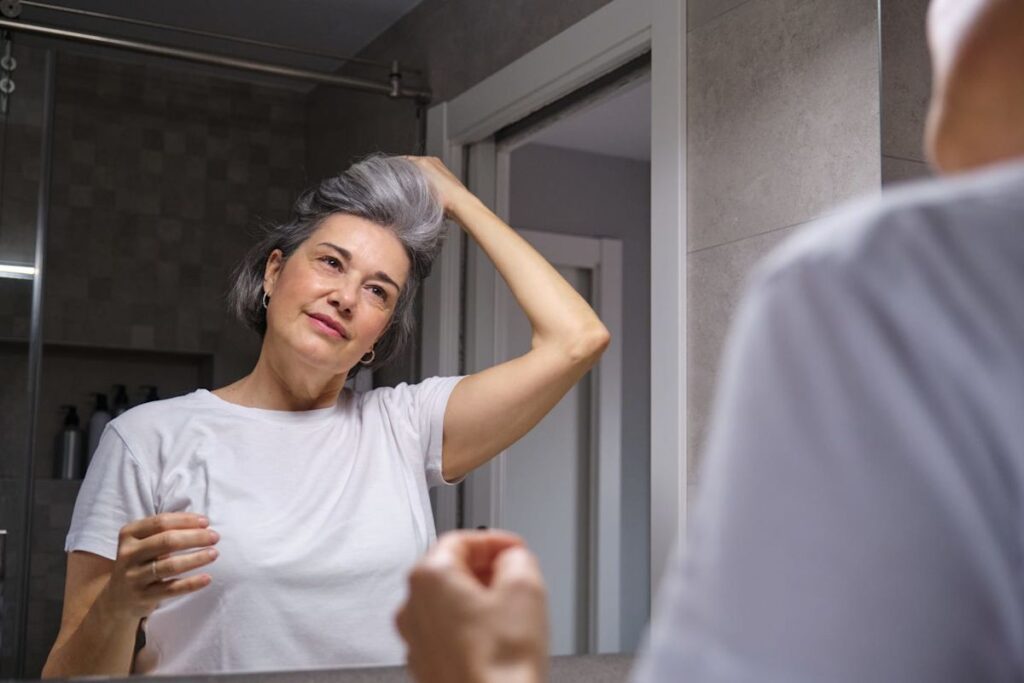
If you have graying hair, you may have noticed it tends to be more coarse and dry than the pigmented hair on your head. That’s because the loss of pigment can trigger structural shifts in the hair strand. “The cells that supply melanin become less active, so new hair grows in with less pigment, and some may develop a different diameter or curvature, making them feel wirier,” Dr. Gohara explains.
But that’s just one piece of the aging hair puzzle: Hormone changes in menopause and years of UV exposure can trigger dryness, too. “Declining estrogen around menopause can contribute to declining oil production on the scalp, leaving hair drier,” Dr. Gohara says. “Cellular senescence means aging follicle cells function less efficiently, while oxidative stress can affect pigment and growth.”
Could your hair texture be signaling underlying health issues?
Like your skin, hair can reflect what’s going on inside your body. For instance, pregnancy, perimenopause, certain medications, illness, and rapid weight loss can impact your usual levels of hair growth or shedding, according to Dr. Gohara. “Thyroid disease is one example: an underactive thyroid can leave hair dry, coarse, and brittle,” she says.
Advertisement
Advertisement
Changes to your hair may also be indicative of a nutrient deficiency, in some cases. “Inadequate protein or iron deficiency—with low ferritin indicating depleted iron stores—can contribute to shedding. Deficiencies in B12, vitamin D, and folate may also warrant evaluation depending on symptoms and history, although their links to hair loss vary.” But while many hair texture changes are totally normal as you age, Dr. Gohara says any sudden changes are worth getting checked out by your doctor, just to be safe.
Can you improve hair texture?
The good news is that babying your hair with more conditioning and less heat styling and chemicals can improve coarse texture. “Treat aging hair like a favorite silk blouse: gentle washing, plenty of conditioning, and less heat,” Dr. Gohara says.
That means making sure you’re using a good conditioner (and maybe adding a leave-in treatment for particularly dry strands) every time you wash your hair, lowering the temps on your hot tools, and giving your tresses enough time to recover between chemical treatments.
“Choose lightweight conditioning for fine strands and richer formulas for coarse or curly hair,” Dr. Gohara suggests. “For thinning hair, a dermatologist can discuss topical minoxidil, prescription oral minoxidil used off-label in appropriate candidates to address hair loss.”
You Might Also Like