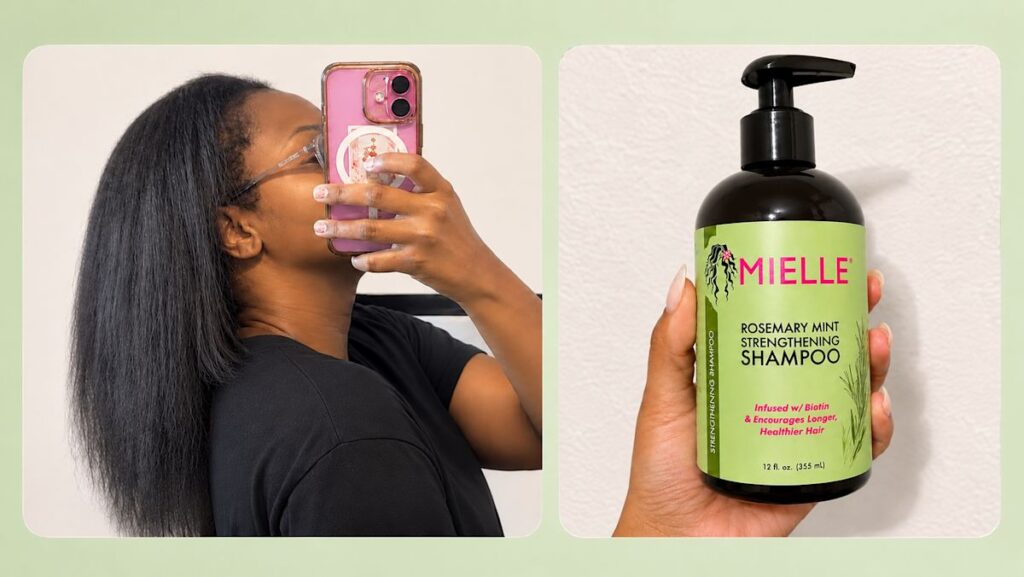


Several years ago, rosemary oil went viral as the “natural Rogaine” thanks to a small study that found the herb performed similarly to 2% minoxidil for hair regrowth over six months. So it’s no wonder rosemary entered the shampoo aisle. To be fair, one of the most popular shower staples, Mielle Rosemary Mint Strengthening Shampoo, isn’t explicitly touted as a hair-growth shampoo. Instead, it claims that its rosemary-and-biotin formula brings “weak or brittle hair back from the brink” and supports the “appearance of longer, healthier hair.” Still, the rosemary on the label is doing a lot of selling.
“Rosemary is a perfect example of how social media excitement can greatly outpace the science,” says Kelly Dobos, a cosmetic chemist and adjunct professor of cosmetic science at the University of Cincinnati, who notes that a shampoo’s short contact time limits the opportunity for rosemary to interact with the scalp.
That said, some shampoos for thinning hair help manage oil, buildup and scalp inflammation, which can make for a healthier environment for your hair to grow. So we handed Mielle’s rosemary shampoo and its matching hair masque to a tester with thinning at her hairline, then asked experts to weigh in on everything from the formulation to the results. Here’s how her 10 weeks went, what’s actually in the bottle and who should (and shouldn’t) bother buying it.
Amazon
A pleasant, budget shampoo that helped our tester hold on to length and shed a little less, but it didn’t grow much hair, and the science says it shouldn’t be expected to.
Best for: Anyone who wants an inexpensive, detangling shampoo with a scalp tingle, as long as hair growth isn’t the goal
Timeline to notice changes: Our tester noticed less shedding within the first two to four weeks
Would she buy it again? Yes, but she’d only “maybe” recommend it to someone with thinning hair
- Tester reported less shedding and easier detangling
- Helped tester keep length she usually loses to breakage
- Pleasant tingle and lots of slip
- Our tester saw “not much growth”
- Tester unsure the shampoo made a difference
- Rosemary and fragrance may irritate sensitive scalps
The baseline: where our tester started
Our tester, in her 30s, has naturally dense, curly hair, but her hairline and temples have been thinning for more than five years, with some bald spots. She attributes the loss to years of wearing tight hairstyles that pull at the roots, which can cause traction alopecia. The hairline is often where this type of hair loss first appears, according to the American Academy of Dermatology (AAD).
Advertisement
Advertisement
A couple of caveats before we get to her results:
Our assessment draws on her intake interview and end-of-test scores. She did not complete the baseline or midpoint surveys, which limits our ability to track changes over time.
We don’t have before photos, so we can’t visually compare where she started with where she finished.
Her feedback is still worth sharing, but these gaps limit what we can say about how well the product worked. We hope to update this review with more complete testing information in the months ahead.
The results: what happened after 10 weeks of testing?
Our tester used the shampoo along with Mielle’s matching masque. Here’s how she rated her hair at the end of testing, on a 1-to-5 scale, with 5 being the best.
Category | Result |
|---|---|
Density and thickness | 4/5 — no starting score to compare against |
Shedding severity | Less by the end |
Most notable change | Kept more of the length she usually lost during wash days |
First noticed | Within the first 2–4 weeks |
Confidence it caused results | 2/5 — not convinced shampoo was behind changes |
Overall results | 2/5 — “not much growth” |
For our tester, the biggest win was less breakage. The set helped her “retain some length usually lost by shampooing/conditioning.” Holding on to that length can be especially welcome for people with curly and coily hair, which is vulnerable to breakage. “Every bend in the strand is a weak point,” explains Dr. Aderonke Obayomi, an assistant professor of dermatology at Mount Sinai in New York City and member of the Skin of Color Society.
Advertisement
Advertisement
Our tester reported “not much growth,” though she did notice some baby hairs and less shedding. Those little wisps can be encouraging, but they’re tricky to interpret. They “may represent true new growth, but they can also simply be short, broken hairs,” says Dr. Sejal Shah, a board-certified dermatologist and founder of SmarterSkin Dermatology in New York City. “Meaningful changes typically take at least six to 12 months of consistent treatment.”
Our tester, after about 10 weeks of using the shampoo and matching masque.
Reduced shedding and “stabilization of hair loss” can be more useful early signs that a treatment is helping, Shah says. Still, our tester wasn’t sure how much credit to give the products, rating her confidence in their contribution just 2 out of 5. And because she used the shampoo and matching masque together, we can’t separate their effects.
Her overall take? “My hair doesn’t feel like it’s changed much, but I did have less shedding.” Easier detangling and holding on to more length were enough to make her want to keep using the set, even without the growth she’d hoped for. Whether she’d recommend it to someone else with thinning hair, though, remained a “maybe.”
The routine: what it’s actually like to use
For our tester, wash day comes once every two weeks. Over roughly 10 weeks of testing, that works out to about five or six washes.
Advertisement
Advertisement
Her wash schedule aligns with AAD guidance, which recommends washing Black hair weekly or every other week. But that gives rinse-out products limited time on the scalp. If growth is the goal, Obayomi favors a more frequent leave-on formulated for the scalp.
On wash days, our tester liked the “tingly feeling,” likely due to the formula’s peppermint oil. The label calls for a dime-sized amount massaged into wet hair, then a thorough rinse.
The masque takes a little more time: After shampooing, smooth it through damp hair from roots to ends, leaving it on for 15 to 20 minutes, then rinse thoroughly. We couldn’t confirm how long our tester left it on.
The research: what’s actually in Mielle’s rosemary shampoo — and what does the evidence say?
Before you add this to your shower rotation, it helps to know what the rosemary love is actually built on. “The rosemary research people point to was done in pattern hair loss, not traction alopecia, and the people in that study were applying a leave-on rosemary oil to the scalp every day for six months,” Obayomi says. “A shampoo is on your scalp for a minute or two before it rinses away, so it is not the same sustained contact.” That doesn’t mean the formula is all hype. Here’s what’s in it, and what each ingredient can (and can’t) do.
Advertisement
Advertisement
Two kinds of rosemary: The shampoo contains rosemary oil and rosemary leaf extract, but they’re “very different ingredients,” Dobos says. Rosemary oil is distilled from the plant, while the extract is made with solvents such as water, glycerin or alcohol and contains different compounds, she explains. Most hair research focuses on the essential oil. “Products containing rosemary extract should not automatically be assumed to deliver the same benefits as rosemary essential oil,” she says.
Rosemary oil is the 11th of 31 ingredients, right after peppermint oil, while the extract appears farther down. “Ingredients are listed in descending order until the 1% threshold, after which they can appear in any order,” Dobos says. In other words, there may be more oil than extract in the bottle, but there’s no way to know for sure, or how much of either you’re getting.
Polyquaternium-7 and -10, panthenol and phytantriol: These less buzzy ingredients are likely the reason our tester experienced less breakage. “From a formulation standpoint, the strongest evidence for reducing breakage comes from conditioning agents like PQ-7 and PQ-10,” Dobos says, adding that polyquaternium-10 “can remain on the hair even after rinsing.”
Mielle’s shampoo is sulfate-free, but that doesn’t automatically make it gentle. Its main cleansing ingredient, sodium C14-16 olefin sulfonate, belongs to a group called sulfonates — which Dobos says many formulators wouldn’t consider much milder than sulfates. Our tester didn’t mention irritation. Rosemary adds fragrance too, and “like other essential oils, it can irritate the scalp or trigger an allergic reaction in some people,” Obayomi says.
The target audience: who’s this actually for?
Think of this as a wash-day option for easier detangling and less breakage, with a minty tingle and an affordable price. Just don’t count on it for regrowth: “My concern is someone with thinning edges spending months on a shampoo while the window for treatment closes,” Obayomi says.
It may be a good fit if you:
Want to keep more length by cutting down on breakage
Enjoy minty hair products and don’t have a sensitivity to rosemary or fragrance
Already have a hair-loss treatment plan and need a shampoo to round out your routine
Look elsewhere if you:
Want to regrow thinning hair. This rinse-out formula isn’t the format used in rosemary hair-growth research
Have a sensitive scalp or a known allergy to rosemary, mint or fragrance
Are losing hair around your hairline from tight styles. See a board-certified dermatologist early, since the AAD notes traction alopecia can become permanent
The competition: other shampoos we tested
KeraFactor Scalp Stimulating Shampoo and Conditioner: Our tester found this duo fine for wash day, but her density rating held at 1 out of 5. “It’s a fine shampoo and conditioner, but it doesn’t really promise growth, and I didn’t see any,” she said. Stay tuned for our full review.
How we test hair growth products
We look beyond the marketing promises in Yahoo’s testing program. Every hair growth product goes to someone dealing with hair loss themselves, whether that’s a widening part, postpartum shedding, a receding hairline or another concern. Once we match a product with a tester, we ask them to complete a baseline survey, flag their trouble spots and snap “before” photos. From there, the plan is three to four months of use in their regular routine, with a midpoint check-in and another round of photos and ratings at the end.
Advertisement
Advertisement
Of course, life doesn’t always stick to the testing calendar. Our Mielle shampoo tester didn’t complete the baseline or midpoint surveys or provide the photos scheduled for those check-ins, so her intake answers are our starting point. She tested the products for about 10 weeks rather than at least three months. That gives us a shorter, less complete picture of her experience and limits how much we can say about changes over time.
The tester’s experience is one part of the picture. To put it in context, we also consult board-certified dermatologists and cosmetic chemists for every review, asking them to weigh in on possible causes of hair loss, what the ingredients can realistically do and how to use the products.
The bottom line
Mielle Rosemary Mint Strengthening Shampoo did what a good shampoo can do: our tester’s hair detangled more easily, broke less, and shed a little less. It didn’t do the thing the rosemary hype promises, and our experts say a rinse-off formula was never likely to. Our test had real limitations, from a missing baseline to a tester who used the product for only 10 weeks. Buy it as a $10 shampoo you enjoy using, not as a hair-growth treatment.
Rosemary shampoo FAQs
Is rosemary shampoo as good as rosemary oil?
Not “if the goal is growth,” Obayomi says. But that doesn’t mean you should reach for pure rosemary essential oil straight from the bottle, which “can irritate and sensitize the skin,” she says.
Advertisement
Advertisement
Her pick: a lightweight serum or spray formulated for the scalp. Patch test it first, then apply it to your scalp rather than through the lengths of your hair. Keeping it light is especially helpful if you wash every week or two. “Heavy oils sitting on the scalp between wash days can build up and contribute to flaking,” she says.
Even with a leave-on, the evidence for rosemary and hair growth is limited. Curious how Mielle’s oil held up in testing? Read our Mielle rosemary oil review.
Are hair growth shampoos worth it?
If you want your shampoo to do more than clean, a medicated anti-dandruff formula may earn its spot in your shower. Treating dandruff and scalp inflammation can help curb related shedding, though it won’t regrow hair on its own. For that, 5% topical minoxidil is a better-supported OTC bet. Wondering what else to leave on the shelf? Read our guide to hair growth products that aren’t worth your money.
Can rosemary help traction alopecia?
Rosemary alone isn’t the answer. “Changing how the hair is styled still comes first, because nothing else works if the pulling continues,” Obayomi says. Keep braids and locs lighter and looser at the hairline, switch up styles and give your edges a break between installs. Pain or bumps are signs a style is too tight. And see a dermatologist early. They may suggest a prescription steroid for inflammation or topical minoxidil. They can also check for other causes, including central centrifugal cicatricial alopecia (CCCA), a type of scarring hair loss that can occur alongside it.
Should I see a dermatologist for thinning hair?
Yes, especially before you spend months on an over-the-counter fix. “If you experience rapidly worsening hair loss, patchy bald spots, scalp pain, persistent itching, significant redness or scaling or hair loss accompanied by other concerning symptoms, I recommend seeing a dermatologist for a thorough evaluation,” Shah says. “Determining the underlying cause of hair loss is often more important than choosing between over-the-counter treatments, since management depends on the specific diagnosis.”
Meet our experts
Kelly Dobos, MSc, cosmetic chemist and adjunct professor of cosmetic science at the University of Cincinnati
Aderonke Obayomi, MD, board-certified dermatologist, assistant professor of dermatology at Mount Sinai in New York City and member of the Skin of Color Society
Sejal Shah, MD, board-certified dermatologist and founder of SmarterSkin Dermatology in New York City
Advertisement
Advertisement
Our health content is for informational purposes only and is not intended as professional medical advice. Consult a medical professional on questions about your health.
Source link