

Key Points
The Koshino Shu*Kura is a sightseeing train in Niigata Prefecture that pairs scenic rail travel with exclusive local sake and seasonal regional cuisine.
The train operates on three routes from March through November, including a stop at Japan’s closest railway station to the sea.
Travelers can enjoy brewery-inspired interiors, rotating sake tastings, panoramic Sea of Japan views, and destinations known for their rice paddies, hot springs, and art.
Niigata Prefecture sits along Honshu’s Sea of Japan coastline, where heavy winter snowfall and fertile rice paddies have made it Japan’s de facto sake capital for centuries. Between the clear mountain water from melted snow and some of the country’s highest-quality rice, generations of brewing craft have come together to produce some of the world’s best sake.
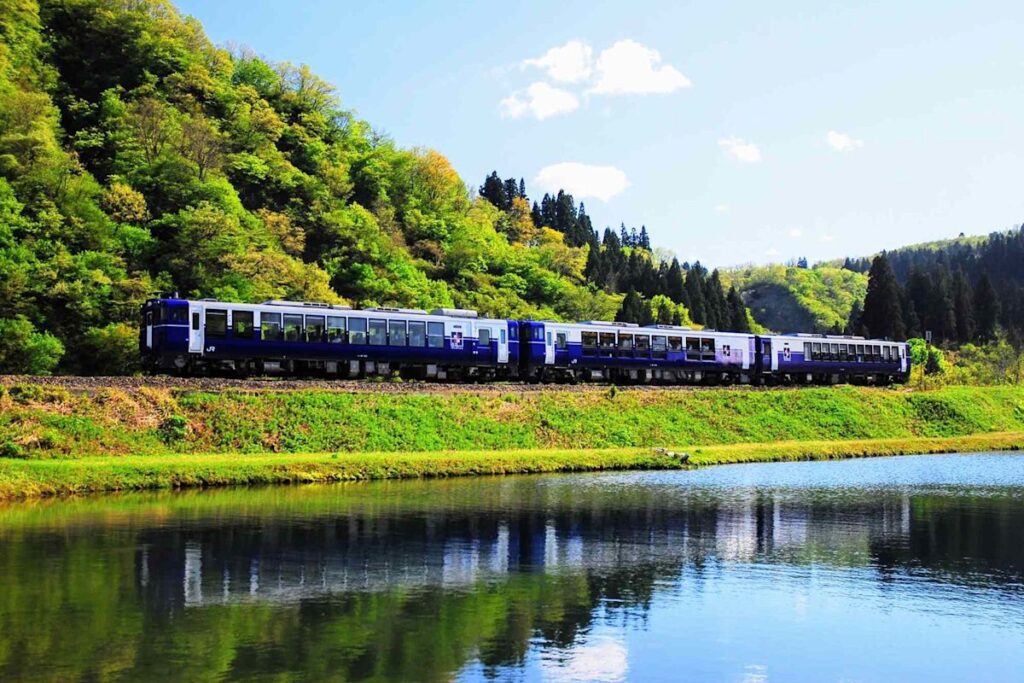
There’s no better way to experience the bounty of the region than on Niigata Prefecture’s Koshino Shu*Kura (operated by JR East), a sightseeing train that celebrates all things rice and sake. The train also stops at Omigawa Station, the closest station to the sea in Japan, where passengers can step out onto the platform for photos. But the best thing about the train is simply watching the landscape pass you by at a leisurely pace, as you sip sake and savor onigiri, aka stuffed rice balls. “Passengers can enjoy Japanese sake and Niigata’s cuisine during their travel time,” says Genjiro Hirota, general manager of JR East’s Regional Cocreation Department, who oversees the train’s routes and onboard services.
Advertisement
Advertisement
Here’s what you need to know before riding Japan’s Koshino Shu*Kura train.
Best Time to Ride
A scenic view from inside the Shu*Kura Sake Train.
Credit: JR East
The train runs from March through November, mostly on Fridays, Saturdays, Sundays, and holidays, so it takes some advanced planning. “Spring and autumn reveal fresh harvests, bright landscapes, and ideal conditions for slow, scenic travel,” says Koichi Mizobe of the International Tourism Promotion Division at the Niigata Prefectural Government.
Spring brings green rice paddies while autumn turns the countryside gold before the first snow. The train runs most frequently from May through August—a summertime ride offers the longest daylight hours for watching the scenery shift.
Know Before You Go
The train has three rotating routes—Koshino ShuKura to Tokamachi, Yuzawa ShuKura to Echigo-Yuzawa, and Ryuto ShuKura to Niigata City—all departing from Joetsumyoko Station.
Advertisement
Advertisement
Seating on the train works in two tiers. Car 3 is open to all passengers. You’ll have to buy a basic fare ticket and a reserved seat ticket, which can be booked together online. If you’re traveling on a JR East-issued rail pass, you can skip the fare but still need to reserve a seat in advance (at no charge). Standard seats are located in Car 3, and reservations open at 10 a.m. one month before departure. Bookings can be made at a ticket office, via a Reserved Seat Ticket Vending Machine, or through the JR-East Train Reservation website.
Car 1 is a separate booking experience, available only through travel packages that include seasonal meals and sake pairings. Book these at least three days ahead through the Joyful Train Reservation website.
What It’s Like On Board
An inside look at seating on the train.
Credit: JR East
Adorably and fittingly, the train’s interior is styled to resemble the inside of a sake brewery, and the ride kicks off with a free pour of local sake.
Car 1 is where meals take place, and dishes change seasonally. You can expect menu items like Niigata-grown rice balls, clam and rapeseed flower gratin, and cherry blossom water yokan (a traditional sweet) in the spring. In the summer, travelers can look forward to offerings like deep-fried sweet shrimp, bitter melon stuffed with meat, and edamame and corn snacks. “The meals feature menus devised by locals that change with the seasons, and the sake is an exclusive onboard selection created in collaboration with Kiminoi Brewery,” Hirota says.
Advertisement
Advertisement
That sake is a delightful daiginjo (a premium sake made from rice where 50 percent of its grain has been removed) brewed by Kiminoi Brewery. Those who don’t imbibe can opt for soft drinks instead. Either way, the meal comes paired with a sake made exclusively for the train.
If you would like a souvenir or a snack to take home with you, head to Car 2. This is where you’ll find local sake, snacks, and original merchandise. There’s also a tasting corner that rotates through five local Niigata brands.
The third and final car is where standard-fare passengers ride, with reclining seats and a lounge with sofa seating. You’ll want to post up here once the train passes the small city of Kashiwazaki, so you can enjoy views of the Sea of Japan. Once you arrive at Omigawa Station, take some time to snap a photo and watch the sunset over the water.
“The roughly four-hour journey flew by in a flash,” says Kenta Mizuno, a Niigata-based railway and travel writer, who likens the experience to a moving izakaya. “Whether you are a sake lover or a railway enthusiast, this is a ride you must experience at least once.”
Stops Along the Route
A scenic view of terraced rice fields in Tokamachi, Japan.
Credit: HIRO/a.collectionRF/Getty Images
The Koshino Shu*Kura route terminates in Tokamachi, a city in the mountainous south of Niigata Prefecture known for its green rice paddies in the summer and its plentiful snowfall in the winter. The most photographed spot around town is Bijin-bayashi, a grove of roughly 100-year-old beech trees whose name translates to “forest of beauties.” A short drive from here, Kiyotsu Gorge has a 750-meter tunnel walk with art installations built into the rock face, part of the Echigo-Tsumari Art Field Triennale, an international creative festival held in the region every three years.
Advertisement
Advertisement
The Yuzawa ShuKura route ends at Echigo-Yuzawa, a classic onsen town that inspired Nobel Prize-winning author Yasunari Kawabata’s novel, Snow Country. The station itself has a sake museum, Ponshukan, inside the station building. For 1,000 Japanese yen (about $7 USD), visitors can sample sake from all of Niigata’s roughly 90 breweries using tokens at a wall of small vending machines. The Echigo-Yuzawa branch also has a sake-infused onsen bath on-site.
The Ryuto ShuKura route runs all the way to Niigata City, the capital of the prefecture and the largest city on the coast of Honshu’s Sea of Japan. Ponshukan has a branch here too, inside Niigata Station, with sake from Niigata breweries and oversized rice balls made with premium Koshihikari rice. Local seafood, rice, and sake are sold fresh alongside rows of casual eateries at Pia Bandai, the waterfront market complex near Niigata Port.
Read the original article on Travel & Leisure
Source link