

Key Points
One of Utah’s “Mighty Five” national parks, Capitol Reef has some of the darkest skies in the U.S., making it an exceptional spot for stargazing.
The park’s remote location and the nearby Dark Sky Community of Torrey protect it from light pollution.
Travelers also love this national park for its scenic daytime hikes and stunning views.
I become downright euphoric whenever I spot a shooting star, and standing beneath the towering sandstone in Capitol Reef National Park, I spotted dozens of them. It was the last leg of a four-state stargazing road trip—and what a grand finale. While I imagined I’d love Capitol Reef, one of Utah’s “Mighty Five” national parks, just as much as the numerous other stops on this adventure through the Southwest, I had no idea the less-trodden getaway would become the trip highlight, not to mention my favorite national park for stargazing.
Perhaps it’s not all that surprising. One look at a light pollution map proves that remote Capitol Reef, located in south-central Utah, has impressively little artificial illumination. Skies this pristine are a rarity in the brightly lit United States, where about 77.6 percent of Americans can’t see the Milky Way from home.
Advertisement
Advertisement
What makes the nightscapes in this Dark Sky International-certified park even more delightful? The nearest town, Torrey, is certified as a Dark Sky Community, too. That means the night skies in and around Capitol Reef are especially protected from star-obscuring light, so this playground of cliffs, arches, and canyons has some of the best stargazing in the country. And I say that having stargazed all over the U.S.
Whether you’re photographing the Milky Way or scouting for shooting stars, here’s how to experience Capitol Reef’s celestial awe on your next trip.
The Milky Way rising over Fruita Barn in Capitol Reef National Park.
Credit: Ujjwal Datta/Getty Images
Where to Stargaze in Capitol Reef National Park
The roads through Capitol Reef National Park stay open all night, so you have myriad stargazing stop-off points to choose from while you’re here. My favorite was the easily reachable Panorama Point, which is about two miles from the visitor center. I came here to soak up the sunset, then drove back several hours later to photograph the starlit skies—all without crowds.
The beginning of the Chimney Rock Trail is another prime spot for sky-watching. It’s relatively level and easily accessible from the parking lot. Plus, you can admire the night sky above the iconic Chimney Rock, a 245-million-year-old spire that’s older than many of the stars overhead.
Guided Stargazing Tours
Stargazing in a new-to-you location can feel intimidating. That’s why I always recommend hiring a local guide. I joined Capitol Reef Photography Tours for an awe-filled night of stargazing and astrophotography. The three-hour excursion included stops at around two to four locations and complimentary transportation from Torrey.
Advertisement
Advertisement
Park rangers also run several free night-sky experiences, typically between mid-May and Mid-October, including stargazing with telescopes and sky-watching in nearby Torrey.
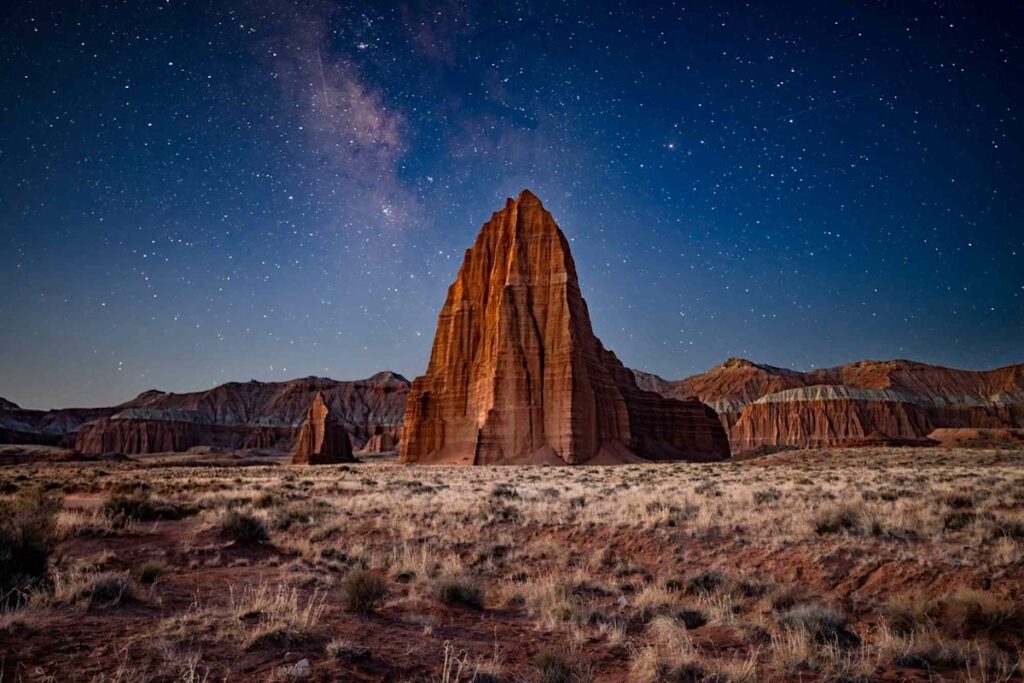
A sky full of stars over the Sun Temple.
Credit: Brad McGinley Photography/Getty Images
Stargazing-centered Accommodations
Skyview Hotel takes Torrey’s Dark Sky Community certification seriously. The property, which opened in March 2023, pushed its architects to use as little exterior light as possible—and it shows. I watched the Milky Way from the hotel’s roof deck, then admired shooting stars from my suite’s private hot tub.
Skyview also has clear-ceiling, glamping-style domes so travelers can stare into the heavens from the comfort of their bed. Night-sky enthusiasts hoping to learn more about the cosmos can access a complimentary stargazing audio guide at the reception desk, too.
Camping is another great option for all-night astronomy. For that, the National Park Service recommends staying at the Fruita Campground, Cedar Mesa Primitive Campground, or Cathedral Valley Primitive Campground.
When to Visit
Spring and fall are Capitol Reef National Park’s prime travel times, with milder temperatures and less monsoon risk. These are also perfect months to see the luminous core of the Milky Way—it’s visible in the early morning hours during spring and early evening in the fall. And given the local dark-sky protections, you can spot that glittery band from all over Capitol Reef and in Torrey.
Advertisement
Advertisement
Summer is perhaps the most popular stargazing season, with meteor showers like the Perseids stealing the show each year, and virtually all-night views of the Milky Way’s galactic center. I visited in early August for this reason, and while the stargazing was out of this world, the daytime temperatures were pretty toasty at around 80 to 90 degrees Fahrenheit. If you are visiting during the summer, plan to allocate your mornings and evenings for adventure time, and your midday hours for relaxing and keeping cool in the shade (or in the air conditioning).
The national park stays open in the winter, too, and while it’s the least-crowded time to visit, snow and frigid conditions can make nighttime excursions less appealing. Quite a few restaurants and accommodations close down in Torrey during this time, too.
In addition to the season, astrotourists should also consider the phases of the moon. Stargazing is best in the days leading up to and after the new moon, so plan your trip accordingly.
What to Do During the Day
Capitol Reef’s night skies wowed me, but the mornings and evenings are blissful, too. Hiking trails abound, and they’re the best way to check out the park’s natural scenery. Hit the roughly two-mile Hickman Bridge Trail to admire the canyon and walk beneath the 133-foot Hickman Bridge, a natural sandstone arch. Or, tackle the dramatic Grand Wash Trail, which winds through 4.5 miles of red rock.
Advertisement
Advertisement
For another view, try horseback riding. I took a two-hour ride into the park with Wilderness Ridge Adventures. The outing takes you through a remote park corner to see the iconic Waterpocket Fold, a nearly 100-mile crease in the Earth’s surface.
And whatever you do, don’t miss the homemade pies at the park’s historic Gifford Homestead (open seasonally from about mid-March to late November). Get there early—these sweet treats, stuffed with regionally grown fruit fillings, typically sell out by the afternoon.
Read the original article on Travel & Leisure
Source link