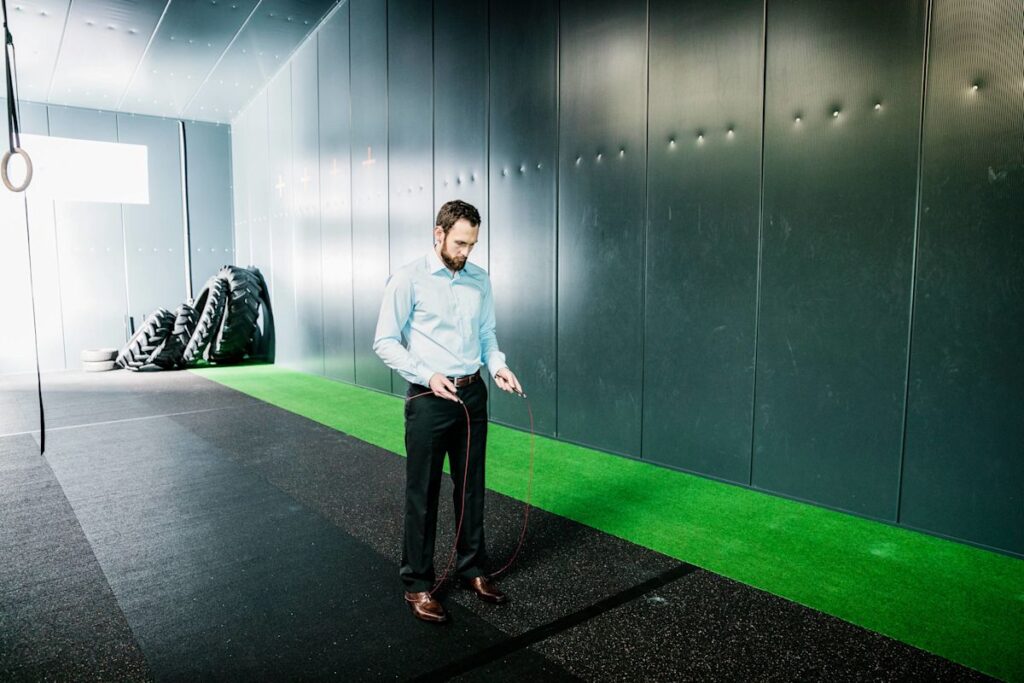
If you can run a mile but cannot clear a jump rope five times, start with the coordination problem. Practice one turn and one small jump, stop, and reset. Linking repetitions can come later. Trying to force a long cardio interval gives you more chances to rehearse the same mistake.
Your hands have a job, too
A 2022 biomechanics study examined jumping, turning, and whole-body skipping performance in 23 rope skippers. Turning performance was closely related to overall skipping performance, and handle movements differed with performance level. This was not a beginner teaching trial, but it helps explain why jumping higher is not the only answer: the movement requires coordinated rope turns as well as footwork.
Check the setup before blaming your rhythm
The American Council on Exercise’s beginner guidance suggests a lightweight rope and shoes with cushioning under the forefoot. For an initial length check, stand on the rope’s midpoint with one foot; its handles should reach roughly chest height. Follow any adjustment instructions for your particular rope.
Advertisement
Advertisement
Choose a level, unobstructed area with clearance around you and overhead. In CrossFit Journal’s jump-rope preparation guide, coach Buddy Lee recommends wood or rubber among suitable surfaces, and checking for nearby people. A cramped room beneath a ceiling fan is a poor practice space.
Make the basic jump smaller
ACE’s cues are straightforward: relax your shoulders, keep your elbows near your sides, soften your knees, and turn the rope with your wrists. Stay upright with your head up. Jump low, just enough to clear the rope, instead of pulling your knees toward your chest.
Work on one cue at a time. If you are simultaneously trying to spin faster, jump higher, and change your foot pattern, it becomes hard to tell which change helped. Begin with both feet together and a forward turn. Leave backward jumping, alternating feet, and double-unders for another session.
A trip does not erase the repetitions you completed. An American Heart Association teaching activity tells learners to continue counting successful jumps after a miss. It is a school resource, not an adult training prescription, but that approach is useful: reset and continue without treating every catch as starting from nothing.
Try a short skill session
This is an original editorial practice template, not a tested training protocol. It is intended for beginners who are comfortable with small hops, and its purpose is practicing the basic movement.
|
Stage |
What to do |
|---|---|
|
Prepare |
Walk to warm up. Then try a few small, comfortable bounces without the rope. |
|
Separate the movement |
Start with the rope behind you. Turn it forward once, make one low jump, then stop and reset. Practice for up to 20 seconds; walk or rest for 40 seconds. |
|
Link a few |
Try two to five smooth jumps, then reset. Use the same short practice-and-rest window. Repeat two to four rounds if comfortable. |
You do not have to fill every practice window with jumping. If the rope catches after two repetitions, untangle it and take your time setting up again. Rest longer if needed. If jumping hurts, stop rather than attempting to solve pain with more repetitions.
Advertisement
Advertisement
Once several jumps link comfortably, let a sequence get a little longer. Keep the same basic step while you do it. There is no deadline for reaching a minute without a miss; getting the rope around smoothly is the skill you came to learn.
This article draws on published biomechanics research and exercise-teaching guidance. No original interviews, rope testing, or supervised coaching were conducted. The practice session is an original editorial example, not a validated protocol or rehabilitation plan. The American Heart Association resource cited was written for schoolchildren; the biomechanics study did not test beginner instruction.
This story was originally published by Men’s Fitness on Nov 4, 2026, where it first appeared in the Training section. Add Men’s Fitness as a Preferred Source by clicking here.