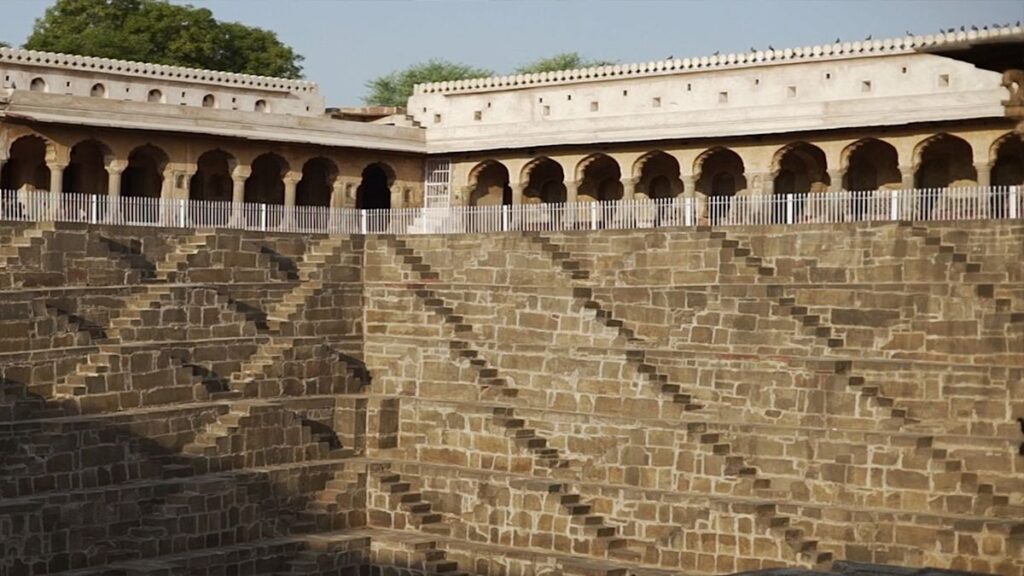
Imagine standing before a structure containing thousands of perfectly arranged steps, each creating geometric patterns that seem to stretch endlessly into the ground. In the Indian state of Rajasthan, Chand Baori offers exactly this extraordinary sight. Often compared to the impossible architectural designs of artist MC Escher, this ancient stepwell is one of the largest and most visually spectacular examples of traditional Indian engineering. Its remarkable appearance attracts visitors from around the world, but its design was created for a much more practical purpose. Built in a region where water is precious and temperatures can become extreme, Chand Baori demonstrates how ancient communities combined engineering, architecture, and everyday necessity.
Chand Baori is a deep, four-sided structure featuring approximately 3,500 terraced steps arranged in an intricate geometric pattern. These steps descend through multiple levels to a depth of around 100 feet, creating a spectacular visual effect when viewed from above. The symmetrical arrangement makes the structure appear almost like an endless staircase, with repeated triangular patterns forming a fascinating architectural illusion. Beyond its impressive design, the stepwell also has an important religious connection. A large temple dedicated to Harshat Mata, the Hindu goddess of joy and happiness, stands alongside the structure. This temple adds spiritual significance to the site and reflects the close relationship between religious traditions and community architecture in ancient India. The stepwell was not simply a water storage facility but also an important place associated with local culture and religious life. Chand Baori has also become recognisable to international audiences through its appearances in several Hollywood productions. Its distinctive architecture has featured in films such as The Fall, The Dark Knight Rises, and The Best Exotic Marigold Hotel. The unusual geometric patterns and dramatic depth provide a visually striking setting that is difficult to recreate elsewhere.
However, the stepwell’s original purpose was closely connected to the challenging climate of northwestern India. Rajasthan experiences extremely dry conditions, making water conservation essential for local communities. Chand Baori was designed to collect and preserve as much water as possible, providing an important resource during periods of limited rainfall. Its deep construction allowed people to access water even when surface conditions became increasingly dry.
Advertisement
Advertisement
Another remarkable feature is the cooler environment found at the bottom of the structure. The air can remain approximately five degrees cooler than at ground level, offering relief from the intense outdoor temperatures. This natural cooling effect made the lower levels an excellent gathering place for local residents during heat waves.
Today, Chand Baori stands as an extraordinary reminder of India’s architectural ingenuity. Its thousands of steps reveal the creativity of ancient builders, while its practical design demonstrates how communities adapted to difficult environmental conditions. More than a beautiful monument, it represents a remarkable solution to one of humanity’s most essential needs: access to water.