

 4 min read
If you follow red carpet fashion, these past few weeks, it’s been impossible to ignore Elle Fanning’s method dressing madness as Effie Trinket. From toy ballerina music box headpieces by Robert Wun fit for a fairy tale to makeup compact dresses (and matching headwear) from Givenchy, the fashion story is strong. All roads lead back to her character as young Effie Trinket from The Hunger Games: Sunrise on the Reaping, which is making its theater debut on November 20. Based on Suzanne Collins’s 2025 novel of the same name, it is set 24 years before The Hunger Games and 40 years after The Ballad of Songbirds & Snakes. It begins the morning of the 50th Hunger Games, with a 16-year-old Haymitch Abernathy (Joseph Zada) and Effie Trinket as a young stylist in the Capitol.
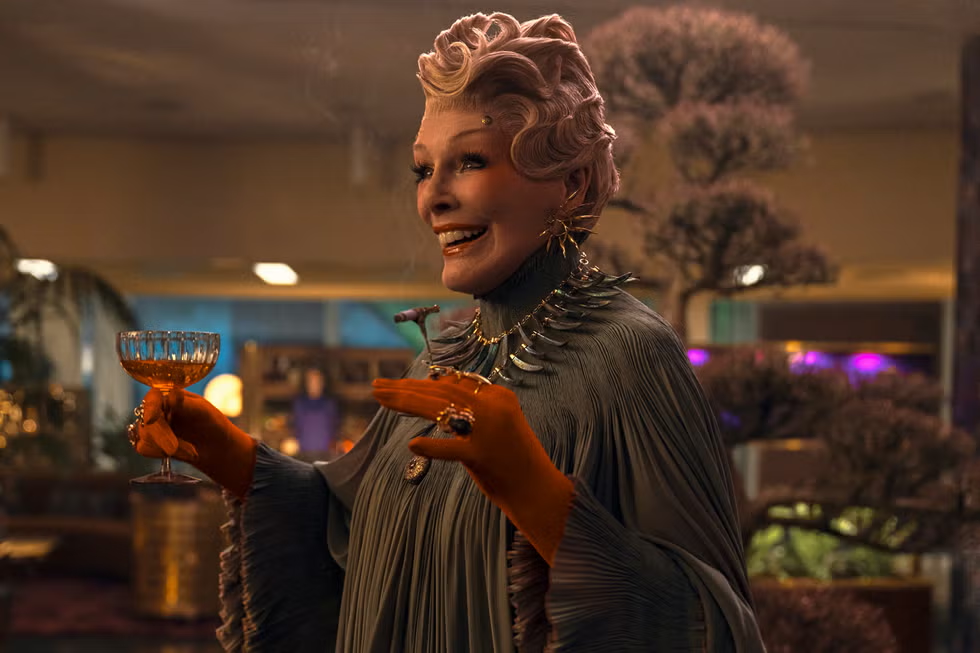
Bina Daigeler is the costume designer behind the new film, and with her team, she oversaw the creation of every single outfit from scratch, with a few helping accessories pulled from vintage specialists. She began with a mood board that focused on the aesthetic differences between the 13 districts while keeping in mind the personalities of the actors. Drusilla Sickle (Glenn Close) had a devoted board full of Alexander McQueen, John Galliano, and Vivienne Westwood, for instance. “It was really like old couture fashion,” Daigeler tells ELLE. “But pieces that, for me, would age very well, you know, that would keep up in time, because I think that is very important when you work on such a famous franchise; that you design for the future. That it’s still interesting in 10 years.”
Elle Fanning as Effie Trinket in The Hunger Games: Sunrise on the Reaping. Photo Credit: Murray Close
Glenn Close as Drusilla Sickle in The Hunger Games: Sunrise on the Reaping. Photo Credit: Murray Close
Billy Porter as Magno Shift and Glenn Close as Drusilla Sickle in The Hunger Games: Sunrise on the Reaping. Photo Credit: Murray Close
“Working with Glenn Close, she really came to me and said, ‘I need to find a thread through all the costumes that are made for me, so that I can understand it,’” says Daigeler. “That was super important for her.” Daigeler wove everything together with “cool accessories to give her the strength,” and one very special finale look. “She wanted to have a big finale, you know, like a finale where she really feels like ‘I’m the winner. it’s nothing about Haymitch, it’s all about me.’” Think: lots of red.
Daigeler also referenced Woodstock, Studio 54, the late ’60s and early ’70s. “I tried really to have a strong concept that has to do with the personality of each character,” she says. Unsurprisingly, given Effie Trinket’s predilection for fashion as a stylist, she was a big focus for Daigeler. “For example, young Effie Trinket, how did she become the Effie Trinket that Elizabeth Banks was? Here she is younger, she is fresh, she doesn’t have a lot of money or a fashion background. So it must be something that looked a little bit vintage that could be done at home, a mixture of fabrics, of textures, of color, something very young and fresh and fun.”
Joseph Zada as Haymitch Abernathy in The Hunger Games: Sunrise on the Reaping. Photo Credit: Murray Close
Early on in the film, we see Effie Trinket’s fashion as improvisational. But Daigeler intentionally showcases her ascension from fashion fan to fashion icon throughout the film. Daigeler says that Effie’s outfits all had to have fun elements. “The black kimono with the flowers and patchwork little waistcoat with a flowery blouse and all the color combinations were very strange, but it worked together,” she says. She also mentions her blue denim, Vivienne Westwood-inspired piece with huge sleeves as being the epitome of young Effie Trinket style.
Joseph Zada as Haymitch Abernathy and Elle Fanning as Effie Trinket in The Hunger Games: Sunrise on the Reaping. Photo Credit: Murray Close/Lionsgate
“The most important thing was, for Effie, that she looks fun, but also free, because she is in the Capitol, but is still the freest and the most positive and optimistic character,” says Daigeler. “She doesn’t look like damaged and depressed and she had to come in and cheer them up and she definitely came with a solution. Our heroes somehow could trust her and they were so happy to see her. All the other characters from the Capitol, you really don’t know who you can trust.” Therefore, their aesthetic is darker while Effie is lighter and brighter.
Look out for the fashion Easter eggs throughout the film, like Effie Trinket’s butterfly crystal rings, which were just some of the pieces that Daigeler sourced vintage from one of her favorite specialists from around the world. Elsewhere, Haymitch has his own fashion revolution in a quieter way. “The way also how Haymitch wears the clothes and how they were aged and the colors, everything just comes together,” says Daigeler. “I think the audience will find, or I hope, that they find that there are things that resemble and they recognize it.”
Joseph Zada as Haymitch Abernathy in The Hunger Games: Sunrise on the Reaping. Photo Credit: Courtesy of Lionsgate
Kieran Culkin as Caesar Flickerman in The Hunger Games: Sunrise on the Reaping. Photo Credit: Murray Close
Likewise for Caesar Flickerman (Kieran Culkin), the longtime Capitol television host, there’s an emphasis on fashionable suits. “It was very, very important that he can move because he is a very physical actor whom moves a lot, so he needed space in his suits,” says Daigeler. “Suits also had to give him power.”
And for Snow (Ralph Fiennes), too, suiting is used to convey power. “He’s very particular about fabrics, about the cut. So I went to a tailor in London, who I have known for many, many years,” she says. “Snow’s suits we developed really like a little bit, World War II military cuts, with a very strong shoulder and a very strong silhouette and these heavy fabrics, and the right colors. But then we gave him the fantasy through hand-embroidered lapels. It had also the hint to his rose that he always wears, and he has somehow always loved flowers.”
Fashion is both spectacle and a survival tool in The Hunger Games: Sunrise on the Reaping. The odds are forever in fashion’s favor.
Source: ELLE
Source link