
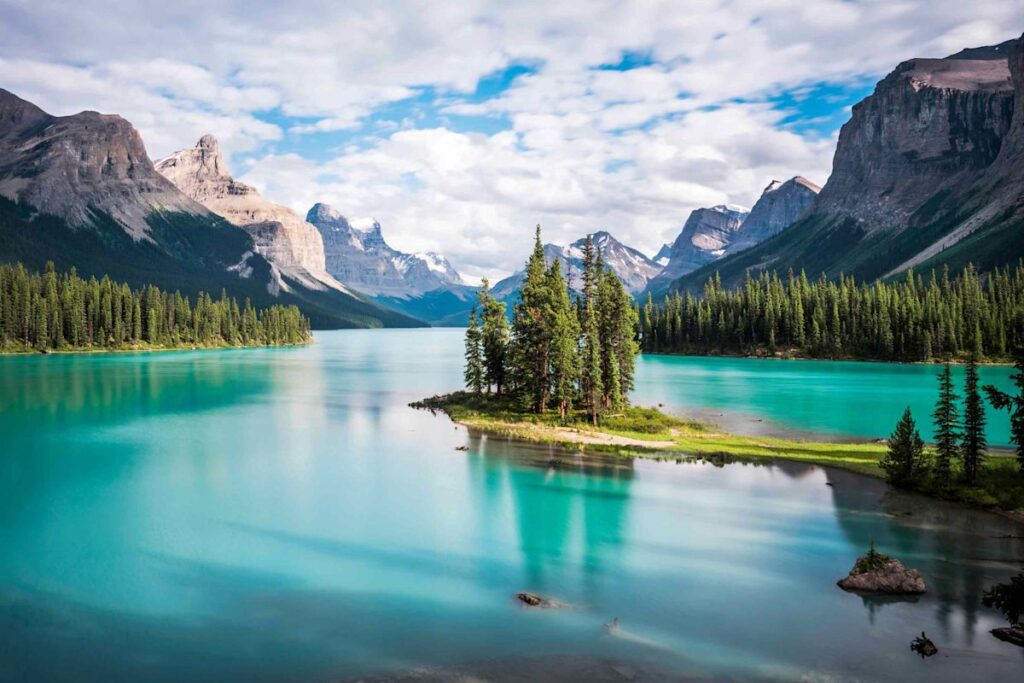


Jasper National Park
Join a wildlife tour to find the elk, moose, and bears that are easy to miss on your own.
Climb above Maligne Lake on the Bald Hills trail, where alpine meadows bloom in July and August.
See the northern lights, Milky Way, and planets in the world’s second-largest dark sky preserve.
Take a cold plunge in a glacier-fed lake at Fairmont Jasper Park Lodge, and practice breathwork techniques from a coach before the dip.
Learn about Cree culture on a walking tour around the town of Jasper on a Warrior Women-guided experience.
In the Canadian Rockies, the saying goes that Banff National Park is for the tourists, and Jasper National Park is for the locals. But that doesn’t mean visitors aren’t welcome.
Granted, Jasper National Park requires a bit more time and effort to visit, which means fewer people make the trip. Jasper sees roughly 2.5 million visitors a year compared to Banff’s 4.5 million, and given that the former is almost twice as big (4,335 square miles versus 2,564), you don’t have to go very far off the beaten path to feel like you have the park to yourself. “It only takes about five or 10 minutes on a trail, and pretty soon, you don’t have people around you anymore,” says Matricia Bauer, the owner of Warrior Women, a tour company based in Jasper.
Advertisement
Advertisement
While Jasper is one of Canada’s most striking national parks and its largest in the Rockies, the history here is complicated, to say the least. Traditionally, the land that now comprises Jasper was used by several Indigenous communities (including the Anishinaabe, Dene-zaa, Cree, and Métis) for hunting, gathering, and trading. The Canadian government established the park’s current boundaries in 1907, and in the years following, Indigenous peoples were forced from their homes.
At the same time, the town of Jasper—which sits in the middle of the park—became a hub for the Grand Trunk Pacific Railway and Canadian Northern Railway, transforming the park from a remote wilderness area to an easily accessible travel destination. The park was ultimately declared a UNESCO World Heritage Site in 1984, and the story of its complex past lives on in the local museums and historic sites.
In addition to its history, Jasper’s biggest draw is its landscapes. “What surprises many first-time visitors is just how diverse the landscape is,” says Merel Pilgrim, a promotions officer with Parks Canada. “In a single day, you can drive through broad mountain valleys, paddle on a glacier-fed lake, hike through forest and alpine environments, explore waterfalls and canyons, or stand beneath some of the highest peaks in the Canadian Rockies.”
Here’s what you need to know before planning a trip to Jasper National Park.
Know Before You Go
A beautiful mountain landscape in Jasper National Park.
Credit: Mae Hamilton/Travel + Leisure
Entering Jasper National Park requires a Parks Canada entry pass, which can be purchased at the park’s gates, Jasper Park Information Centre National Historic Site, or online. Day passes for adults are $12.25 Canadian dollars (about $8 to $9 USD).
Advertisement
Advertisement
Some activities require reservations and/or additional permits, such as camping, overnight backcountry trips, and fishing, so check the park website before you go. Parks Canada also shares bulletins about trail conditions, fire bans, and closures that are worth keeping tabs on.
Spotting wildlife throughout the park is common, and visitors are required to keep their distance from animals. Per Parks Canada, visitors have to stay at least 100 meters (about 330 feet) from bears, wolves, and cougars, and at least 30 meters (about 100 feet) from elk, moose, sheep, goats, and caribou.
The ecosystem itself is still fragile in the wake of wildfires that tore through Jasper in 2024. “The 2024 wildfire had a significant impact on the community of Jasper and portions of the national park,” says Pilgrim. “However, the vast majority of Jasper National Park was unaffected, and visitors will find that most attractions, trails, campgrounds, and tourism experiences are accessible and ready to welcome them.”
Signs of regrowth are visible, but you should still pay attention to signage and closure information. “A small number of areas remain closed or have temporary restrictions while recovery work continues,” Pilgrim adds.
Best Time to Visit
A scenic sunset over a lake in Jasper National Park.
Credit: Mae Hamilton/Travel + Leisure
There’s never a bad time to visit Jasper National Park, but summer is the busiest season. So, if you’d prefer to avoid the crowds, opt for spring or fall. “In spring, waterfalls are at their peak and wildlife is often active in valley bottoms,” says Pilgrim. You’re likely to spot deer, elk, and mountain goats, as well as bears emerging from hibernation. There’s lots of bird life at this time of year, too, as several species’ migration patterns take them through the park.
Advertisement
Advertisement
Summer brings exceptionally long days, with 14 to 17 hours of sunlight depending on the month, so you’ll have more than enough time for hiking, biking, and paddling. However, you should make reservations for accommodations and restaurants in advance due to the higher visitor numbers at this time.
When fall arrives, you can still expect to get some warm weather—just with more room on the trails. “I highly recommend coming in September. You’re not going to be standing in lines or having to make reservations the same way as you would in the summer,” says Bauer.
Even in winter, the park is rich with opportunities for outdoor recreation, from snowshoeing and skating to downhill skiing at the family-friendly Marmot Basin. Outfitters like Jasper Outdoors and Source for Sports can get you kitted out in the right gear to hit the slopes and trails.
Best Things to Do
Canoes on a lake at sunset.
Credit: Mae Hamilton/Travel + Leisure
Marvel at the Night Sky
Jasper is the world’s second-largest Dark-Sky Preserve and arguably the largest accessible one. Depending on the conditions, you may be able to spot the Milky Way, planets like Saturn, and the Northern Lights.
Advertisement
Advertisement
At Jasper Planetarium, you can attend an indoor experience and hear more about our solar system. Outdoors, Jasper Star Trails’ guided astronomy tours take place on the shore of Lake Annette, where telescopes are set up to get clear views of distant star clusters. This is a chance to ask any and all space-related questions you might have. If you’re visiting in October, you can also ask those questions at the 10-day Jasper Dark Sky Festival, which includes astronomy lectures, free concerts after dark, and stargazing at the top of the Jasper SkyTram.
Connect With Indigenous Culture
Led by Bauer, who is Cree, Warrior Women provides several tours and experiences that connect visitors to Indigenous traditions. The Indigenous Jasper Cultural Tour takes place in downtown Jasper, where Bauer shares the area’s history through murals, statues, and the Indigenous Art Park. The Wapakwanis Plant Walk, Make & Take reveals the world of plant medicine and includes some hands-on medicine-making—you’ll leave the tour with an item, like a salve. And at the end of the day, the Fireside Chat is an evening of open discussion about Cree culture while sitting around a crackling fire.
Spot Wildlife With the Pros
Elk, deer, moose, bears—the park is teeming with wildlife. Though you may catch a glimpse of these animals while driving through the park or walking through town, a guided tour with SunDog Tours and Transportation or the Métis-owned Jasper Tour Company will get you to the most reliable viewing spots. Along the way, you’ll learn about the park’s ecology and the animals’ behaviors and habits. Bauer says, “You could spend eight hours driving around and not see a bear, or you get a wildlife tour and probably see all the animals on your list because they know the park; they know where the animals are going to be.”
Get On the Water
The park is home to more than 1,700 lakes, and one of the best ways to see these turquoise and emerald-green gems is by booking a relaxing paddling trip. Niki Wilson, a science journalist and host of the Jasper Dark Sky Festival, recommends heading to Lake Edith, Patricia Lake, and Pyramid Lake, or signing up for a guided canoe tour. “Wild Current Outfitters’ canoe tours on Pyramid Lake are the most relaxing, informative, beautiful experience,” she says. Tours run from May to November, and no previous paddling experience is required.
Advertisement
Advertisement
For something more relaxing, swing by Miette Hot Springs, a series of natural hot springs that are the hottest in the Canadian Rockies. The springs are open from mid-May to mid-October on a first-come, first-served basis, and they’re surrounded by stunning scenery. “Visitors can easily spend a full day exploring the area, enjoying the scenic drive along Miette Road through the Fiddle Valley, and stopping at Punchbowl Falls,” says Pilgrim.
Best Hikes
A wooden walkway to scenic island in Jasper National Park.
Credit: Tanya Nikolic/Travel + Leisure
Lake Annette Loop
The 1.7-mile Lake Annette Loop is flat and paved, making it wheelchair- and stroller-friendly. “This is a beginner-friendly option, with flat, wheelchair-accessible paths, mountain views, and a chance to see fire-affected ecology,” says Wilson.
While circling the lake’s shimmering turquoise water, you’ll have views of some of the park’s most prominent mountains, including Pyramid Mountain, the Colin Range, and Mount Edith Cavell. There’s also a small beach, and benches and picnic tables if you want to linger.
Valley of the Five Lakes
This easy-to-moderate trail and its surrounding forests were affected by the 2024 wildfire, but after a couple of years of restoration work, the Valley of the Five Lakes trail reopened in May 2026. The trail’s network of paths—which loop around five lakes, past regrown forest and wetlands—ranges from roughly one mile to almost five miles. There are picnic spots and chairs where you can pause and take in the mountain views.
Athabasca Falls
While many visit Athabasca Falls to grab a quick photo, Bauer recommends hiking down to the shore. “Lots of people just go to the falls, stop, and turn around, but there’s a really nice walk along the river, and you see the landscape from a different point of view,” she explains.
Advertisement
Advertisement
This half-mile trail is flat, paved, and equipped with guardrails. There are viewing platforms along the way, and interpretive signage to learn more about the area’s geology. Visitors must stay on the path, as the wet rocks are slippery.
Bald Hills
Experienced hikers will appreciate the challenge of Bald Hills. One of the park’s most iconic hikes, the trail “[climbs] above Maligne Lake through forest and alpine meadows to sweeping views of the lake and surrounding peaks,” says Pilgrim. The hike is just over nine miles round-trip, and includes an elevation gain of almost 2,500 feet. In July and August, the alpine meadows are in full bloom.
Best Places to Stay
An aerial view of the Fairmont Jasper Park Lodge.
Credit: Fairmont Jasper Park Lodge
Fairmont Jasper Park Lodge
Considered the luxury resort in Jasper, the Fairmont Jasper Park Lodge spans 700 acres. There are rooms in the main lodge, as well as cabin suites and multi-bedroom standalone cabins. The resort’s multiple restaurants serve creative dishes made with Alberta fish and game, like the elk shakshuka at Elderwood. Along with an on-site golf course, guests can take advantage of hiking trails around Lac Beauvert; canoe, kayak, and stand-up paddleboard rentals; and snowshoeing in the winter. You can also earn bragging rights with a glacial plunge into Lac Beauvert, a reservation-only experience led by certified guides.
Pine Bungalows
If you’re coveting a cabin in the woods, this is the place to find it. Though just a five-minute drive from the center of town, Pine Bungalows feels like a true forest retreat. Choose from one- or two-bedroom cabins (most come with full kitchens, heated floors, and gas fireplaces) or the modern, four-bedroom chalets for bigger groups. The lodge also has pine-paneled guest rooms.
Advertisement
Advertisement
To top it off, the lodge is where you’ll find a communal fire pit that’s lit every night, a convenience store-like canteen, and Kumama Bistro, the Pine Bungalows’ restaurant. The menu includes a delicious breakfast sandwich and an “All the Sides” dish with toast, bacon, eggs, potatoes, and greens.
Forest Park Hotel
Located on Connaught Drive, Jasper’s main drag, Forest Park Hotel has two room styles, one of which—the Alpine—is outfitted with kitchenettes. But you might not need to break out the pots and pans. There are two restaurants in-house, and Forest Park is a short walk from many of Jasper’s restaurants, bars, and cafes. It’s a good choice for those who prefer to stay in the town center.
Places to Eat
A table filled with dishes from Malgine Range.
Credit: Jasper Tourism
The Maligne Range
The Maligne Range is a former movie theater turned restaurant and whisky distillery. Since Alberta is known for its beef, the restaurant specializes in smoked meats. Pair your meal with a flight of Canadian whiskies or sip on the Shangri La cocktail, a blend of rye whisky and plum sake with elderflower and pomegranate.
Jasper Brewing Co.
You can sample ales, pilsners, and IPAs, as well as seasonal brews, at Jasper Brewing Co. The drinks menu includes gluten-free and non-alcoholic options, plus cocktails featuring gin from Calgary-based Last Best Brewing, Jasper Brewing Co.’s sister brewpub. Order a poutine with your drink of choice.
De’d Dog Bar & Grille
The town watering hole, De’d Dog Bar & Grill, draws in Jasper residents and tourists alike to grab a beer and watch the game—typically, hockey. Between the hearty food and craft brews, you’ll have plenty of options to fuel up after a long day of hiking. Nab yourself a Dog Bone (a beef rib doused in barbecue sauce), a big game burger, or a shepherd’s pie made with Alberta beef, bison, and elk.
Fiddle River Restaurant
Fiddle River Restaurant offers views of the Rockies from its second-floor dining room, as well as arrivals and departures from the town’s rail yards. A local favorite for special occasions, the restaurant focuses on seafood, like Arctic char fillets and rainbow trout in a curry sauce.
Jasper Food Tours
Believe it or not, there are more than 70 restaurants in this small town. If you’re not sure which to choose, book an afternoon with Jasper Food Tours, which leads a downtown walking tour with eats at four different restaurants. The locations are only revealed when the tour starts, and both food and drink portions are generous.
Advertisement
Advertisement
Read the original article on Travel & Leisure
Source link


