

Snow, in my Los Angeles childhood, was a present absence: a fantasy I absorbed from favorite novels and animated Christmas shows, and also a reality I couldn’t touch. As an adult, I closed that gap by settling in Brooklyn. Here was snow in the icy flesh—draping trees and hushing streets; buoying my ecstatic children down sledding hills; and, less romantically, slushing at city corners.
From left: Fairview Mountain overlooking skaters on the lake; an illuminated tunnel at Fairmont Chateau Lake Louise, in Banff, Alberta.
Credit: Kamil Bialous/Travel + Leisure
Then one day, I realized that in recent years there hadn’t been much snow at all. As the climate warmed, winter was changing, and in New York, as across the whole Northern Hemisphere, snowfall was in decline. Once again, it was a present absence, but this time in an epochal, almost unfathomable sense. Wanting to understand—and maybe memorialize—the role snow has played both in planetary health and our imaginations, I began writing a book about it.
From left: An ice sculpture at Fairmont Chateau Lake Louise; Joel Hagen of Great Divide Nature Interpretation leads a snowshoe tour.
Credit: Kamil Bialous/Travel + Leisure
But spending time with snow on the page isn’t the same as being with it in person. I hungered for the ethereal estrangement of a snow-covered landscape, the preternatural quiet, the exhilaration of moving in the cold. So in late February, I went to the Canadian Rockies for a winter retreat. (Ironically, a blizzard hit New York while I was gone.) I planned to do some skiing—there are three resorts in Banff National Park—but mostly I wanted, simply, to be in snow, to re-experience it.
From left: The Ember, a bourbon-based cocktail at Fairmont Banff Springs’ Rundle Bar; the interior of the bar.
Credit: Kamil Bialous/Travel + Leisure
Banff, in the province of Alberta, was Canada’s first national park—founded in 1885—and remains a jewel of its well-maintained park system. Its 2,500 square miles include peaks that exceed 11,000 feet in elevation, as well as the iconic Lake Louise, where I began my stay. This glacier-fed body of water is best known as a summer destination, but in an Instagram age, its picturesqueness is drawing overwhelming crowds. More than one local told me they much prefer the peace of winter. Under snow, encircled by forested slopes and the Victoria Glacier, the lake is magnificent.
Advertisement
Advertisement
After flying into Calgary, I caught a shuttle to Fairmont Chateau Lake Louise, which began its life as a one-story log cabin by the shore in 1890. Today, it encompasses 539 rooms and suites in an imposing Renaissance Revival building. It’s the only hotel—indeed, the only structure—directly on the lake, with park restrictions preventing further development. Staying there, then, allows you to explore the pristine natural surroundings while sampling the hotel’s luxuries. Among them is a new spa that I was eager to investigate, having learned from experience and Nordic friends that winter and saunas are made for each other.
From left: Helaman Stanley, a sauna master with Basin Glacial Waters, the thermal wellness facility at Fairmont Chateau Lake Louise; the Glacier Lounge at Basin Glacial Waters.
Credit: Kamil Bialous/Travel + Leisure
Once I’d checked in, I retreated to my comfortable, well-designed room in the hotel’s old wing (which dates back a century), planning to stay in for the evening after a long travel day. Then I looked out the window. Against a dark sky, snow gently fell onto giant, pillowy drifts. On the frozen lake, skaters swirled around a miniature ice castle that the hotel had constructed. I pulled on my coat and snow boots and went out into the most idyllic winter night I’ve ever experienced.
It was 20 degrees but felt warmer. The snow was soft and powdery, the night windless, the air scented with campfire smoke. Trees were wrapped in lights; ice sculptures of speed skaters evoked the recently concluded Winter Olympics in Italy. The foreground of the lake had been cleared and floodlit to host the ice castle and the skaters, who were undeterred by the accumulating snow on the surface. “Perfect,” I heard one say, and I sensed she was speaking about more than the skating. A father and his four children had cleared a rectangle of snow and were playing hockey, their shouts ringing in the crisp air.
From left: A mid-mountain run at Banff Sunshine Village; a view of Banff from a gondola through a snowstorm.
Credit: Kamil Bialous/Travel + Leisure
The rest of the lake, vast and mysterious, extended into the darkness, and I skirted the rink and walked out onto it. Despite the snowfield beneath my boots, I couldn’t forget that I was on ice probably three feet thick, beneath which the water lurked. (Lake Louise usually freezes in mid-December and fully thaws around early June.) It’s a destabilizing and subtly thrilling sensation to walk on water, especially in the dark. The night’s stillness seemed to swell as I moved farther from the lights of the hotel.
Advertisement
Advertisement
When I returned to its vicinity, I found firepits on the terrace, along with staff members offering s’mores. A guest from Calgary told me that her whole approach to winter had changed once she found something—snowboarding, in her case—that she loved to do in it. Now she couldn’t wait for the snow to start each year. Her husband agreed, adding that winter is only boring if you don’t embrace it.
From left: An exhibit on Skoki Lodge, a historic ski lodge, at the Whyte Museum in Banff; on the lift at Lake Louise Ski Resort.
Credit: Kamil Bialous/Travel + Leisure
I embraced it. I spent two hours outdoors that night, and would happily have stayed longer. (“You can’t get too much winter in the winter,” as Robert Frost wrote.) Over the next four days I skied, ice-skated, and snowshoed, but also at times did nothing more than watch the blue light suffuse the reflective terrain, or the wind spin the snow up into a whirling gyre. I watched others, too, as they took Bavarian-curling lessons, or rode horse-drawn sleighs, or posed for photos on the white immensity beneath their feet under a dramatic, ever-changing sky. I was struck by the smiles, a mix of giddiness and awe, on every face, adult and child alike. Other than the ever-present iPhones, it felt like a simpler time. A joyous one. Snow has many powers. This enchantment was one of them.
The dryness of the climate makes the Banff–Lake Louise area an especially appealing winter destination. The sugary snow was a pleasure to be in, and the air felt not just invigorating but actually healthful. To be fair, I had lucked into a week of perfect weather, with moderate temperatures and fresh snowfall. Winter—all weather—is unpredictable, and only becoming more so. I would counsel both acceptance and a backup plan: the spa, or a good book with which to sit by a window.
From left: Skaters circle an ice castle on Lake Louise; pasta and salads at Lupo restaurant, in Banff.
Credit: Kamil Bialous/Travel + Leisure
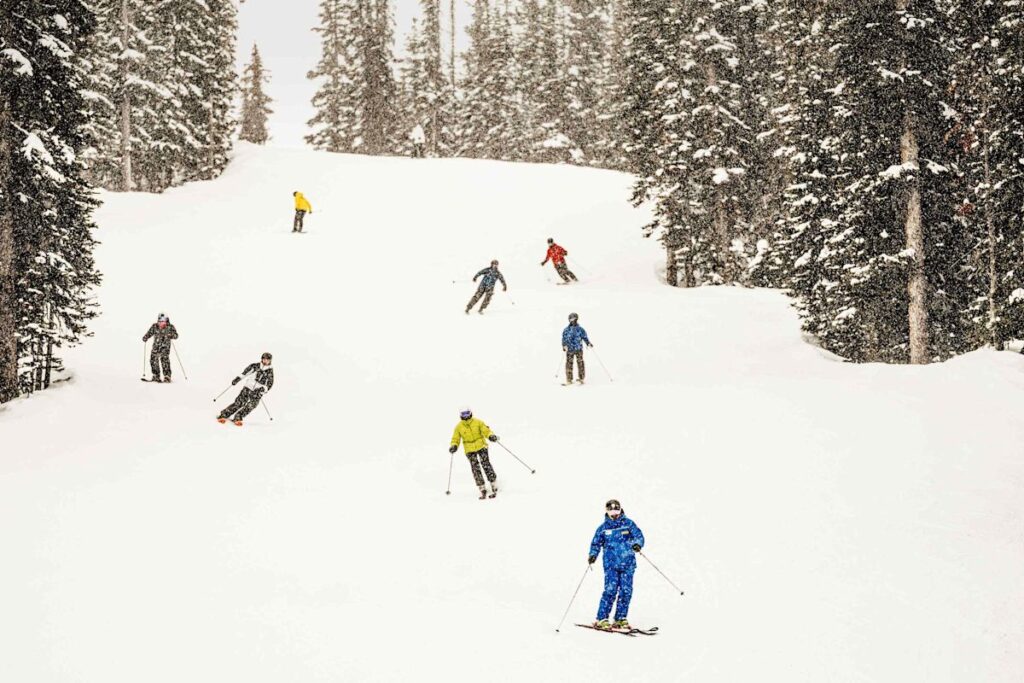
I am not an especially experienced skier, but even I could tell, during my first morning there on skis, that the snow was extraordinary. My instructor, David MacLellan, a retiree who loves skiing so much he comes to Banff to teach a few months each year, said it was maybe the best he’d ever seen. After a year when much of the western United States was snow-impoverished, Lake Louise Ski Resort, where I did my first runs, saw both record snow and record visitors, many of them American. It makes sense: Calgary is a relatively short flight from most major U.S. airports, and the prices at Lake Louise are lower, and the lift lines much shorter, than at American resorts. The cold temperatures also keep the snow in place: despite almost none falling in January, the thick coat from December was holding well into February.
Advertisement
Advertisement
The resort is characterized by fairly steep terrain, making many of its green runs more like “dark greens,” in MacLellan’s words. “Maybe even aquamarine,” he joked. But he was an able guide, calling out, “Don’t lean into the hill—fear will make you want to do that!” and “Use your hips!” (This was transformative, giving me much greater control in my turns.) “Skiing is basically a one-legged sport,” he told me, meaning I should always keep my weight on my downhill ski, though he also cautioned that, at my skill level, I shouldn’t take the one-legged thing literally. We ended with a (truly green) run through pine trees, whose silky snow and crystalline beauty I still fantasize about.
A guest room at Fairmont Chateau Lake Louise overlooks the water.
Credit: Kamil Bialous/Travel + Leisure
The area is also terrific for cross-country skiing. I rented equipment from the hotel and set off across the lake at dawn, turning around occasionally to watch the sun rise over the hotel. At the far end was a frozen waterfall, from which the voices of early-morning ice climbers echoed down.
On another day I joined a cross-country outing along the Bow River. Clare McCann, whose operation Bikescape also offers fat-tire bike tours in winter, prides herself on being able to teach anyone, ages two to 72, to cross-country ski. “Anyone can put on skis and walk on them,” she said. Does everyone walk equally well? No: my form and McCann’s were not the same. But as we moved through the virtually silent, blazing-white landscape, I forgot about my capabilities, or lack thereof. Snow can do that—the mind empties, as if to better receive the emptiness all around.
Clare McCann of Bikescape leads a cross-country excursion on the Bow River Trail in Banff National Park.
Credit: Kamil Bialous/Travel + Leisure
To slow down enough to really appreciate snow, which I was no longer taking for granted, I signed up for a group snowshoe expedition with Joel Hagen, who runs Great Divide Nature Interpretation. Snowshoeing requires less technical competence than skiing—which is not to say it doesn’t require exertion—and its slower pace allows for a close encounter with the ways in which winter transforms the world.
Advertisement
Advertisement
We set off from a parking lot up behind the hotel and walked into the forest. The snow was deep, and the up-and-down gradients plentiful, which made me thankful for the crampons on the snowshoes. Hagen noted that much of the woods where we were walking would be impassable in summer because of dead material, undergrowth, and shrubs. But snow, by thickly blanketing all of that, was giving us a “superhighway” into the interior. The air pockets beneath the trees and boulders, meanwhile, were the “subway system,” in Hagen’s phrase, for the small animals that tunneled inside for winter. We are always using human referents to explain nature, even as we also call on nature for metaphors to explain ourselves.
A snowboarder at Banff Sunshine Village.
Credit: Kamil Bialous/Travel + Leisure
Hagen, an exuberant guide, took equal pleasure in the arches formed by snow-bowed trees and the tracks of a pine marten. Beneath a perfect blue sky, as I savored his homemade energy bars, it was hard not to delight in his delight. With a saw he cut through the snow on a tree branch to reveal its cake-like layers, and he drew our attention to how a relatively stunted grove of trees revealed where an avalanche had leveled the forest 50 years ago. This was a reminder that winter is not just enchanting but dangerous, its hazards also including, as the Banff National Park website notes, disorientation, thin ice, hypothermia, and frostbite. Also, tree wells: the pockets of air beneath snow around trees, which can suffocate you if you fall in. Hagen helpfully steered us around them.
From left: The indoor-outdoor pool at Basin Glacial Waters; ramen from Kuma Yama restaurant, at Lake Louise Ski Resort.
Credit: Kamil Bialous/Travel + Leisure
All of this activity had my body crying out for some relaxation, and I eagerly arrived for my three-hour session at Basin Glacial Waters, the thermal wellness facility at Chateau Lake Louise. It opened in 2025 after 20 years of development, the long timeline partly due to the complex environmental approvals required by the national park. Nestled in a subterranean space beneath the hotel, it has wall-high windows that bring in the lake and the surrounding mountains. My temptation to photograph the views was thankfully curbed by the no-phones rule, and the spa’s current policy of restricting reservations to hotel guests meant it was quiet and uncrowded.
From left: The Lakeview Lounge at Fairmont Chateau Lake Louise; a salad of local greens from 1888 Chop House, at Fairmont Banff Springs.
Credit: Kamil Bialous/Travel + Leisure
I was asked to select my goals (detox and renewal)and then given a “trail” to follow through various treatments. I began with the Kneipp pool, wading through long channels of warm, then icy-cold, water that set my lower legs tingling. There was a hydro pool, a cold plunge, a Finnish sauna, a steam room, and more, with breaks for hydrating teas and infused waters. The hot-stone room provided a version of heaven, my body warmed by the floor’s radiant heat as I watched clouds sail over snow-covered mountains outside.
Advertisement
Advertisement
Another highlight was a sauna ritual imported from Europe called the Aufguss—German for “infusion.” With electronic music filling the room, around 20 of us spread out on wooden benches while our Aufguss master, a charming Australian named Helaman Stanley, poured water and placed ice on hot coals to create steam. Carrying scents of spruce and citrus, he then walked around the room to fan the heat into each of our bodies. When I placed some snow that Stanley offered beneath my sauna cap, the combination of cold on my head and the heat reaching its peak was almost hallucinatory. Afterward we went outside into the snowy alpine landscape for a bracing plunge into cold water, followed by relaxation in warmer pools.
Downtown Banff.
Credit: Kamil Bialous/Travel + Leisure
While Lake Louise was hard to beat as scenery, its location is isolated, so I also spent a few nights at Fairmont Banff Springs, at the edge of the town of Banff. (The drive between the two Fairmonts is about 45 minutes.) The place began as a wellness destination, its hot springs drawing Europeans who would come for weeks or months to “take the waters.” The hotel opened in 1888 to lure travelers onto the newly opened Canadian Pacific Railway. Its original wooden structure burned down in 1926; two years later the current incarnation opened—a baronial stone castle with stunning views of forest and mountains. They don’t build this way anymore, I thought as I took in the giant stone ribs on the lobby ceiling. A tour gave me a glimpse of the hotel’s history (including some ghost stories) and architectural details, such as the fossils embedded in the Tyndall-stone staircases and the epic scale of the Mt. Stephen Ballroom, which looks ready for a medieval banquet.
In the afternoon, I walked from the resort along the river and into Banff itself, which has just under 12,000 residents. Cradled by the mountains, it offers a shot of the sublime on your way to coffee, and these days it’s drawing a new category of health-seekers, eager to spend their free time trail-running or skiing in the well-conserved natural surroundings. Banff’s setting within the national park has protected it from overdevelopment: neither its footprint nor its height can grow, and to prevent an influx of second-homeowners and Airbnbs, it also has what’s called a “right to reside” rule, limiting residency primarily to people who work within the national park.
An ice castle at Fairmont Chateau Lake Louise.
Credit: Kamil Bialous/Travel + Leisure
Yet it doesn’t feel like a time capsule. The Dusty Boot, a new saloon with country music and line dancing, had a lively mix of locals and visitors on the night I visited, and the Banff Centre for Arts and Creativity draws a rotation of visiting artists. Each fall its Mountain Film and Book Festival includes a night devoted to movies about skiing and other snow sports.
Advertisement
Advertisement
To learn more about the area, I visited the Whyte, a museum established over 50 years ago by two local artists, Peter and Catharine Robb Whyte. Its intriguing exhibits helped me understand how the development of towns in the Canadian Rockies, and the creation of the national park, were tied to the building of the railroad and the need to recruit tourists to ride the trains. This meant the exclusion of the Stoney Nakoda and other First Nations who had roamed this region for thousands of years, and it was poignant to see in the museum how, from the late 19th century to the 1970s, “Indian Days” staged for visitors were the only reason they were ever invited back.
From left: Mount Rundle rising above Fairmont Banff Springs; gondolas at Banff Sunshine Village.
Credit: Kamil Bialous/Travel + Leisure
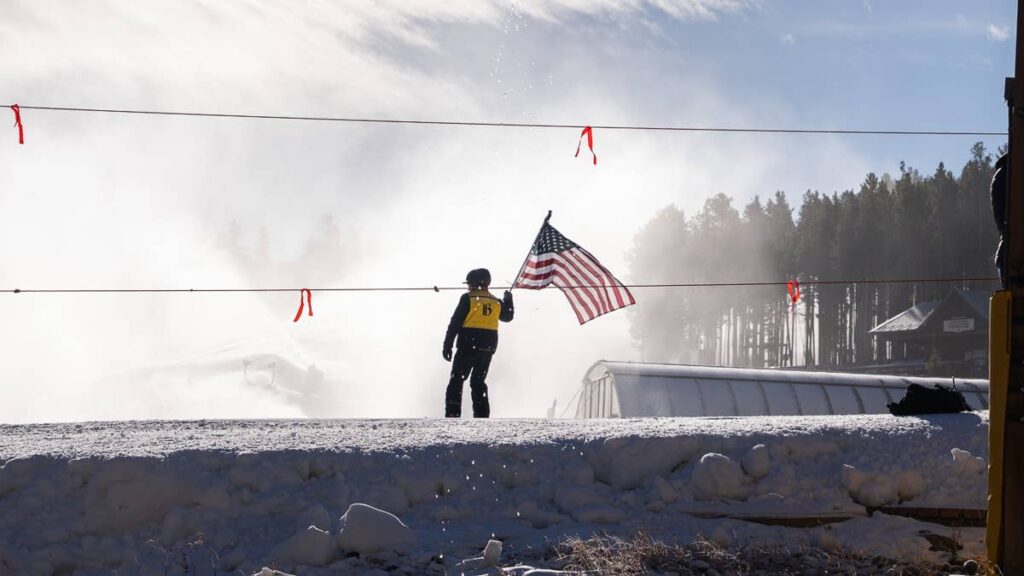
It was poignant as well to see photographs of early forays into skiing on abundant snow, when so many areas are now grappling with its lack. Aiming to make the most of the remaining time I had in it, I grabbed my skis and took a shuttle from the Fairmont to Banff Sunshine Village, another of the three area resorts. A high-speed gondola carried me up to the lifts and trails, where I got expansive views of both Alberta and British Columbia. The built world dropped away, leaving only gray clouds and white peaks. The snow, again, was perfectly powdery on the groomed slopes. I could have taken the gondola back down to the shuttle-bus stop when I finished, but I skied the three miles instead. I wanted to prolong winter’s end.
A version of this story first appeared in the December 2026 / January 2027 issue of Travel + Leisure under the headline “In Search of Snow.”
Read the original article on Travel & Leisure
Source link