

Brig Gen Hubert Rees commanded the advance of the pals battalions – fellows who had joined up together from Accrington, Sheffield, Chorley, Bradford, Leeds and the rest – as they attacked up the slope towards the village of Serre, about 20 minutes north of Albert. It was 7:30am on July 1, 1916. On this, the first morning of the Battle of the Somme, the pals walked – for they had no reason to run. A seven-day artillery barrage had softened up the German defences at the top of the hill. Except it hadn’t. Targets had been missed. The Germans were little-scathed, and ready. Their heavy machine guns cut down the pals “like swathes of corn”, according to a German infantryman.
Yet, said Rees: “Not a man wavered, broke ranks or attempted to go back. [I could never have] imagined such a magnificent display of gallantry, discipline and determination.”
These were lads from factories, mines and the land. It is salutary to stand where they stood, walked and died: 2,000 were killed in under an hour. It is perhaps even more salutary than usual to do so in this 110th anniversary year – when it occasionally appears, in both France and Britain, that the lunatics are sabotaging the asylum.
There were 57,470 British and Commonwealth casualties on day one – Getty/The Calne Collection/Popperfoto
The reasons for a visit to the Somme battlefields are, thus, manifold. November 11 brings them into focus. This was the bloodiest battle of the war, with 57,470 British and Commonwealth casualties on day one. At Serre, and everywhere else along the 20-mile Somme front, the memories of young, and not so young, men still hallow a mainly flat, hedgeless landscape.
Advertisement
Advertisement
They died, if not for us, then for their mates and in the name of our country. And they suffered. That elevates them above any individual failings into a pantheon vital to the narrative of the nation. Every man demands to be honoured, for the contrary would be unthinkable.
Monuments, museums and graveyards – there are 410 British and Commonwealth cemeteries in the Somme sector alone – punctuate farmlands once smashed to smithereens by millions of shells, now prosperous with beetroot. (Though farmers are still turning up shells, and human bones, as they plough. They will be doing so for decades to come.)
It has been said that monuments co-opt the killed (or “fallen”, in war-speak) to the cause of the national glory that underpinned the conflict in the first place. It has also been said that this is nonsense, not least by a Canadian veteran I once met. “I was close to this kind of s— in Bosnia,” he said. “Memorials are thank-yous. These guys did it. They lived it. They died. We say ‘thank you’. It’s that simple.”
And anyway… What else could have been done? Epic grief needed epic expression, as did the unparalleled impact of the war on so much and so many. Unesco agrees. The organisation added 139 Western Front funerary and monumental sites in Belgium and France to its World Heritage list in 2023.
The Historial de la Grande Guerre museum presents a comprehensive picture of the war – Getty/Godong/Universal Images Group
A visit is, then, an opportunity to brush against a certain nobility. There is irony, too, in the fact that the battlefields – apocalyptic 110 years ago – today engender calm, respect and friendliness among people. In few other places is politeness so universal.
Advertisement
Advertisement
In his 1928 memoir, Undertones Of War, Edmund Blunden wrote of the Great War soldiery: “It is time to hint to a new age what your value was, what your love was.” Some 110 years on, the Somme may still do this. It should serve us well.
This is not the place to tell the story of the battle. It is, rather, to suggest a few sites that, for me, fill in the story usefully and poignantly. Should you care to follow, this may be the most moving trip you’ll ever make.
Lochnagar crater
The Lochnagar crater was the result of explosives placed under German positions by the British – Ashley Cooper
The most colossal hole on the Western Front – 71ft deep, 330ft across – was created by the British Army’s 179th Tunnelling Company digging under German lines to blast the enemy to high heaven. Some 27 tons of ammonal explosives did the job at 7:28 on July 1, 1916 – thus, effectively, kicking the battle off with the biggest conceivable bang.
Similar but smaller sites have been filled in for farming. The Lochnagar has survived thanks latterly to the British site owner, Richard Dunning, and volunteers of the Friends of Lochnagar. They keep the place accessible – there’s now a wooden walkway around the 300m circumference – and the memories alive. The on-site Armistice Remembrance Ceremony at 11:45 on November 11 is livestreamed for all.
What to visit
Péronne
A 13th-century castle was turned into the Historial de la Grande Guerre museum – Alamy/Maurice Savage
Key thing in this hard-bitten battle-front town – 90 per cent destroyed during the war – is the Historial de la Grande Guerre, one of the most complete museums of the First World War. A contemporary building tacked on to what’s left of a 13th-century château, it tackles not only military matters but also the cultural and social impact on all three major protagonists. The rounded picture is engrossing, fleshed out by a terrific choice of war material, both army and civil (comics, games, ration books, newspapers). There’s coverage, too, of how the post-war period panned out. Among standouts is a complete set of Otto Dix’s Der Krieg etchings – perfectly savage in their portrayal of savagery. I’d consider starting any visit to the Somme battlefields here (£8.30 – or £10 for a joint ticket, Grande Guerre and Thiépval museums).
Beaumont Hamel Newfoundland Memorial
A great bronze caribou has been placed where the 820 men of Newfoundland set out at 9:15am on July 1, 1916 – iStock/Fabio Lavarone
The great bronze caribou up on its rock announces the colour: this is where the 820 men of Newfoundland set out at 9:15am on July 1, 1916. They were heading for enemy lines more than 500m away. The Germans shouldn’t have been ready, but were. Barbed wire was blocking the advance. The Newfoundlanders were slaughtered. Only 68 were present for roll call the following day. As a British officer said: “It was a magnificent display of trained and disciplined valour, and its assault only failed because dead men can advance no further.”
Advertisement
Advertisement
The site is exceptional. It retains bomb craters and trenches left untouched after the war. The twisted skeleton of the Danger Tree – a killer reference point in the middle of no man’s land – still stands. On hand are young Canadian volunteers who will walk and talk you through the experience.
You’ll then need lunch. Make for nearby Auchonvillers and the Ocean Villas tea rooms, where, in a converted Picardy farmhouse, Avril Williams has effectively been Britain’s ambassadress to the Somme for decades. She and her family don’t make too many concessions to Frenchness, serving ham, egg and chips; sausage, egg and chips; or egg and chips for around £7. It’s a delight; there’s accommodation on-site, and Avril is inexhaustible about the Somme battlefields (double B&B: £86).
Thiépval
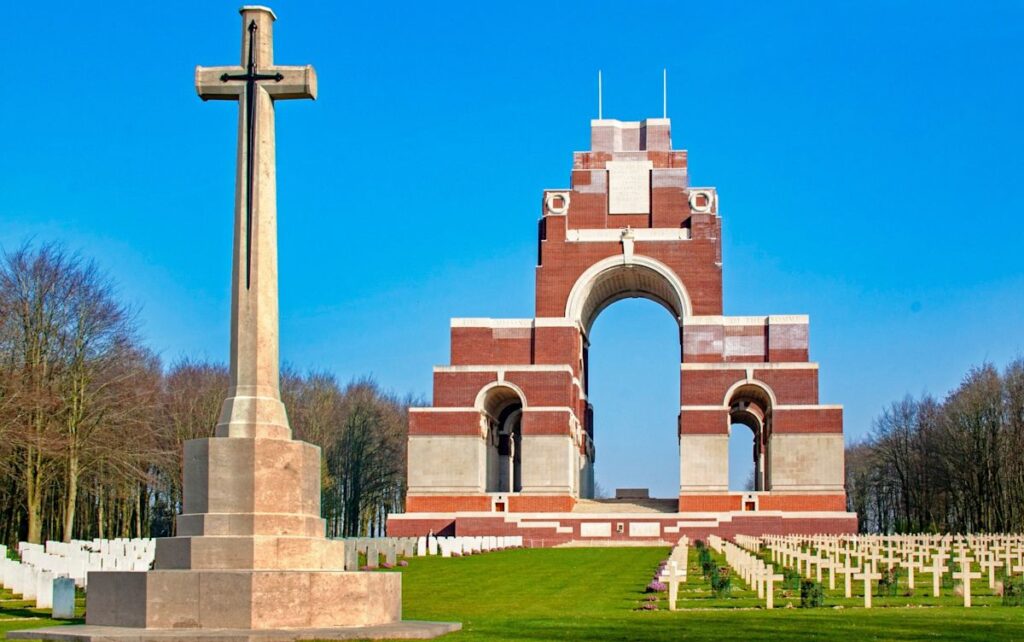
The columns beneath the Thiépval memorial’s arches bear the names of tens of thousands of British and South African soldiers of the Somme with no known graves – Ashley Cooper
Edwin Lutyens’s vast complex of interlocking arches is the major British memorial on the Somme. It is both monumentally brutal – an angry fist shaking at the sky – and diabolically effective. The 16 columns bear the names of 72,301 British and South African soldiers of the Somme with no known graves. I have seen grown men cry, and rowdy teenagers silenced, as they approached the work across the grass. Lutyens’s aim, apparently, was a monument balancing triumph and commemoration. I’d say he got it right.
Beyond, the cemetery hosts 300 French and 300 British graves, symbolising the joint sacrifice on the Somme. The Cross of Sacrifice itself stands at the end of the cemetery, before a patch of rough grass. This grows along what was the 1916 German front line. Back by the car park, the visitor centre has a museum effective not least for a Bayeux Tapestry-inspired 61m fresco of the battlefield as it was on July 1, 1916.
A Bayeux Tapestry-inspired fresco shows the Somme battlefield as it was on July 1, 1916 – Getty/Sylvain Lefevre
Nearby, you should pause at the 21m Ulster Memorial Tower – a copy of Helen’s Tower back home in Northern Ireland – mostly to pay homage to the 5,500 Ulster casualties on July 1 but also to visit the museum and (this is real life) have a cup of tea at the on-site café.
Advertisement
Advertisement
Nearby, too, is Pozières, wiped out in summer 1916 to a greater degree than any other village on the Somme. It has been put back together unremarkably in brick. It is now home to 263 people, hard work and little to suggest that the village name tolls gravely through Commonwealth history, notably in Australia. From shortly after midnight on July 23, the Aussies were hurled at the Pozières and its little ridge. They succeeded, but it took a fortnight and thousands of casualties.
Further assaults on Mouquet Farm (“Moo-Cow farm”, in Australian) added to the death toll. The first important Australian victory on the Western Front came at a hellish price. You might stop before the memorials in and around the village, and realise why Australians are so popular around here.
Sheffield Memorial Park
Sheffield Memorial Park still bears traces of trenches and shell holes – Alamy/David Crossland
Here we bump into the pals at the most northerly point of the main July 1 attack. The park is a wooded area off the main road 600m out of the village of Serre, down a farm track. (Don’t, for heaven’s sake, drive the track; the local farmer goes ape. Use the new parking area just beyond the track’s entrance.) The park bears traces of trenches and shell holes. Its cemeteries and memorials are a punch to the emotions, notably of northerners.
Here’s a memorial in brick (obviously) to the Accrington lads and another to Sheffield fellows. The Barnsley men have a black granite item, and those from Chorley – once my neighbours in time and place – a plaque reading: “Where larks sing and poppies grow / Sleep in peace for ever more.” Which is the sort of thing you say when words are inadequate.
Delville Wood, Longueval
The Delville Wood memorial pays tribute to South African troops – Getty/Flament AS/Andia/Universal Images Group
The monumental memorial, grand enough to be the parliament of a smaller nation, testifies to the intense valour of South African troops ordered to take, and hold on to, Delville Wood. Of the 3,153 men who set out on July 15, only 780 were still standing a few days later. “Their ideal is our legacy, their sacrifice our inspiration,” reads the memorial’s legend. It would be good to think this was true.
Advertisement
Advertisement
Around about, oak and birch trees grown from acorns and seeds from South Africa flank greensward pitted by shell holes now grassed over, like the world’s most hazardous pitch-and-putt course. As in all former hell-fire sites, the calm here is heavy and palpable. I am moved to stillness every time I visit. So it goes for all the sites. It may be that past devastation presently brings out the best in us.
Where to stay
The Les 3 Luppars hotel (second from left) sits on the Grand’Place in Arras – Hemis / Alamy Stock Photo
I’d favour Arras, around 30 minutes from key Somme sites. With its two grand arcaded squares and multiple bars and restaurants, it’s a convivial place to retreat to after a day of remembrance. The town also, of course, has its own Great War stories, but they are for another time. Try Les 3 Luppars, a 15th-century Flemish Gothic pile bang on the Grand’Place (doubles from £67).
Try full access to The Telegraph free today. Unlock their award-winning website and essential news app, plus useful tools and expert guides for your money, health and holidays.
Source link