

I’d come to Trøndheim for its Viking history, but I was equally curious about its growing reputation as Norway’s food capital. What better way to start than with a bowl of bacalao?
A bowl of bacalao at Krambua Restaurant
The dish itself is uncomplicated: salted cod with potatoes, tomatoes, onions, olive oil and chili. But bacalao has a fascinating history. Norwegian klippfisk has been traded for centuries, with salted cod travelling to markets all across Southern Europe. And while the word bacalao comes from the Spanish word for cod, the Norwegian version has become a beloved staple dish. At Krambua Restaurant, in the heart of Trondheim, the bacalao was delicious, and a fitting introduction to a region whose food culture is deeply connected to both the sea and its trading history. But there was plenty more to discover.
A Taste Of Trøndelag
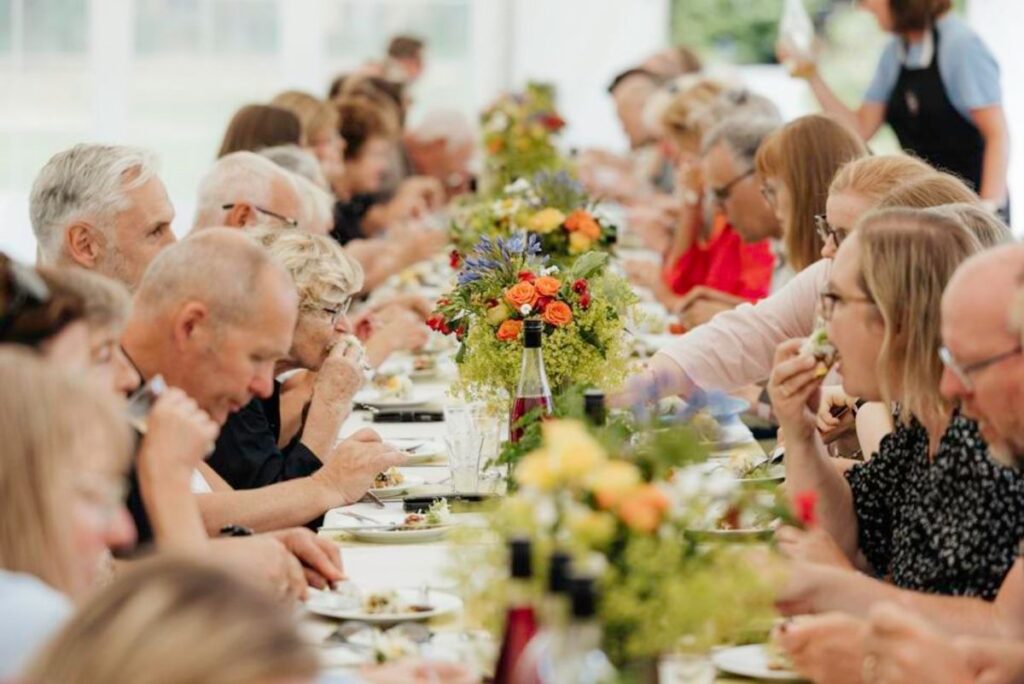
Trøndheim’s reputation as Norway’s food capital owes much to its surroundings. The wider Trøndelag region is one of the country’s most productive agricultural areas, with fertile farmland, a rich coastline and an impressive collection of farmers, fishermen, dairies, bakeries and independent food producers. I got my first real taste of this at the annual Trøndelag Food Festival (Trøndersk Matfestival), which brings more than 200 local producers and 30 breweries into the city center.
The annual Trøndelag Food Festival (Trøndersk Matfestival) brings more than 200 local producers and 30 breweries together.
The unconventional but delicious bacalao pizza.
I spent hours wandering between stalls, sampling everything from cheese and freshly baked bread to seafood, meats, fruit and local drinks. What struck me most was the creativity. Traditional Norwegian ingredients were being used in all sorts of unexpected ways. One of my favorite discoveries was bacalao pizza. Having started my trip with a bowl full of this traditional dish, I was curious to sample this rather unconventional version. Surprisingly, it worked beautifully. The tomato-based sauce and salty cod made perfect pizza toppings, and it was a great example of how local food traditions continue to evolve.
The Trøndelag Food Festival (Trøndersk Matfestival) is an annual event, bringing together more than 200 local producers and 30 breweries, from all across the region
Advertisement
Advertisement
I also loved meeting the people behind the products. Many of the stallholders were the farmers, fishermen, bakers and cheesemakers themselves. Being able to chat with them gave me a much better understanding of where the food came from and the people responsible for producing it.
From Street Stalls To Fine Dining
After spending the day sampling my way through the food festival, perhaps sitting down for a five-course meal might sound excessive. But that was exactly what I wanted.
At Troll I saw how a restaurant could put Norwegian ingredients together across a complete meal ̶ fried cod tongue, grilled halibut, reindeer steak, braised pork cheeks, seared duck heart. A menu built entirely around Norwegian produce, but with a contemporary twist. Despite the sophisticated presentation the food never lost its connection to the ingredients.
While the menu at Troll changes with the seasons, it is built entirely around Norwegian produce.
Discovering Hitra And Frøya
By now, I had a much better appreciation of Trøndheim’s food scene, but I wanted to understand where so many of those wonderful ingredients had originated from. So I headed west, to the islands of Hitra and Frøya, where much of the region’s seafood and agricultural produce is sourced.
Advertisement
Advertisement
Our first stop was Hotel Frøya, particularly known for its breakfasts. While I’m not usually much of a breakfast person, this was next level! There was such an impressive selection of local produce that I found myself returning to the buffet far more times than I’d like to admit! It was a wonderful introduction to the food being produced here in the islands.
Nybakt Bakeri og Spiseri, an artisanal bakery specialising in sourdough and traditionally fermented breads.
On Hitra, I called in at Nybakt Bakeri og Spiseri, an artisanal bakery specializing in sourdough and traditionally fermented breads. There was also a mind boggling selection of sensational pastries. I spent some time chatting with owner Siw Hermanstad while sampling her creations. It was a much more relaxed experience than the restaurants in Trondheim, but no less memorable. Sometimes, all you need to understand a place is a really good bakery. I only wish I’d arrived with a little more space in my stomach!
Cheese, Caves And Coastal History
Next came Hitra Gårdsmat, an organic dairy farm and, as far as I was concerned, one of the highlights of the trip. Cheese is probably my favourite ‘food group’, so the opportunity to learn about local cheesemaking and sample the finished products was particularly appealing.
Hitra Gårdsmat, an organic dairy farm with amazing cheese.
Hitra Gårdsmat, an organic dairy farm with amazing cave aged cheeses.
The farm’s specialty is a cave-aged cheese, which was every bit as delicious as it sounds. But what made the visit extra special was seeing the entire process. I met the cows, saw the milking, watched how the cheese was made, visited the cave where it was aged and, naturally, finished up in the farm shop. It was a lovely example of what eating locally really means. There was no disconnect between the land, the animals, the producer and the food on the plate.
Advertisement
Advertisement
After a day exploring the islands, I ended up at Hopsjøbrygga, a historic trading post on Hitra that was once a general store and is now a popular restaurant. It was easy to imagine the role places like this one had once played in Norwegian coastal life, before roads, tunnels and modern connections had linked the islands to the mainland. Though I was actually here for yet more food… dinner.
The restaurant was lively and filled with locals, there was a band playing and the meal itself was one of my favourites on my trip. Hjemmelaget gravlaks (traditional home-cured cured salmon), tender lamb shank from the ancient, hardy coastal breed of Norwegian wild sheep, known as villsau or gammel norsk sau, that we’d seen as we traversed the islands, and finally a crème brûlée served with caramelized apples that grew here on the island. There was something special about eating in a place where so much of the island’s history still felt present, and so much of its produce was represented on the menu.
Food With a Social Purpose
At DalPro, also on Hitra, the focus is as much on people as it is on food. We wandered around the farm, met some of its animals, including the deer and wild sheep, and got a glimpse of the work DalPro does to provide training and adapted employment for people who struggle to enter the traditional workplace and need extra physical, mental or emotional support. It was a reminder that the local food industry is about more than simply producing good ingredients. It can also create opportunities and bring communities together.
Smaker fra Øyriket is a collaboration of local food producers across the islands of Hitra and Frøya
Then came lunch, courtesy of Smaker fra Øyriket, a collaboration of local producers across Hitra and Frøya, who between them produce everything from craft beer to smoked salmon and trout, crab, lamb, organic fruit, herbs and vegetables, pickles and juices. After days of meeting farmers, fishermen and food makers, Smaker fra Øyriket felt like a moment when all those threads came together.
Garnvik on Frøya Island smoke and cure salmon, trout, and herring.
Smaker fra Øyriket is a collaboration of local producers across the islands of Hitra and Frøya, who between them produce everything from craft beer to smoked salmon and trout, crab, lamb, organic fruit, herbs and vegetables, pickles and juices.
The meal really brought the islands to the table: local ingredients, local producers and wonderful fresh flavors. After several days of meeting individual producers, it was wonderful to see their products brought together in one meal.
One Last Dinner By The Sea
My final meal on Hitra was at Brygga Restaurant, overlooking the sea in the fishing village of Kvenvær. With close relationships with local fishermen and farmers, the restaurant keeps its menu firmly rooted in its surroundings, with fish and shellfish taking center stage.
Working with local fishermen and nearby farmers, Brygga restaurant makes a point of keeping their dishes closely tied to their location.
Advertisement
Advertisement
Brygga in the fishing village of Kvenvær, work with local fishermen and nearby farmers, making a point of keeping their dishes closely tied to their location.
By this point, I’d eaten my way through traditional bacalao, bacalao pizza, gourmet tasting menus, award-winning breakfasts, artisan breads, cave-aged cheese and some wonderful island produce. This final dinner brought everything together.
The fishing village of Kvenvær
Looking out across the water, I thought about what it was that had made this journey so enjoyable. Trøndheim may have the restaurants, the chefs and the food festival, but its culinary identity stretches far beyond the city itself. It belongs just as much to the farmers, fishermen, bakers, cheesemakers and small producers scattered across the surrounding countryside and coastline.
The waters around Hitra Island
If I’d arrived in Trøndheim curious about its reputation as Norway’s food capital. I left understanding why it deserves the title, and perhaps more importantly, I’d discovered that the best way to experience this part of Norway is to follow the food well beyond the city limits.
This article was originally published on Forbes.com
Source link