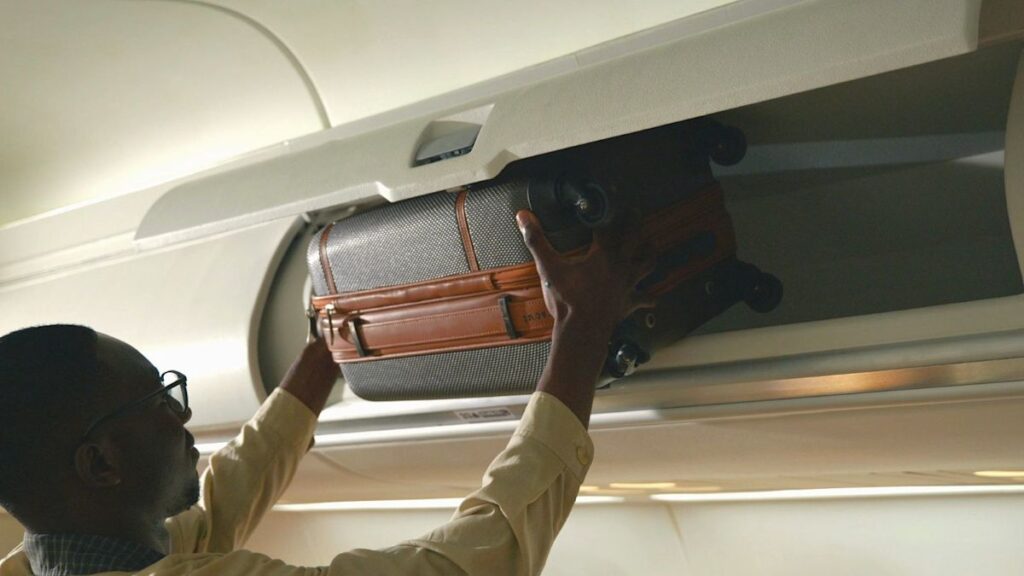


Boarding can grind to a halt over one suitcase. A traveler stops to unzip a bag, a coat consumes half a compartment, and the line behind them loses patience. Overhead bins are shared storage with airline limits and unwritten courtesies. Avoid these seven mistakes if you want your carry-on stowed without becoming the cabin’s opening act.
Repacking in the Aisle
Boarding is the wrong time to search for headphones, medication, or a charging cable. Take out what you need before joining the line, then move out of the aisle as quickly as the space allows. Flight attendants told Condé Nast Traveler that more passengers searching for bin space can delay when everything is stowed, and the aircraft door can close.
Photo credit: sinenkiy, Depositphotos.
Ignoring the Bag Sizer
Carry-on limits change by airline. American caps a standard carry-on at 22 by 14 by 9 inches, including handles and wheels. Southwest allows 24 by 16 by 10 inches, again counting wheels, handles, and attachments. Measure the suitcase you will use, not the dimensions printed on an old product page, and check the operating airline’s rules before leaving home.
Using Bin Space for Small Items First
Putting a purse, small backpack, and coat overhead before larger bags are settled uses space other travelers may need. American says a qualifying personal item belongs under the seat in front of you. Flight attendants also advise holding coats and smaller belongings until boarding is complete, then using leftover space if the crew permits it.
Claiming the Bin Above Your Seat
The compartment above your row is convenient, but it is not universally treated as an assigned locker. Flight attendants told Travel + Leisure to use nearby space when necessary and ask the crew for help instead of turning a storage problem into a passenger dispute. Keep your bag near your seat when possible, but do not move another traveler’s belongings without permission.
Bringing a Bag You Cannot Lift
Don’t pack an ordinary carry-on assuming a flight attendant will raise it for you. Delta says its flight attendants can’t proactively help place carry-ons in overhead bins, with certain exceptions, partly to reduce injuries from repetitive lifting. Pack within your own safe lifting ability or check the bag before boarding.
Boarding Before Your Group Is Called
Boarding early to capture bin space undercuts the order printed on everyone else’s pass. American’s current airport guidance says it boards in groups and tells travelers to check their boarding pass for the assigned group. Wait until that group is called unless a gate agent specifically directs you to board earlier.
Fighting a Gate Check
A compliant carry-on is still not guaranteed overhead space on every aircraft or full flight. Delta says a bag that does not fit, or one caught by an exceptionally full flight, may be checked at the gate. Cooperate with the crew, but first remove spare batteries, electronic cigarettes, and any other item the airline prohibits in checked baggage.
Shared Space Rewards Flexibility
A carry-on is more than a size calculation; it also promises you can move through boarding without turning shared space into a negotiation. The more flexible you are about where the bag lands or whether it must be checked, the less likely a crowded cabin is to become a conflict.
Source link