

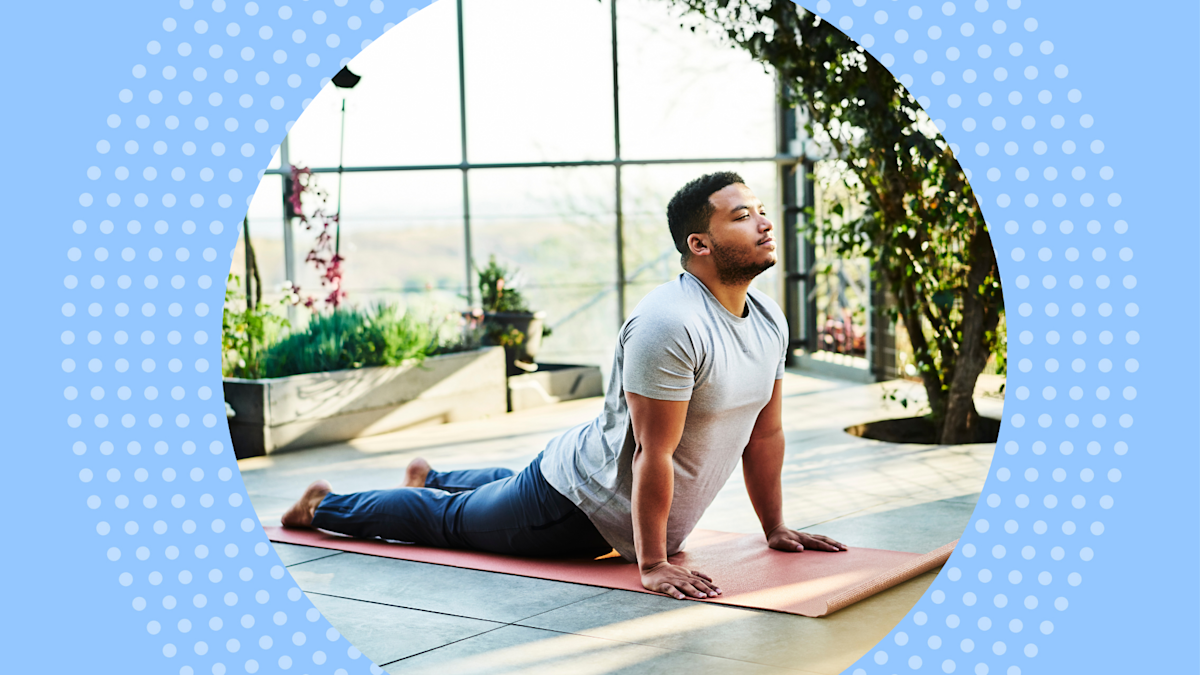
Back pain is the uninvited guest that can ruin your day, whether you’re just rolling out of bed or sitting at your desk. If your back hurts, you’re not alone — roughly 16 million adults in the US live with persistent pain that disrupts their daily routine. The idea of doing yoga when you can barely tie your shoes might seem impossible. However, performing the best yoga poses for back pain isn’t about fancy flexibility tricks. Research suggests that focusing on simple alignment and stability can help you move better and hurt less. “Yoga is really effective for general low-back pain that’s caused by muscle tension, poor posture or stress,” says Timothy Burgin, a RYT 500 yoga teacher and founder of YogaBasics. “When practiced consistently and appropriately, yoga helps stretch tight muscles around the spine, strengthen the core and improve movement patterns that often contribute to pain.”
That said, not all back pain — or yoga — is the same. And pushing into the wrong poses or moving too aggressively can make symptoms worse rather than better. Alicia Dugar Stephenson, an E-RYT 500 yoga teacher at Rice University who focuses on back pain relief and accessible movement, says she starts with proprioception, or self-awareness. In other words, noticing not just where pain is the loudest, but what the body feels like at rest and which movements bring relief rather than resistance.
“Our backs are so important to how we show up in this world, so if we’re feeling stress in our lives, we can experience a parallel effect in our bodies,” Stephenson adds. “For both stress and tension, gentle yoga can subconsciously remind our bodies that rest is good and necessary, giving yogis a chance to slow down from our multitasking, over-productive, hustle and bustle lifestyles.”
For some, back pain can show up as sciatica. Too much time at a desk can leave your lower back and hips feeling compressed and tight and the discomfort can creep down the back of your legs. As a yoga instructor myself, I know that yoga won’t fix all these problems overnight, but it helps in a very real, practical way — by getting things moving again. Gentle poses that stretch the hips and hamstrings and encourage the spine to lengthen, make it easier to stand up and go about the rest of your day without constantly thinking about your back.
To help you start developing flexibility through the spine, hips and hamstrings, I’ve put together five gentle, back-friendly yoga poses that emphasize slow movement, support and control. Each can be modified with props and adjusted to meet you where you are — whether you’re brand new to yoga or easing back into movement after an injury or long break.
Marjaryasana–Bitilasana (Cat—Cow Pose)
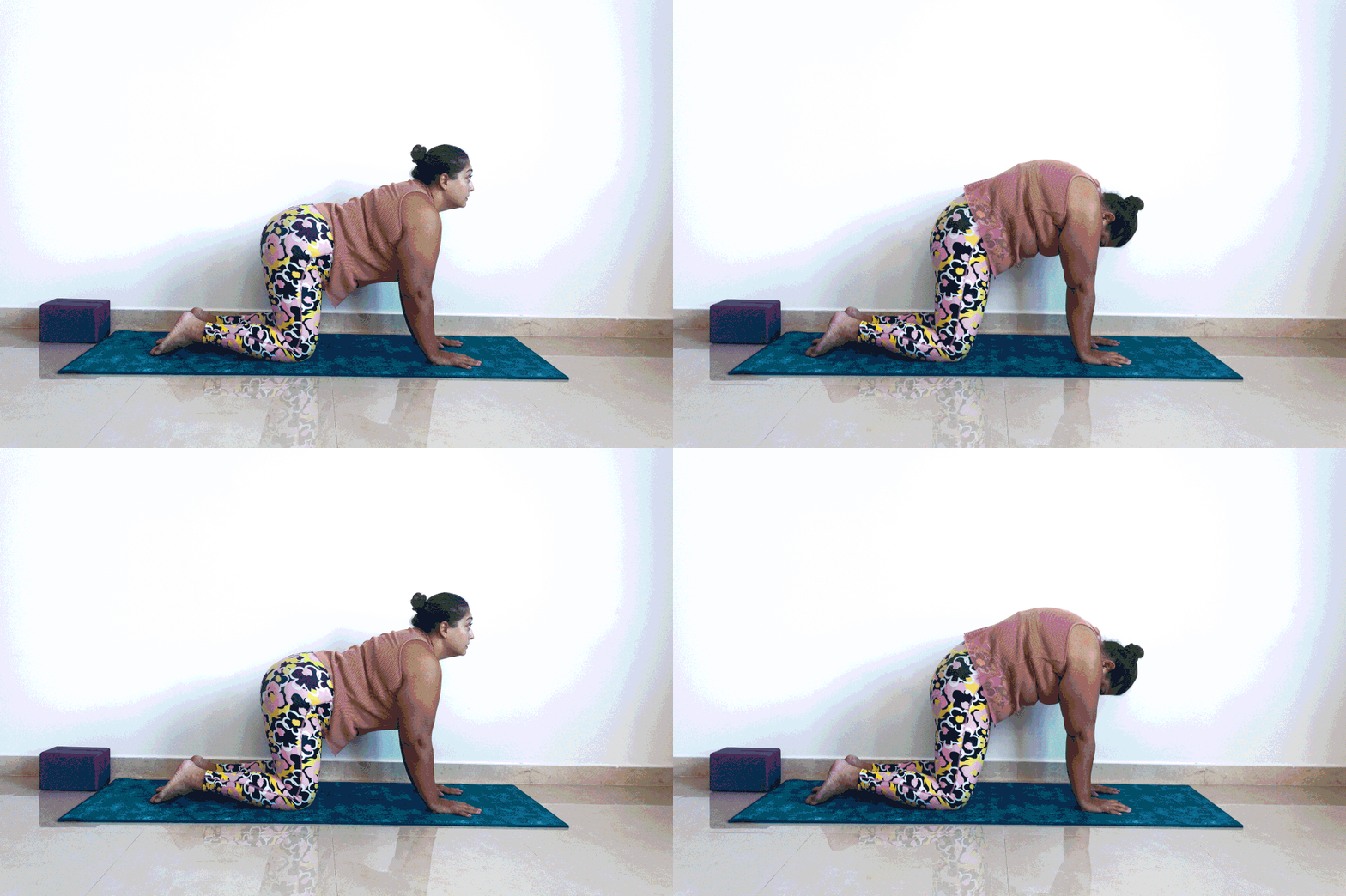
Remind your spine how it’s meant to move with the cat-cow pose. Just make sure to take it slow.
The secret to this pose is focusing on the quality of your movement rather than the depth of the arch. When you move slowly and stay within a comfortable range, Cat-cow reduces stiffness and gently warms up the muscles that protect your spine.
How to do it
-
Start on your hands and knees in a tabletop position, with your wrists stacked under your shoulders and knees under your hips. If your wrists feel sensitive, place a folded blanket under your palms or make fists instead.
-
Let your spine settle into a neutral position — not rounded or arched.
-
As you inhale, gently tilt your pelvis forward and allow your belly to soften toward the floor. Lift your chest slightly and let your collarbones widen. Keep your neck long and your gaze forward.
-
As you exhale, slowly tilt your pelvis back and round your spine, drawing your navel gently toward your spine. Let your head and neck follow the movement naturally, with your chin moving to your chest.
-
Flow back and forth between these two shapes for 5 to 10 slow rounds. Inhale as you lengthen your spine and exhale as you round your back. Keep the movement fluid and controlled rather than jerky.
Setu Bandha Sarvangasana (Supported Bridge Pose)

This pose helps counter the hip-shortening effects of prolonged sitting without requiring you to hold yourself up in the position.
Supported Bridge pose offers a gentle way to open the front of your body and encourage spinal extension without straining your muscles. A block or bolster will be your best friend in this variation, counteracting the effects of prolonged sitting and relieving tension in the lower back and hips.
How to do it
-
Lie on your back with your knees bent and feet flat on the floor, about hip-width apart. Place your arms alongside your body, palms down.
-
Walk your heels back so they’re close enough to your hips that you can comfortably touch them with your fingertips.
-
Press gently into your feet to lift your hips just enough to slide a yoga block, bolster or firm pillow under your sacrum — the flat, bony area at the base of your spine.
-
Lower your hips onto the support and let your bodyweight rest there. Your glutes and legs should be relaxed — this pose is meant to be supported, not held with effort.
-
Adjust the support height as needed. A lower height is often more comfortable for sensitive backs.
-
Let your chest gently lift as your shoulders soften toward the floor. Breathe slowly and evenly for 5 to 10 breaths, or longer if it feels comfortable.
-
To come out of the pose, press lightly into your feet, lift your hips just enough to remove the support, then slowly lower your spine back down to the mat.
Paschimottanasana (Chair-Supported Seated Forward Bend)

If a standing forward fold is too stressful for your back and hamstrings, this is a more comfortable alternative.
A chair-supported forward bend allows you to stretch tight hamstrings and ease tension along your spine. It provides all the value of the classic pose without forcing your lower back to work too hard.
How to do it
-
Sit at the front edge of a sturdy chair with your feet flat on the floor, hip-width apart. Press down through your soles to ground yourself.
-
Place your hands on your thighs and sit tall to let your spine lengthen naturally.
-
Inhale to lift your chest and lengthen your back.
-
Exhale and hinge forward from your hips while keeping your spine straight. Think about tipping your torso like a plank rather than rounding your back.
-
Rest your hands on your thighs, shins or blocks placed in front of you. Only fold as deeply as feels comfortable.
-
Relax your neck and look down at the floor.
-
Take 5 to 10 slow breaths and allow your lower back soften without forcing the stretch.
Supta Padangusthasana (Strap-assisted Reclined Hand-to-Big-Toe Pose)
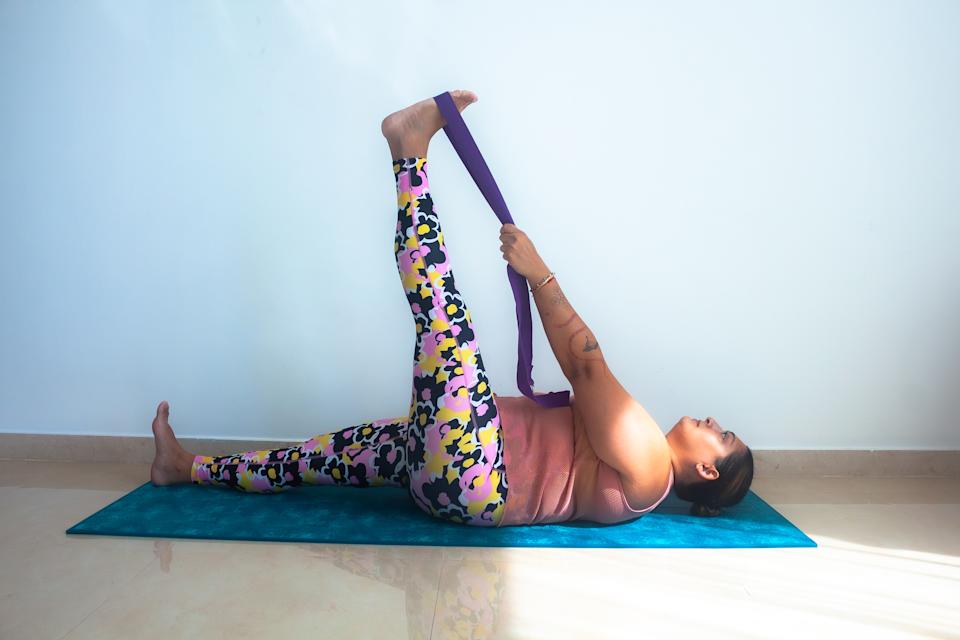
Tools like yoga straps can help make many stretches feel more accessible.
Tight hamstrings often contribute to back discomfort, especially for people who sit for long periods. Using a yoga strap in supta padangusthasana allows you to address that tightness while keeping your spine fully supported by the floor.
How to do it
-
Lie on your back with both legs extended, your arms resting alongside your body.
-
Bend your right knee toward your chest and loop a yoga strap around the ball of your right foot. Hold the ends of the strap in each hand.
-
Extend your right leg toward the ceiling, keeping a slight bend in your knee if your hamstrings feel tight.
-
Keep your left leg extended on the floor. If your lower back arches or feels uncomfortable, bend your left knee or place the foot flat on the floor for support.
-
Allow your shoulders, head and neck to relax on the mat. Keep your pelvis neutral and grounded. Avoid lifting the hips or pulling the leg closer than feels comfortable.
-
Take 5 to 10 slow breaths, noticing the stretch along the back of the leg without forcing it.
-
Gently bend the right knee, release the strap and switch sides.
Salamba Bhujangasana (Sphinx Pose)

This pose is a gentle first step on the way to deeper backbends.
Sphinx pose is a gentle backbend that encourages spinal extension without the intensity of deeper backbends like Cobra or Upward-Facing Dog. The emphasis here is on creating space and length through the front of the body, not pushing into a deep arch.
How to do it
-
Lie on your stomach with your legs extended behind you, the tops of your feet resting on the mat about hip-width apart.
-
Place your forearms on the floor, elbows stacked under your shoulders and your palms pressing gently into the mat.
-
As you inhale, lightly press into your forearms to lift your chest. Keep your pelvis, thighs and the tops of your feet grounded on the mat.
-
Soften your shoulders and roll them down your back to create space away from your ears. Broaden across your collarbones to keep your chest open and lifted.
-
Keep your neck long and your gaze forward. Stay here for 5 to 10 slow breaths, paying attention to how your lower back feels.
-
If you feel compression or discomfort in your lower back, try moving your elbows slightly forward to reduce the intensity or place a folded blanket under your chest for extra support.
Helpful yoga tools if you have back pain
“Back pain almost always involves protective muscle guarding,” says Sita Severson, a certified RYT 500 yoga therapist and educator. “When the body feels vulnerable, muscles tighten to protect the spine. Thoughtful, supported yoga helps reduce compression and creates enough safety for those muscles to release — not because you force them to, but because the body no longer feels the need to guard.”
I always teach my students that yoga props aren’t shortcuts but tools to help make poses safer and more accessible, especially if you’re dealing with back pain, tight hamstrings or limited mobility. That mindset is echoed by Stephenson, who emphasizes that tools can entirely change how a pose feels. “Props change the way that we experience poses by allowing benefits to be more accessible — sometimes even more enjoyable than without them.”
Whether you practice online or go to a yoga studio, your yoga practice will benefit from having the following yoga props on hand:
Yoga strap
If your hamstrings are particularly tight, a yoga strap can make stretches more accessible while keeping your spine supported. “Straps allow hamstring stretching without rounding the spine, helping reduce postural dysfunction,” Severson says. This is especially helpful in reclined poses like Supta Padangusthasana, where maintaining a neutral spine matters more than how far the leg lifts.

Manduka
If you don’t have a yoga strap available, Yahoo Health’s senior editor, Laura Williams, who also happens to be a 200-hour yoga instructor, says you can use a towel or belt in a pinch. But if you’re interested in purchasing a prop designed for the purpose, she’s a fan of Manduka’s AligN strap, which is available in 8- or 10-foot lengths and includes a secure buckle that offers more options when it comes to personalizing your poses.
$22 at DICK’S Sporting Goods
Yoga block or bolster
For people who find sitting or folding on the floor uncomfortable, yoga blocks and bolsters can dramatically reduce strain on the lower back by bringing the floor closer to you. They also do a great job at tilting the pelvis into a more neutral position, making seated poses feel supported rather than stressful.
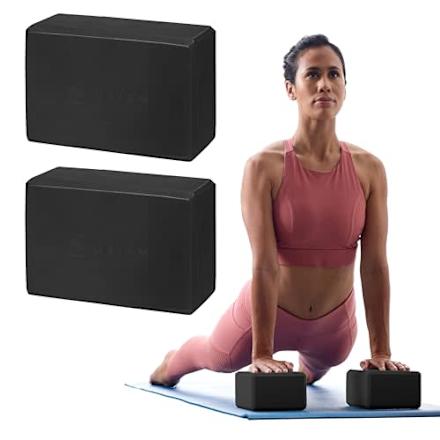
Gaiam
Additional items you have around the house
Stephenson encourages students to rethink how they use everyday objects for support. “One of my favorite things to use to relieve sciatica and low back pain is a couch or a chair,” she says, noting that resting your legs on a chair — similar to a supported legs-up-the-wall variation — can be deeply relieving when held for several minutes. She also points out that blocks can actively support the body, not just prop it up. Bringing the floor closer to you means you don’t have to bend over as far, she says, adding that squeezing a block between the thighs in standing or seated poses can help activate the legs and reduce strain in the back.
FAQs
What type of back pain does yoga help with?
A recent meta-analysis found that yoga tends to be most helpful at alleviating the dull, achy discomfort of low back pain. “Yoga is really great for general low back pain caused by muscle tightness, poor posture, acute strain or stress,” says Burgin. He notes that yoga helps by gently stretching muscles around the spine, strengthening the core and improving movement patterns that often contribute to pain. That said, sharp pain, numbness or pain that radiates down the leg should always be evaluated by your doctor before you start a new workout routine.
Are there any yoga poses I should avoid if I have back pain?
Yes — and this is where being selective matters. Severson explains that deep backbends can increase compression in sensitive spines, while forceful forward folds may worsen disc-related issues if done without support. In short, it’s best to avoid forcing your range of motion beyond what’s comfortable and to prioritize supported, controlled yoga poses that feel relieving rather than demanding. Stephenson adds that people living with ongoing pain may need to relearn how to interpret sensation. “When somebody is living with constant pain, the way that they interact with their body senses has been altered,” she says, which makes moving slowly and paying attention to relief versus resistance especially important.
How often should I do yoga for back pain relief?
Consistency tends to matter more than intensity. “Doing some yoga every day will be the most effective way to [reduce] back pain,” Burgin says, adding that even brief daily sessions can make a difference. “But don’t stress over it — just do as much as you can with your schedule.” From personal experience, short practices a few times a week are often easier to sustain than occasional longer ones, and this is where I see the most difference in my back pain relief.
What’s the best time of day to do yoga for back pain relief?
There’s no single best time — the right time is when you can move without rushing or pushing through pain. Burgin suggests practicing before your back pain typically becomes most noticeable or disruptive. Many people find gentle movement helpful in the evening, when stiffness from sitting all day tends to peak, while others prefer slow, cautious movement in the morning to ease into the day. Stephenson notes that timing matters less than awareness. “It’s crucial to be more attentive than usual to what your body is saying when you do a physical movement practice,” she says, especially when pain has been present for a long time.
Can yoga help prevent back pain?
Yes, yoga can play a meaningful role in prevention, especially when practiced regularly and with attention to alignment — a regular practice allows you to notice how you sit, stand and transition throughout the day. “I’ve noticed that the times when my yoga practice is most consistent are when I experience the fewest issues with back pain,” Burgin says. Stephenson adds that prevention also involves breaking repeated patterns. “Our bodies learn the patterns that we repeat,” she says, noting that long periods of sitting and stress can reinforce tension in the back over time.
Meet our experts
-
Timothy Burgin, RYT 500 yoga instructor and founder and executive director of YogaBasics.com
-
Alicia Dugar Stephenson, E-RYT 500 yoga teacher, yoga instructor at Rice University and teacher trainer at Yoga Queen Academy
-
Sita Severson, E-RYT 500, YACEP, CIAYT-certified yoga therapist, director of the Soul of Yoga Institute
Our health content is for informational purposes only and is not intended as professional medical advice. Consult a medical professional on questions about your health.