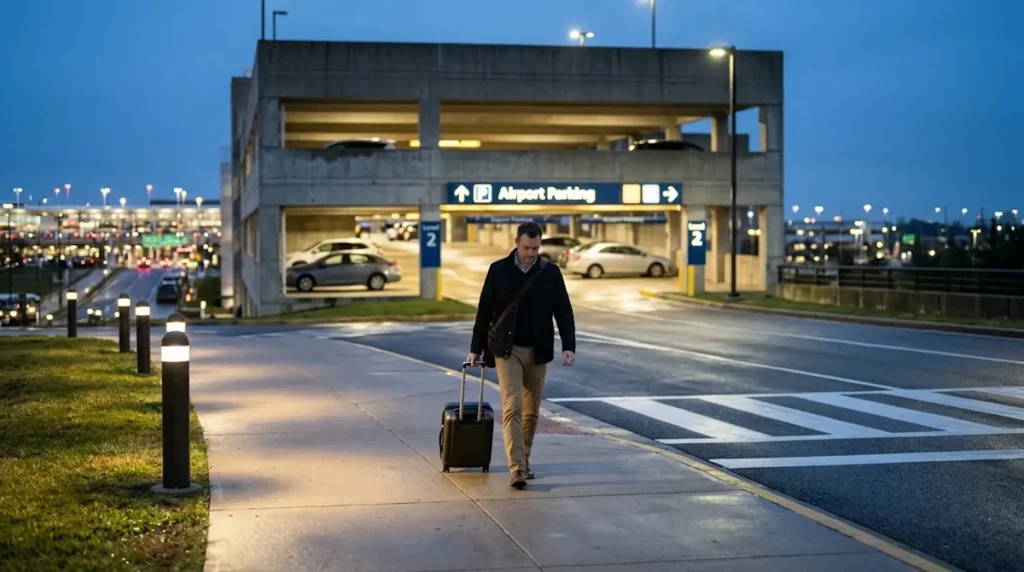


You’ve seen this person. They roll into the airport lot like they own it, never circle for a spot, never pay the drive-up rate, and never stand in the rain wondering where they left the car. The 23 habits below come from lot operators’ own guides and published rates, and they’re what that calm is built from.
Here’s the twist: it isn’t talent. Most weekly flyers learned every one of these the hard way, through a dead battery, a surprise bill or a shuttle that wasn’t running. Some habits are cheap, some are strangely specific, and one comes from a $63,000 car that came home moldy.
#23 – They Never Bet on a Lot They Can’t Reserve
#23 – They Never Bet on a Lot They Can’t Reserve (Image Credits: Gemini)
The cheapest lot is often the one you can’t book. On-airport economy lots usually can’t be reserved, and they fill up during holidays and weekends. Frequent flyers find this out once, usually while circling a full lot with a boarding time ticking.
Advertisement
Advertisement
Most off-site lots and many on-airport valet and garage options do let you reserve in advance. A lot with the lowest sticker price can be the riskiest choice for a Friday-morning flight. Weekly flyers check how a lot works before they ever pull in.
#22 – They Pay the Pre-Book Price, Never the Gate Price
#22 – They Pay the Pre-Book Price, Never the Gate Price (Image Credits: Gemini)
Same lot, same spot, lower bill. At Tampa International, the Economy Garage is $10 a day pre-booked online and $12 at the gate. Weekly flyers book from the couch and skip the drive-up rate.
That’s a small gap per day, but it adds up fast. Pre-booking at TPA saves up to 17% compared with paying at the gate. Do that every week and you’re quietly handing yourself a few hundred dollars back a year. Rates differ by airport, so they check the official site first.
By The Numbers: Discounts of 10–30% are common for travelers who book in advance or use long-term parking programs, depending on the operator and length of stay.
#21 – They Check the Shuttle Schedule Before Booking Anything
#21 – They Check the Shuttle Schedule Before Booking Anything (Image Credits: Gemini)
A cheap off-site lot can turn expensive at 4 a.m. Take two hotels near Dulles. One is about $10 a day with a free 24/7 shuttle, running every 30 minutes from 6 AM to 11 PM and on demand overnight. The other costs about $26 a day.
Advertisement
Advertisement
The pricier one has a gap in service: its shuttle doesn’t run between midnight and 4 AM. Picture a 5 a.m. flight and a shuttle that doesn’t exist yet. Weekly flyers read the fine print on hours, not just the daily rate.
Quick Compare
Hotel A: about $10 a day, free 24/7 shuttle, every 30 minutes from 6 AM to 11 PM, on demand overnight
Hotel B: about $26 a day, but no shuttle between midnight and 4 AM
The catch: the higher price didn’t buy better overnight coverage
#20 – They Back In So the Car Faces Out
#20 – They Back In So the Car Faces Out (Image Credits: Gemini)
Parking nose out looks like a quirk until something goes wrong. A travel columnist once said more travelers he knew had dead batteries at an airport than in any other situation. He blamed interior lights left on in the rush to catch the lot bus.
His fix was simple. Park nose out for easier access to the battery or an easier hook-up to a tow truck. A thirty-second maneuver at the start of a trip can save a long, awkward wait at the end of it. Weekly flyers do it on autopilot.
Advertisement
Advertisement
Why It Works: A car facing out puts the hood in reach of jumper cables. It also lets a tow truck line up without a three-point turn in a cramped row. You pay for it once, when you park.
#19 – They Photograph the Row Sign Every Single Time
#19 – They Photograph the Row Sign Every Single Time (Image Credits: Gemini)
Parking lots are bigger than most people picture. Dulles’s Economy Lot alone holds up to 11,431 vehicles, by far the largest parking facility at IAD. That’s a lot of identical gray sedans to scan after a red-eye.
Weekly flyers snap a photo of the row or level marker before they walk away. Skipping that one tap is how people end up pressing the panic button across a dark lot. It takes five seconds, and they’ve done it enough times to stop thinking about it.
#18 – They Test the Battery Before It Fails
#18 – They Test the Battery Before It Fails (Image Credits: Gemini)
Battery age matters more than most drivers think. If a car is older than about five years and has a weak battery, two weeks can be enough to leave it unable to start. Weekly flyers don’t wait for the warning light.
Advertisement
Advertisement
They get it checked early. One parking operator’s advice is that replacing a weak battery before the trip is far cheaper and less stressful than dealing with a dead one on return. The cheapest fix is the one you make before the flight.
Try This: Many auto parts retailers offer free battery testing. Ask for a test once or twice a year, and again before any trip that’s longer than usual.
#17 – They Carry Their Own Jump Starter
#17 – They Carry Their Own Jump Starter (Image Credits: Gemini)
Waiting for help at midnight is a bad way to end a trip. Parking guides keep making the same suggestion: keep a portable jump-starter in the trunk, which they call small, cheap insurance. Weekly flyers took that seriously years ago.
Some go further and use solar. A solar battery maintainer is a small panel placed on the dashboard that plugs into the OBD-II port or lighter socket, and one guide says to look for a model with a blocking diode so it doesn’t drain the battery at night. A little panel on the dash can be the difference between a quick exit and a call for help. Not every car or lot suits that setup, so they read the manual first.
#16 – They Switch Off the Dashcam Before Walking Away
#16 – They Switch Off the Dashcam Before Walking Away (Image Credits: Gemini)
Your car isn’t really off when you walk away. Dashcams, always-on trackers and Tesla Sentry Mode all draw from the battery around the clock. That’s a quiet drain on a car you’ve already forgotten.
Advertisement
Advertisement
Weekly flyers run a quick mental checklist before they lock up. A gadget meant to protect your car can be the thing that strands it. They check which accessories stay powered and disable what they don’t need.
The Science Behind This: Modern cars have many always-on systems, including keyless entry, the alarm and telematics. Each one sips a little power, and over days that adds up.
#15 – They Check Every Window Twice
#15 – They Check Every Window Twice (Image Credits: Gemini)
The most common unpleasant surprise is wet seats. One parking guide says an unexpected rainstorm is the most common “bad surprise” on return. A window open a fraction of an inch is enough.
It’s an easy mistake in a rush. The same guide tells drivers to close all windows and the sunroof fully at drop-off. A sunroof you thought was shut can let in an entire storm’s worth of water. Weekly flyers check for it every time.
#14 – They Never Leave Home With the Fuel Light On
#14 – They Never Leave Home With the Fuel Light On (Image Credits: Gemini)
Nobody plans to run out of gas on the way home. Still, one airport guide describes landing after a long, exhausting flight only to realize the fuel light is blinking or an EV shows 1%. Weekly flyers avoid that scene.
Advertisement
Advertisement
The same guide’s rule of thumb is simple: have at least a quarter-tank of fuel to get home comfortably. After a long flight, a gas station detour is the last thing you want. They start the trip with enough in the tank for the ride home.
Try This: For a car that will sit three to four weeks, one parking guide suggests adding a fuel stabilizer to the tank. It’s worth knowing for the occasional long trip.
#13 – They Know the Lot’s Day Limit Before a Long Trip
#13 – They Know the Lot’s Day Limit Before a Long Trip (Image Credits: Gemini)
Some lots have a maximum stay, and few drivers know it. One guide notes that some airports cap on-airport parking at 30 days, after which the car may be flagged as abandoned. That’s an ugly thing to learn from a notice on your windshield.
The workaround is easy. Off-airport lots typically have no hard maximum, so they’re the better choice for longer trips. A car can be treated as abandoned even while you’re thousands of miles away. Weekly flyers call and confirm their dates when a trip runs long.
Advertisement
Advertisement
Editor’s Note: A two-minute call to confirm your dates costs almost nothing. Finding out a car was flagged costs a lot more. This is the cheapest insurance in the whole lot.
#12 – They Plan Around the Days the Whole Country Flies
#12 – They Plan Around the Days the Whole Country Flies (Image Credits: Gemini)
Some days, everyone is at the airport. The single busiest day in TSA history was November 30, 2025, with 3,134,613 travelers screened. Lots feel that crush before the checkpoints do.
Weekly flyers treat holiday weekends differently. Economy lots fill up during holidays and weekends, so they reserve, arrive early or pick another lot entirely. A normal Tuesday plan can fall apart on the Sunday after Thanksgiving. They look at the calendar before they look at the clock.
By The Numbers: TSA’s busiest days have all topped 3 million people screened, and the records keep falling in recent years. Crowded airports are becoming routine.
#11 – They Do the Weekly Math Nobody Else Does
#11 – They Do the Weekly Math Nobody Else Does (Image Credits: Gemini)
The same car, parked for a week, can cost very different amounts. One lot guide shows that a $25-a-day on-airport rate costs $175 a week, while $10 a day off-site costs $70. That’s a gap of $100 or more for a short shuttle ride.
Advertisement
Advertisement
Fly weekly and that gap turns into thousands over a year. Not everyone agrees the off-site lot wins, though. One guide urges travelers to factor in shuttle reliability, operating hours and any rideshare costs before assuming off-site is cheaper. Weekly flyers run both numbers.
Insider Tip: Some off-site lots near TPA run $7.99 to $9.99 a day with free cancellation. That makes it easy to book one as a backup and drop it later if your plan changes.
#10 – They Book the Extra Day Before the Delay Happens
#10 – They Book the Extra Day Before the Delay Happens (Image Credits: Gemini)
Flights run late, and parking meters don’t care. A parking cost guide warns that staying beyond your reserved or paid time triggers extra charges, often at the standard hourly rate. That can be much pricier than a prepaid daily rate.
Weekly flyers build in a cushion. A pre-booked spot can turn into a drive-up rate the second a delay pushes you past your window. They pad the return date, or they know how to extend a reservation from their phone. It costs a little extra up front and saves the sting later.
Advertisement
Advertisement
The Psychology Behind This: Nobody budgets for a delay until one happens. A spare day removes a decision you’d otherwise make while tired, standing at a gate, with a phone at 12 percent.
#9 – They Give the Car a Long Drive Before It Sits
#9 – They Give the Car a Long Drive Before It Sits (Image Credits: Gemini)
Short trips around town are hard on a battery. One parking guide explains that short trips often aren’t long enough to fully top off the battery. Frequent short trips can actually lead to a net drain over time.
The suggested fix is a real drive: at least 30–45 minutes on the highway before heading to the airport. Plenty of drivers never think about this, because the battery has always started before. Weekly flyers whose airport run is a long highway haul get it for free, and others plan their route accordingly.
Worth Knowing
A weak battery in a car older than about five years can fail after just two weeks parked.
Short hops around town often don’t fully recharge a battery.
The suggested pre-airport drive is 30 to 45 minutes on the highway.
After a jump-start, guides advise driving 20 to 30 minutes before shutting the engine off.
#8 – They Ask the Valet About a Battery Check
#8 – They Ask the Valet About a Battery Check (Image Credits: Gemini)
Valet lots sometimes offer something you won’t find on the price board. One guide notes that at some valet lots, you can request a battery-check service on return. It’s not everywhere, and it’s easy to miss.
Weekly flyers ask before they book. A question at the counter can turn a bad homecoming into a routine one. They don’t assume the service exists. They find out in advance which lots offer it and which ones simply hand back the keys.
Try This: Ask about the battery-check service when you book, not when you’re back at the lot. Add it to your notes so you don’t forget on the next trip.
#7 – They Know an EV Has Two Batteries to Worry About
#7 – They Know an EV Has Two Batteries to Worry About (Image Credits: Gemini)
EV owners focus on the big battery, but the small one can strand them. One guide says many roadside issues after long parking stays are caused by the 12V battery. That smaller battery powers key electronics, security systems and the wake-up process that lets the car start.
Charging advice is mixed. One guide says a moderate charge level is usually better than a full one for battery health, while another suggests charging EVs to 100% before driving to the lot. Even the guides don’t fully agree on the right number. Weekly flyers check the owner’s manual and plan their trip length around it.
Insider Tip: If the lot’s charger fails, what happens next? EV drivers who plug in at the airport ask that question first, and they keep a backup lot in mind.
#6 – They Pick Lots by Fences and Cameras, Not Just Price
#6 – They Pick Lots by Fences and Cameras, Not Just Price (Image Credits: Gemini)
Security features matter more on a long trip. One guide lists the ones that count for extended stays: 24/7 staff on site, so someone can respond if an alarm goes off or the weather turns. It also lists fencing and gated entry, which limit access to authorized parkers and staff.
A lot with no staff at 3 a.m. can leave a car alone with a problem. Weekly flyers check which lots have these features before they book. They’d rather pay a bit more than gamble on an unattended gravel lot.
Why It Works: CCTV coverage means recorded footage can be reviewed if an issue comes up. A camera won’t stop every problem, but it gives you something to point to afterward.
#5 – They Empty the Trunk Before the Car Sits
#5 – They Empty the Trunk Before the Car Sits (Image Credits: Gemini)
Forgotten groceries are a classic mistake. One preparation checklist says to remove all perishable items from the trunk. Left in a hot car for days, that bag of food becomes a real problem.
The same logic applies to anything a thief might notice. A bag on the back seat turns an ordinary car into a target. Weekly flyers keep the cabin bare and the trunk clean, which protects the car from two kinds of damage.
At a Glance
Trunk: perishables out before you leave
Cabin: nothing visible on the seats
Windows and sunroof: fully closed
Dashcam and trackers: off unless you truly need them
#4 – They Skip the Pricey Close-In Garage Unless It’s Worth It
#4 – They Skip the Pricey Close-In Garage Unless It’s Worth It (Image Credits: Gemini)
Close-in parking costs a lot more, and weekly flyers notice. At Dulles, on-airport parking runs from $20 a day in the Economy Lot to $40 a day in the Terminal Lot. At Tampa, valet is $32 a day, against $10 for the pre-booked Economy Garage.
Opinions split here. Some travelers swear the short walk is worth every dollar. Others argue it’s the biggest waste of money in the whole airport. Frequent flyers tend to pay for convenience only when they’re truly short on time.
Editor’s Note: Convenience is a fair thing to pay for. But paying double for a spot you’ll use twice a week, for a few minutes, is worth a hard second look.
#3 – They Treat Winter Like a Different Game
#3 – They Treat Winter Like a Different Game (Image Credits: Gemini)
Cold changes the rules. One parking operator advises that you should get your battery tested before extended winter parking. Weekly flyers do it before the first freeze.
If the car won’t start, they know who to call: the same operator says to contact the parking facility immediately. After a jump, they drive for at least 20 to 30 minutes so the alternator can recharge the battery. Turning the engine off right away can put you back where you started.
The Science Behind This: Cold weather accelerates battery capacity loss and rates of discharge. A battery that’s fine in September can quit in January.
#2 – They Always Have a Plan B Lot
#2 – They Always Have a Plan B Lot (Image Credits: Gemini)
Lots change, fill and close. Denver is a good example. A recent cost guide notes that the Pikes Peak Shuttle Lot costs $10 a day while the Longs Peak Shuttle Lot was listed as closed. Economy Lots there are $20 a day.
A lot you’ve used for years can simply stop being an option. Weekly flyers keep a second lot saved in their phone. A short detour beats panic at the curb every time.
Insider Tip: Reserving is especially smart during holiday windows like Thanksgiving, winter break and the Fourth of July. That’s when a backup lot saves the most stress.
#1 – They’ve Seen What a Neglected Car Looks Like
#1 – They’ve Seen What a Neglected Car Looks Like (Image Credits: Gemini)
The strongest habit comes from a cautionary tale. A parking company’s blog describes a driver who left a $63,000 BMW for three weeks. He came back to a dead battery, flat-spotted tires, a moldy interior and rodent damage. The blog calls it a story of improper preparation.
Weekly flyers don’t need that story. They treat a parked car as a car in storage, not one that’s just resting. Dead battery, flat tires, mold, rodents: all from a single trip with no prep. For very long absences, guides suggest disconnecting the battery or using a trickle charger if you’ll be gone more than four weeks. That’s a bigger step, so it’s one to take only if you’re comfortable doing it.
Weekly flyers aren’t lucky. They’ve simply made a hundred small choices that keep the car running and the bill low.
The surprise isn’t any single trick. It’s how much airport parking stress comes from things you can plan for. Which of these did you learn the hard way, and which one are you adding to your routine?
Source link