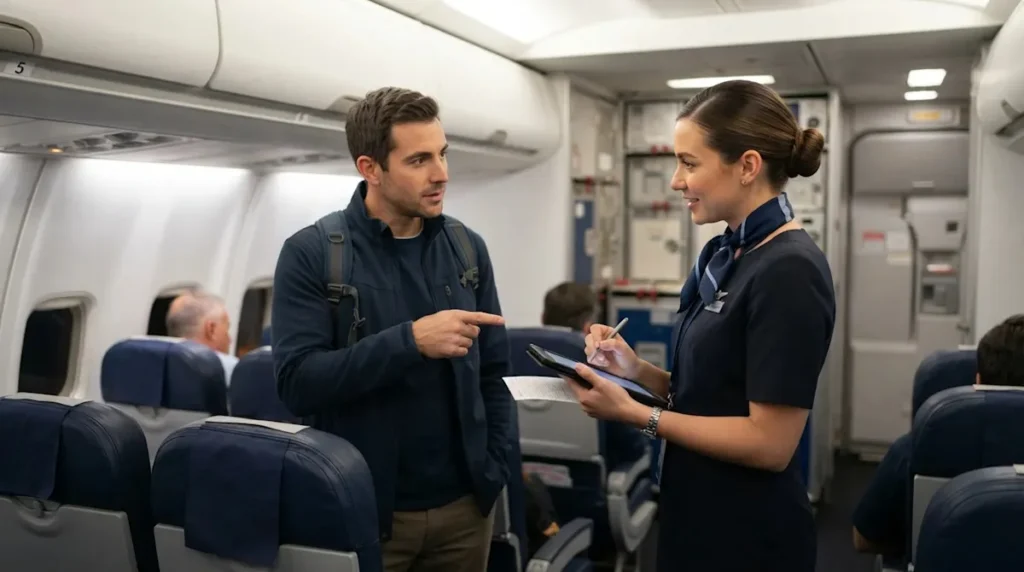


Most travelers treat a seat assignment like a court ruling. Middle seat, bad row, noisy neighbor? Too bad. But several seat changes are routine for cabin crew to consider, and almost nobody asks for them.
The catch is the clock. The best window to ask is small, and it usually closes with the aircraft door. Some of the answers below come from former crew and pilots, and a few of them are not what you’d expect.
#13 – The Same-Cabin Swap That Sounds Like Housekeeping
#13 – The Same-Cabin Swap That Sounds Like Housekeeping (Image Credits: Gemini)
The easiest yes on a plane is often the smallest ask. Delta’s guidance says that if you want an unoccupied seat within your ticketed cabin or seat product, you should ask a flight attendant. Changes are at the crew’s discretion and depend on safety considerations. Notice what that wording leaves out: other cabins, paid seats, and anything that looks like a freebie.
Advertisement
Advertisement
American Airlines lets crew permit moves to open Main Cabin seats after boarding, but not into Main Cabin Extra unless the passenger booked it. That makes “Can I take another regular seat?” a very different question from “Can I have more legroom?” One sounds like housekeeping. The other sounds like a free upgrade attempt, and crews hear plenty of those.
The Psychology Behind This: Framing your request as a lateral move, same seat type at no extra cost, shows the crew you already understand where the line is. That makes a yes feel low-risk to the person who has to give it.
The next entry comes with a timing rule most passengers get backwards.
#12 – The Empty Row You Spot While Everyone Else Is Still Boarding
#12 – The Empty Row You Spot While Everyone Else Is Still Boarding (Image Credits: Gemini)
The moment you notice open seats is the moment to speak up. Former American Airlines flight attendant Bobby Laurie told Travel + Leisure to ask before door closure, but not to be surprised if you aren’t moved until you’re in the air. So the ask belongs at the door, and the move may come later.
Advertisement
Advertisement
Why wait? Upgraded Points expert Stella Shon says last-minute connecting passengers, non-revenue employees on standby, and weight-and-balance moves mean nothing is guaranteed until the door closes. That empty row you’re eyeing might be spoken for. Most people don’t realize that a “yes” can arrive after takeoff, and that it’s still a real yes.
Insider Tip: Ask early, then stay put. Moving before the crew confirms is the quickest way to turn an approved request into an awkward correction when a late passenger shows up for that row.
That’s nothing compared to how small the next move can be.
#11 – The Row-Mate Shuffle Nobody Thinks to Request
#11 – The Row-Mate Shuffle Nobody Thinks to Request (Image Credits: Gemini)
Sometimes the smartest move is just one seat away. The Points Guy says there’s no harm in asking to be moved to another seat in your cabin. He’s also cautious about self-service moves. He doesn’t recommend changing seats on your own unless you’re swapping with another passenger or moving to another seat in your row.
Advertisement
Advertisement
There’s a reason short hops get less pushback. Canadian airline pilot Tyler Herbert explains that commercial aircraft seating is usually split into zones for weight and balance, not counted seat by seat. A slide within your own row doesn’t change which zone you’re counted in. Zones, not seats, are what load planners track. That makes the tiny ask the safest one.
Worth Knowing
A move within your own row is the lowest-risk request on this list.
Swapping with another passenger in your row is the self-service move The Points Guy says is acceptable.
Balance is tracked by zone, so a one-seat slide rarely changes the math.
A quick heads-up to the crew still keeps everyone’s records accurate.
The next entry is where airlines split into two camps.
#10 – The Middle-Seat Escape Into an Open Window or Aisle
#10 – The Middle-Seat Escape Into an Open Window or Aisle (Image Credits: Gemini)
A middle seat with an empty neighbor isn’t a lottery. It’s a question. The Points Guy’s etiquette guide says that if you’re in the middle with an empty aisle seat beside you, you’re expected to move over to create space. View From The Wing adds that on most airlines it’s fine to spread out when there are plenty of empty seats, though not into extra-legroom seats you haven’t paid for. It also says Delta’s rules are explicit about allowing it.
Advertisement
Advertisement
Southwest is the outlier. Customers there report being scolded for moving into an empty window beside their middle seat. One passenger said they were told nobody could change seats on a flight that was only about 60 percent full. The Reddit poster called it insane and argued that crews should be able to use discretion. Would you have pushed back?
By The Numbers: Simple Flying notes that seat swaps can become an issue once an aircraft is less than 80% full. Light loads leave less margin for balance, which is why half-empty flights are where crews get strict.
And some crews don’t wait for you to ask at all.
#9 – The Fresh Seat Assignment Handed Out at the Door
#9 – The Fresh Seat Assignment Handed Out at the Door (Image Credits: Gemini)
On a near-empty flight, the airline may move you before you say a word. USA Today’s Zach Wichter described a relatively empty flight home from Utah where gate agents repeatedly announced that many passengers would get new seat assignments at the boarding door. They stressed that staying in the new seats for takeoff and landing was important to keep the plane balanced.
Advertisement
Advertisement
Simple Flying explains that if you’re asked to move for balance, you shouldn’t take it personally, because passenger weight is generally estimated rather than specific to each person. Being moved isn’t about your own weight. It’s about where the seat sits in the cabin. If you’re getting a new seat anyway, that’s a natural moment to politely mention a preference, such as an aisle.
The Science Behind This: Aerospace Global News says that if the center of gravity shifts too far forward or back, a plane can handle unpredictably, especially during takeoff and climb when stability margins are tightest.
Next up is a request crews treat very differently from a preference.
#8 – The Nervous Flyer or Injury Request Crews Take Seriously
#8 – The Nervous Flyer or Injury Request Crews Take Seriously (Image Credits: Gemini)
Real needs beat preferences. Simple Flying lists seating someone more comfortably because of an injury, a special need, or flight anxiety among the common reasons for seat changes. The Points Guy adds that unequal swaps are only appropriate when a family is separated from young children or a passenger needs care from a traveling companion.
Quick Compare
Real need: an injury, flight anxiety, or a child seated apart from a parent usually gets a sympathetic hearing.
Preference: an aisle or a quieter row is possible, but it’s entirely up to the crew.
Extra legroom you didn’t book: the answer is usually no, however nicely you ask.
Advertisement
Advertisement
Former flight attendant Bobby Laurie told Yahoo Travel that if it’s in the same cabin and the seat is truly open, you’re usually fine. The tone of the ask matters too. One travel guide says airline staff are more likely to help when you approach them respectfully and explain your situation clearly. Clarity gets a faster answer than hints do.
Try This: State the need in one sentence, then the ask. For example: “I’m recovering from a knee injury. Is there an open aisle seat in my cabin?” Specific requests are easier for crew to say yes to.
The next situation is less about comfort and more about escape.
#7 – The Escape Hatch From a Seat-Kicker or Unruly Seatmate
#7 – The Escape Hatch From a Seat-Kicker or Unruly Seatmate (Image Credits: Gemini)
You don’t have to endure the row from nightmares. The Points Guy says that if the flight is wide open, you might be able to switch once boarding is complete. Don’t be surprised if attendants ask you to wait until after takeoff. A calm word at the door can set that up before the problem starts.
Advertisement
Advertisement
He suggests trying a friendly approach first. Some noise comes with the territory, but kicking the seat in front of you repeatedly isn’t acceptable at any age. He also takes a contrarian view of the usual blame game: he sees adults misbehaving in the air far more often than children. Plenty of travelers would argue the opposite. Either way, the crew can fix a seat problem faster than you can win a debate.
Editor’s Note: Moving away from a problem is usually quicker than winning the argument. A seat change is a two-minute fix for the crew. A dispute over behavior can take the whole flight.
The next entry involves strangers, and that’s where it gets delicate.
#6 – The Family-Together Fix Crew Can Actually Broker
#6 – The Family-Together Fix Crew Can Actually Broker (Image Credits: Gemini)
Nobody should have to guess who gets stuck in the middle. The Savvy Explorers notes that airlines hold broad authority to change seat assignments, and that common reasons include a parent needing to sit near a small child. That’s the lane where crews tend to be most sympathetic.
Advertisement
Advertisement
It still depends on the other passengers. Travelers should never ask someone to trade into a worse seat, such as a window for a middle. Offering an equal swap or a seat farther forward gets far better results. And passengers are within their rights to decline a swap unless a flight attendant directs it. A “no” from a stranger is completely legitimate.
Why It Works: Handing the problem to the crew keeps strangers from being cornered. A flight attendant can ask on your behalf, and a refusal doesn’t turn into a public standoff in the aisle.
The next entry is an even simpler version, and it only needs two yeses.
#5 – The Friends-Only Swap Both Sides Agree To
#5 – The Friends-Only Swap Both Sides Agree To (Image Credits: Gemini)
A swap needs two yeses, and the crew only has to hear about it. Laurie says swapping with someone in your group is fine as long as both people agree. Even on small regional planes, flight attendant Hailey Way says moving is not allowed unless it’s a passenger-to-passenger seat exchange.
Advertisement
Advertisement
Skipping the permission step is where things go wrong. A Carnegie Mellon piece on air travel etiquette says to always seek approval from flight attendants before starting or agreeing to a seat switch. One widely shared Fox News story features a passenger who moved first and asked later. The flight attendants later apologized to the man who ended up switching and gave him free snacks and drinks. The crew sided with the person who’d been moved.
Did You Know: Some airlines state in their conditions of carriage that passengers must stay in their assigned seats until the doors are closed and the crew gives clearance to move, according to Aerospace Global News.
Next comes the timing rule that quietly decides whether your “yes” sticks.
#4 – The “Yes, But Only After the Seatbelt Sign Goes Off” Move
#4 – The “Yes, But Only After the Seatbelt Sign Goes Off” Move (Image Credits: Gemini)
A yes at the door can still mean wait. Simple Flying reports that flight attendants who approve a move will ask you to stay in your allocated seat for takeoff and landing, then move once the seatbelt sign is off. The approval is real. The timing is the crew’s call.
Aerospace Global News explains the logic: once boarding is complete and the doors are closed, attendants can judge whether the balance allows a move, and they may let passengers spread out if there are empty rows, especially on longer flights. Some carriers go the other way. Japan’s Peach Aviation asks passengers not to change seats after boarding under any circumstances. Policies really do differ by airline.
At a Glance
At the door: make the ask and get a clear answer.
Takeoff and landing: stay in the seat you were assigned, even after an approval.
Seatbelt sign off: this is usually when an approved move can happen.
Strict carriers: some, like Peach Aviation, don’t allow post-boarding changes at all.
The next entry is the one that protects everyone, and few people do it.
#3 – The Quick “Tell the Crew” Swap Record
#3 – The Quick “Tell the Crew” Swap Record (Image Credits: Gemini)
The move you make quietly is the one crews dislike most. The Savvy Explorers says to ask a flight attendant before moving once the door closes. Even after a yes, tell them so the crew has an accurate seating record in an emergency. That record is part of why a plain request at the door matters.
Simple Flying says crews rely on the passenger information list in a serious incident, and unreported moves can delay identifying people. Not everyone buys that argument. Hailey Way pushes back on the idea that identification after a fatal accident is a reason to stay put. On one point, though, the sources agree. Many seats that look empty carry an extra fee, such as exit rows, extra-legroom options, or other “preferred” seats. Some empty-looking seats may even be crew rest seats or inoperable.
The next entry is the one people want most, and the hardest to get for free.
#2 – The Last-Minute Upgrade Ask at the Boarding Door
#2 – The Last-Minute Upgrade Ask at the Boarding Door (Image Credits: Gemini)
The boarding door is where upgrade hopes quietly get decided. Flight attendants say passengers who want to upgrade should submit their request at the boarding door as soon as possible. Airline staff can see whether passengers who booked business or first class missed a connection or canceled, which can free up seats.
But the odds depend on you. Paying for the upgrade or holding elite status improves your chances. A successful request usually means being bumped up a few rows, with no guarantee of going from basic economy to first class unless you pay. And Simple Flying says passengers should never move into a higher class on their own or demand a free upgrade. Most upgrade “hacks” online skip that part.
By The Numbers: USA Today reported a social media post from a United passenger who said an attendant wanted $86 each to change seats on a nearly empty flight. Treat it as one reported example, not a price list.
And the last entry is the one that surprises almost everyone.
#1 – The Cross-Cabin Swap One Airline Quietly Allows
#1 – The Cross-Cabin Swap One Airline Quietly Allows (Image Credits: Gemini)
Two strangers in different cabins can sometimes trade places. In a statement published by The Points Guy, Delta said customers in different cabins can change seats once during a flight, after takeoff once the seatbelt sign is off and before the first meal service. The airline added that its flight attendants are empowered to use situational flexibility. The ask can start at the door, but the swap itself comes later.
It’s far from universal. The same piece listed American Airlines as not permitting it. Another carrier said it doesn’t allow class switches for fairness and safety, but its flight attendants can offer options and make exceptions when necessary. A cabin swap is a crew decision, not a passenger right. Policies change, so check the current rules for your airline before counting on it.
Why It Stands Out
Delta’s stated policy allows one cross-cabin change per flight.
The window is narrow: after the seatbelt sign goes off and before the first meal service.
American Airlines was listed as not permitting it.
Even where it’s allowed, flight attendants make the final call.
Across the airlines and experts we checked, the pattern holds. Same-cabin moves, family needs, medical needs, and agreed swaps get the most traction. Free upgrades and unauthorized moves get the least.
The seat on your boarding pass may feel final, but the person standing at the door often has more room to help than you’d think. The only thing it costs is one polite sentence, spoken before the door closes. Which of these 13 would you have the nerve to ask for?
Source link