

You’d think the giveaway would be the fancy luggage or the loyalty badge. It’s usually quieter than that. Watch a front desk for ten minutes and you can pick out the veterans: no hovering, no digging through emails, just two or three oddly specific questions before they head for the elevator like they already know the room.
None of these habits is a big secret, and most take under a minute. But a few of them separate a smooth stay from a very long night, and one of them only kicks in after you’re back home. Here are 16 routines, counted down from the least obvious.
#16 – They Read the Newest Reviews, Not the Highest-Rated Ones
#16 – They Read the Newest Reviews, Not the Highest-Rated Ones (Image Credits: Gemini)
A hotel’s star average can hide a lot. Seasoned guests sort by most recent, because a place that was great two years ago can be a different property today. Ownership changes, renovations and staff turnover all show up first in the newest comments.
Advertisement
Advertisement
They also hunt for repeated complaints, not one angry rant. A single report of bugs or noise doesn’t prove a hotel-wide problem, and it may already be fixed. One bad review is noise, but the same complaint five times in a row is a pattern.
Quick Compare
Star average: a blended score that can include years-old stays
Newest reviews: a read on current staff, cleanliness and noise
Repeated complaints: the strongest warning sign of all
Next up is a routine that happens at the desk.
#15 – They Ask for the Total Price Before Handing Over a Card
#15 – They Ask for the Total Price Before Handing Over a Card (Image Credits: Gemini)
Few things sour a trip like a surprise line item at checkout. Veteran guests ask what the total will be, with every mandatory fee included. A federal rule on hidden fees for short-term lodging took effect in 2025, so advertised prices are supposed to include mandatory charges.
Advertisement
Advertisement
They still confirm it out loud. Parking, incidental holds and optional extras can sit outside that headline number. A ten-second question at check-in beats a ten-minute argument at checkout.
Insider Tip: Ask whether the card hold at check-in is separate from the room charge. Holds can tie up your available balance for days after you leave, which matters on a long road trip.
But that’s nothing compared to what they do about their room number…
#14 – They Ask the Desk to Write the Room Number, Not Say It
#14 – They Ask the Desk to Write the Room Number, Not Say It (Image Credits: Gemini)
It sounds paranoid until you picture a busy lobby. If an agent announces your room number across the counter, everyone standing nearby just heard it. Travel safety guides commonly suggest asking for it in writing, usually on the key sleeve.
Advertisement
Advertisement
Seasoned guests also never leave that sleeve sitting on the counter. They tuck the number away and keep it out of sight. It’s a tiny move that costs nothing and takes two seconds. The next one is about where in the building you end up.
#13 – They Quietly Request a Room Far From the Elevator and Ice Machine
#13 – They Quietly Request a Room Far From the Elevator and Ice Machine (Image Credits: Gemini)
Ask any frequent traveler what ruins sleep. It’s rarely the bed. It’s the ice machine clunking at 2 a.m. and the elevator dinging at dawn.
So they ask for a quiet corner away from both, often on a higher floor. They make the request early, because rooms get assigned fast. The same hotel can feel like two different properties depending on which hallway you land in. Availability isn’t guaranteed, but asking costs nothing.
Why It Works: Agents often have flexibility early in the day, before the rooms fill. A specific, polite request is easier to grant than a vague “anything quiet?”
Advertisement
Advertisement
Once they reach the door, though, the real ritual starts…
#12 – The Suitcase Never Touches the Bed
#12 – The Suitcase Never Touches the Bed (Image Credits: Gemini)
The first thing a pro does is find the luggage rack. The EPA advises using luggage racks when packing or unpacking, rather than setting bags on the bed or floor. Some go further and park the bag in the bathroom while they inspect the room.
There’s a reason the bathroom works. Entomologists note that bed bugs struggle to climb smooth surfaces. A hard tile floor or bathtub is simply a harder place for them to get into your bag. That leads to the inspection itself.
The Science Behind This: Smooth tile and tub surfaces give bed bugs little to grip. Carpet and upholstery are the opposite, which is why the bed and floor are the riskiest spots for your bag.
Advertisement
Advertisement
And the next step is the one most guests skip entirely…
#11 – They Pull Back the Sheets and Check the Seams
#11 – They Pull Back the Sheets and Check the Seams (Image Credits: Gemini)
Before unpacking a single sock, they peel back the bedding. The classic spot check is to run a finger along the mattress seams and look at the tag, where bed bugs often hide. A small flashlight makes it quick.
They know what they’re looking for: dark specks, shed skins and tiny pale eggs about the size of a grain of rice or smaller, tucked into seams and crevices. Cleanliness doesn’t protect a room, because any hotel room can harbor bed bugs, however clean or expensive. A luxury lobby proves nothing about the mattress.
Try This: Pack a flashlight and a plastic card. The light shows dark specks in seams, and the card helps you probe tight creases without using your fingers.
Advertisement
Advertisement
If something does turn up, the pros know exactly what to do next…
#10 – They Photograph the Evidence Before Saying a Word
#10 – They Photograph the Evidence Before Saying a Word (Image Credits: Gemini)
If they spot something suspicious, they don’t just march to the lobby. The first move experts recommend is a photo as proof. Note the room number, the date and the exact location of what you saw.
Then comes the part many guests get wrong. Bed bugs can travel between rooms through walls, so the new room shouldn’t be directly above, below or next to the affected one. A swap to the room next door can be the worst possible fix. They also re-inspect the replacement room from scratch, since one room swap doesn’t make it clear.
At a Glance
First: photograph the suspicious spot
Then: note the room number, date and exact location
Ask for: a room that isn’t above, below or beside the first
Finally: inspect the new room from scratch
Advertisement
Advertisement
Now for a routine that has nothing to do with bugs…
#9 – They Test Every Lock Like a Skeptic
#9 – They Test Every Lock Like a Skeptic (Image Credits: Gemini)
The deadbolt, the latch and the swing bar all get a quick try. A lock that doesn’t fully engage is better discovered at 4 p.m. than 4 a.m. If the room has a connecting door, they check that it’s locked on their side.
It takes under a minute, and plenty of guests never think to do it at all. If something is loose or broken, the pros ask for a different room right away, while the front desk still has options.
Why It Works: Hotels have the most flexibility right after check-in. Reporting a broken lock before you’ve unpacked makes a room change an easy yes.
Advertisement
Advertisement
The next habit is one you hope never to use…
#8 – They Know Exactly Where the Exit Stairs Are
#8 – They Know Exactly Where the Exit Stairs Are (Image Credits: Gemini)
On the walk to the room, they note where the stairwells are. Then they walk the route once. Fire safety guidance commonly advises counting the doors between your room and the nearest exit, in case smoke makes the hallway hard to see.
They also remember a second exit, in case the first is blocked. In a smoky hallway, the route you can’t see is the one you need to know by touch. It adds about a minute to check-in and costs nothing.
Did You Know: Fire safety advice generally says to take the stairs, not the elevator, during a fire alarm. That’s why knowing where the stairwell door actually is matters more than the room’s view.
Advertisement
Advertisement
But the next trick is a surprisingly petty one…
#7 – They Check the Alarm Clock Before Trusting It
#7 – They Check the Alarm Clock Before Trusting It (Image Credits: Gemini)
The last guest may have set a 5:30 a.m. alarm for a flight. It’s a classic hotel mishap, and it works the other way too: some clocks are left silent or set to the wrong time. Pros check the clock, the alarm and the volume before they settle in.
Many simply skip the bedside clock and use their phone. Still, the wake-up call and the bedside radio are worth a glance. An alarm someone else set can go off long before you want to be awake. It’s a ten-second check that spares you a rough first morning.
The Psychology Behind This: We assume a room is reset to neutral. Experienced travelers know that assumption is the real mistake, so they verify the small things first.
The next one protects something far more valuable than sleep…
#6 – They Ask for the Exact Wi-Fi Network Name
#6 – They Ask for the Exact Wi-Fi Network Name (Image Credits: Gemini)
Open a hotel’s Wi-Fi list and you may see several similar names. Security experts have long warned that lookalike networks can be set up to impersonate a hotel’s. Pros ask the front desk for the exact network name and password, and nothing else.
Many also use a VPN on public networks. The network that looks most official isn’t necessarily the real one. They avoid banking on any open network and switch to their phone’s hotspot when a task matters.
Worth Knowing
Get the exact network name and password from the desk, not from a guess
Several near-identical names in the list is a reason to double-check
A VPN adds a layer of protection on shared networks
Your phone’s hotspot is the fallback for anything sensitive
#5 – They Test the Room Safe With Something Low-Value First
#5 – They Test the Room Safe With Something Low-Value First (Image Credits: Gemini)
The safe is useful, but it’s not automatic. Pros set their own code, then open and close it a few times before trusting it. A safe that fails to open at checkout is a bad way to learn it’s faulty.
They also keep the truly irreplaceable items with them. A passport photo and a spare card stay in separate bags. In-room safes are a convenience, not a guarantee of protection.
Editor’s Note: Our view: a hotel safe is for convenience, not for anything you couldn’t bear to lose. Carry the truly irreplaceable items with you.
The next routine takes a few seconds and may save hundreds of dollars…
#4 – They Photograph the Room Before Touching Anything
#4 – They Photograph the Room Before Touching Anything (Image Credits: Gemini)
A quick sweep with the phone camera covers stains, scuffs, a broken lamp or a burn on the carpet. It’s a dated record that the damage was there when they arrived. If a dispute ever comes up, they have proof instead of an argument.
Most guests never need it. The one time you do need it, nothing else will do. Pros take the pictures in the first minute, before bags are open and the room looks lived in.
Why It Stands Out
It takes about a minute and needs nothing but your phone
Phone photos carry a date and time in their file details
It turns a he-said, she-said damage claim into a simple comparison
It works best before the room looks lived in
The next one is about being found, not being safe…
#3 – They Pocket a Hotel Business Card
#3 – They Pocket a Hotel Business Card (Image Credits: Gemini)
It looks like a throwaway, but it carries the property’s name, address and phone number. In an unfamiliar city, that’s a lifeline when a phone dies or a rideshare driver can’t find the entrance. Showing it to a cab driver beats trying to pronounce the street.
It’s also useful if you’re locked out and need to call the desk. A phone with a dead battery can leave you unable to say where you’re staying. A small card in the wallet fixes that for free.
Insider Tip: Check that the address on the card matches your booking. Some hotels share names with others in the same city, so a driver can end up at the wrong one.
Now for the habit that saves the most heartbreak on the way out…
#2 – They Do a Final Sweep and Photograph the Empty Room
#2 – They Do a Final Sweep and Photograph the Empty Room (Image Credits: Gemini)
Before the door closes for the last time, they check the outlets, the nightstands and under the bed. Phone chargers are a classic casualty, along with glasses and the contents of the safe. They check the safe last of all.
Then they take one more photo of the empty room. It’s the quickest way to show the room was left in good order. If a charge appears later, they have a dated image to point to.
Try This: Make the sweep a fixed loop: bathroom, outlets, nightstands, closet, safe. A set order means you stop relying on memory when you’re rushing to the airport.
But the most important routine doesn’t happen at the hotel at all…
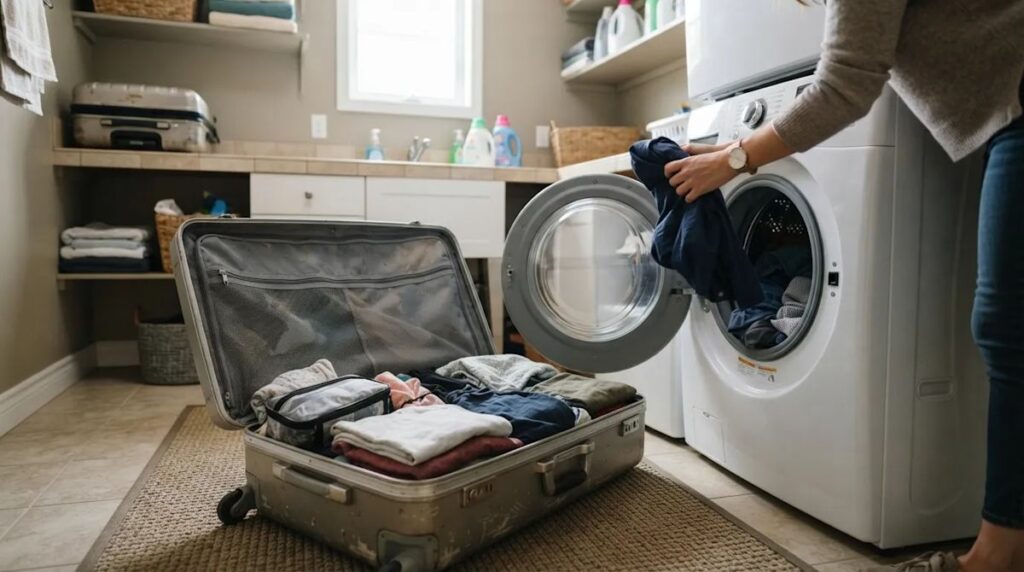
#1 – They Unpack Straight Into the Washing Machine at Home
#1 – They Unpack Straight Into the Washing Machine at Home (Image Credits: Gemini)
The trip isn’t over when you walk through your own front door. The EPA advises unpacking directly into a washing machine and inspecting your luggage carefully. That’s the step most travelers skip.
Heat from a dryer at a high setting kills bed bugs, while washing alone generally won’t. The EPA also advises storing suitcases away from the bedroom, such as in a basement or garage, and never under the bed. The suitcase you tuck under your bed after every trip is the worst place to keep it. The pros treat the arrival home as part of the stay.
The Science Behind This: Heat is the reliable killer here. That’s why the dryer, run at a high setting, does the work that the wash cycle alone usually doesn’t.
Almost none of these habits needs special gear, only a flashlight and a few minutes of attention. The most telling ones happen before the bags are open and after the trip ends, which is exactly why staff rarely see them.
What they do see is a guest who never seems rattled. Nothing goes wrong, and that calm is the whole point. Which of these have you been skipping?
Source link