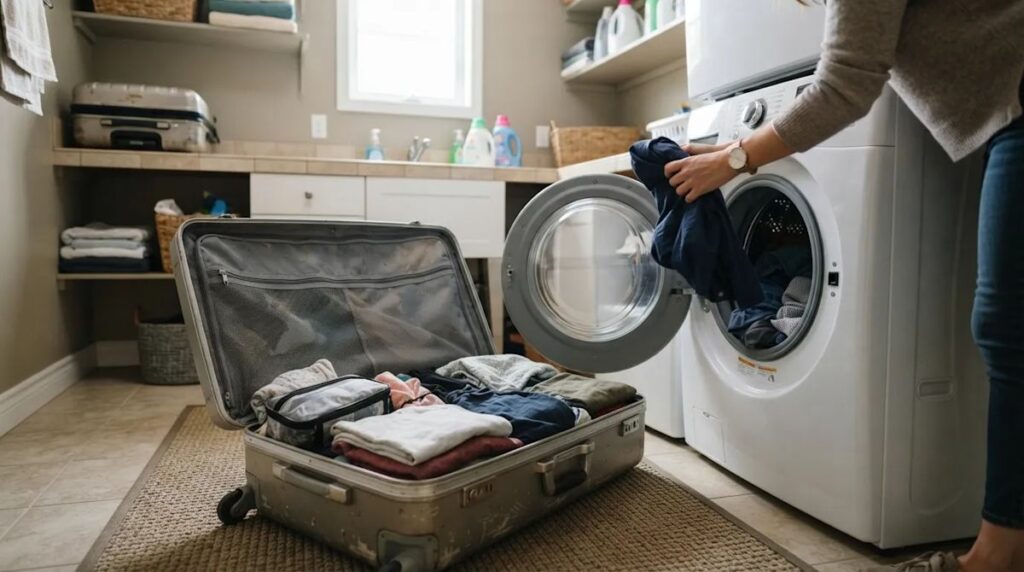


You’ve watched them do it. They stroll past a snaking security line, rebook a cancelled flight from their seat before the gate agent has even picked up the mic, and land with a charged phone, a bag that actually arrived and a decent night’s sleep behind them. It looks like luck. It isn’t. Experienced flyers do most of their winning in the living room, days before takeoff.
The strange part is how unglamorous it all is. There are no secret lounges and no insider codes, just a handful of quiet chores that most people never think to do. Some of them matter more now because of rules that changed in 2025 and 2026, and one involves a $45 charge that catches travelers right at the checkpoint. Keep reading, because the habit at #1 is the one almost nobody thinks of.
#15 – The Backup ID That Dodges a $45 Surprise at Security
#15 – The Backup ID That Dodges a $45 Surprise at Security (Image Credits: Gemini)
Frequent flyers check their ID at home, not at the checkpoint. REAL ID enforcement began May 7, 2025, and since then a non-compliant state license no longer works on its own for domestic flights. A valid passport still does the job. Experienced travelers simply look at the card in their wallet and make sure it has the star.
Advertisement
Advertisement
Starting in February 2026, domestic travelers without acceptable ID can be sent to a $45 TSA ConfirmID process. The payment covers a 10-day window, and TSA has warned that the extra identity verification can mean delays. Critics see it as a toll on people who can’t easily get to a DMV. Frequent flyers see it as a fee that’s completely avoidable, which is exactly why they avoid it.
#14 – The Trusted Traveler Account Opened Months Before the Trip
#14 – The Trusted Traveler Account Opened Months Before the Trip (Image Credits: Gemini)
Experienced flyers don’t wait for a big trip to apply for fast-lane access. Global Entry now costs $120 for five years, up from $100, and it automatically includes TSA PreCheck. PreCheck on its own runs roughly $78 to $85, depending on the enrollment provider. They file the application early, long before they need it.
Insider Tip: Treat the application like a slow-moving errand. Enrollment involves an in-person step, and appointment availability varies a lot by city. Start it well before you need it, not the week of your flight.
Global Entry requires an interview, so you can’t finish it from the couch. Many premium credit cards reimburse the fee entirely, which is why plenty of frequent flyers pay nothing for it.
Advertisement
Advertisement
There’s a spicy debate here too. CLEAR’s list price sits close to $200 a year, and a lot of regulars say paying full price is the real waste. They sign up only when a card perk or discount knocks the cost down.
Quick Compare
Global Entry: $120 for five years, with PreCheck included.
TSA PreCheck alone: roughly $78 to $85, depending on the provider.
CLEAR: close to $200 a year at list price, so regulars wait for a card perk.
#13 – The Power Bank Sorted Before the Bag Is Zipped
#13 – The Power Bank Sorted Before the Bag Is Zipped (Image Credits: Gemini)
Frequent flyers check their power banks at home, where there’s no gate agent holding one up and asking questions. Lithium-ion batteries go in carry-on baggage only. The FAA limits them to 100 watt-hours per battery, and with airline approval you can carry up to two larger spares of 101 to 160 Wh.
The Science Behind This: A damaged lithium cell can overheat and ignite itself. In the cabin, crew can reach it fast. In a cargo hold, nobody can. That’s the logic behind the carry-on-only rule.
Advertisement
Advertisement
Many packs print only milliamp-hours. If yours shows only mAh, convert it to Wh. A typical 20,000 mAh pack at 3.7 volts works out to about 74 Wh, comfortably under the line.
New international guidance taking effect in 2026 tightens how power banks can be used in flight, and many airlines already ban or limit using them on board. Policies vary by carrier and keep changing, so the smart move is to read your airline’s rules before packing. Plan on charging everything at home.
#12 – The Delay Folder That Turns Into Cash
#12 – The Delay Folder That Turns Into Cash (Image Credits: Gemini)
Seasoned flyers keep a digital folder for every trip. Screenshots of the original itinerary, the delay notice and every receipt go straight in. It looks fussy right up until a flight falls apart. Then it’s the difference between a refund and a shrug.
Why It Works: Airline systems can overwrite the original schedule once a flight changes. A saved screenshot with your own timestamp shows what you were actually sold and when.
Advertisement
Advertisement
Federal rules define a “significant” change as a delay of three hours or more on domestic flights and six hours or more on international ones. Refunds are supposed to be automatic, and airlines can’t hand you a voucher unless you choose to accept it.
The U.S. rule doesn’t create fixed delay-compensation payments like the EU’s €250 to €600 system. In 2025, the DOT also backed away from a proposal that would have required cash compensation for delays. So the folder protects what you’re clearly owed, which is your money back.
#11 – The Suitcase Photo Taken Before the Bag Leaves the Hallway
#11 – The Suitcase Photo Taken Before the Bag Leaves the Hallway (Image Credits: Gemini)
Experienced flyers photograph their open suitcase before closing it. They also photograph the bag itself, with the tag showing. It takes ten seconds. Those pictures can back up an airline claim and help a baggage agent pick your bag out of a pile of look-alikes.
Smart packers also tuck a card with their name and phone number inside. Outside tags get ripped off in the belt system, and an inside card still identifies the bag. Under the DOT’s refund rules, a checked bag delayed more than 12 hours on a domestic flight can qualify for a baggage fee refund.
Advertisement
Advertisement
A short written inventory makes any claim easier to prove. Many travelers also drop a Bluetooth tracker inside, so they can see where the bag is even when the airline’s app says nothing.
Fast Facts
The whole photo routine takes about ten seconds.
Shoot two pictures: the open suitcase and the outside of the bag with the tag visible.
An inside card with your name and phone number survives when outer tags get torn off.
A checked bag delayed more than 12 hours on a domestic flight can qualify for a baggage fee refund.
#10 – The Offline Download Night That Beats a Dead Wi-Fi Signal
#10 – The Offline Download Night That Beats a Dead Wi-Fi Signal (Image Credits: Gemini)
Frequent flyers load their phones the night before. Shows, podcasts, playlists, offline maps and boarding passes all get downloaded at home on fast Wi-Fi. Occasional travelers assume the plane will provide, and then they spend four hours staring at a frozen seatback screen.
Try This: Download your destination’s offline map area, then open it once in airplane mode at home. If it loads, you’re set. If it doesn’t, you’ve found the problem while you still have Wi-Fi.
Advertisement
Advertisement
In-flight Wi-Fi is slow, patchy or sold as a premium add-on on many flights, and seatback screens do break. The most dependable entertainment is whatever is already stored on your phone.
Offline maps matter even more after landing. Roaming data may not work in a new country, and a weak signal at an unfamiliar curb at midnight is a terrible time to search for your hotel.
#9 – The Airline App Signed In and Alerts On Before Departure Day
#9 – The Airline App Signed In and Alerts On Before Departure Day (Image Credits: Gemini)
Experienced flyers install the airline app and sign in at home. They turn on notifications and save their loyalty number. The reason is simple. The app often knows about a gate change or delay before the board does.
They also scout backup options in advance. They know which other flights go to their destination and roughly when they leave. When a cancellation hits, they’re rebooking from their seat while the gate line keeps growing.
Advertisement
Advertisement
Occasional travelers are still downloading the app on airport Wi-Fi. And if you turn down the rebooking the airline offers, you’re entitled to the automatic refund. Knowing your options ahead of time makes that choice a lot less rushed.
#8 – The Permanent Toiletry Kit That Never Gets Unpacked
#8 – The Permanent Toiletry Kit That Never Gets Unpacked (Image Credits: Gemini)
Frequent flyers keep a toiletry bag that’s always ready to go. Travel-size shampoo, toothpaste, deodorant and a razor live in it all year. They restock it the day they get home, so nothing gets packed in a panic at 11 p.m.
Did You Know: TSA’s liquids rule is nicknamed 3-1-1. Containers must be 3.4 ounces (100 milliliters) or smaller, fit in one quart-size bag, and each traveler gets one bag.
The kit solves two problems at once. You never forget something, and you never grab a full-size bottle by mistake. Watching a favorite full-size product get tossed in the checkpoint bin is a small loss almost everyone has felt.
Advertisement
Advertisement
Many seasoned travelers keep a spare phone cable and a mini sewing kit in the same bag. Nobody has ever thanked themselves for packing late.
#7 – The “Bag Never Arrived” Carry-On That Holds Your Whole First Day
#7 – The “Bag Never Arrived” Carry-On That Holds Your Whole First Day (Image Credits: Gemini)
Experienced flyers assume the checked bag might not show up. At home, they pack the carry-on as if it has to carry the whole first day. That means medications, a phone charger, one change of clothes, and glasses or contacts. Occasional flyers put the essentials in the bag that gets checked.
It’s a trade-off, but a smart one. Anything you can’t replace in an hour belongs with you. That includes prescriptions, passport copies, house keys and a laptop.
Medications are best kept in their original labeled containers so they’re easy to explain at security. Sorting this out takes five minutes, and it turns a lost bag from a crisis into an inconvenience.
At a Glance
Health: medications in original labeled containers, plus glasses or contacts.
Power: phone charger and cable.
Wardrobe: one full change of clothes.
Can’t-replace items: passport copies, house keys and laptop.
#6 – The Home-Front Plan Made Before the Suitcase Comes Out
#6 – The Home-Front Plan Made Before the Suitcase Comes Out (Image Credits: Gemini)
Seasoned travelers treat the house as part of the trip. Mail is paused, a neighbor is looped in, and a plant-watering plan is set. A few lamps go on timers. The goal is a home that looks lived-in for the whole trip.
Advertisement
Advertisement
Try This: The U.S. Postal Service offers a Hold Mail service you can request online. It keeps a pile of envelopes from announcing your absence. Set it up the same day you book.
It sounds like a lot, but each step takes minutes. A stack of packages on the porch is one of the easiest signals that nobody’s home.
Some frequent flyers also shut off the water supply to appliances that could leak. Others say that’s overkill. Either way, they make the call at home instead of discovering a puddle on return.
#5 – The Airport Parking Spot Reserved Before the Holiday Rush
#5 – The Airport Parking Spot Reserved Before the Holiday Rush (Image Credits: Gemini)
Experienced flyers solve the airport ride before it becomes a problem. Some book a parking space days or weeks ahead. Others line up a ride or ask a friend. Almost none leave it to “we’ll figure it out.”
Opinions split here. Rideshare fans say it’s cheapest for short trips, while long-trip travelers often find parking costs less. Either choice works if it’s decided early.
Airport lots that look endless in January can be packed in the middle of a holiday week. Travelers who skip this step often burn through the buffer time they planned for security. The route and the hour you leave deserve a decision too, since traffic is part of the trip.
#4 – The Two-Card, Two-Pocket Rule for Money Trouble
#4 – The Two-Card, Two-Pocket Rule for Money Trouble (Image Credits: Gemini)
Experienced flyers never rely on a single payment method. They carry at least two cards from different banks, and they keep them in different places. One lives in a wallet, the other in a zipped bag or hotel safe. If one is lost or frozen, the trip goes on.
Editor’s Note: A bank fraud freeze is meant to protect you, but it can strand you in a foreign taxi with no way to pay. Telling your bank where you’re going is a cheap fix.
They also check for foreign transaction fees before an international trip. Some cards charge them and others don’t. A card that quietly adds a fee to every purchase can add up fast over a week abroad.
A small amount of local cash helps too. Some taxis and tiny cafés still don’t take plastic.
#3 – The Sleep Shift That Starts Days Before the Flight
#3 – The Sleep Shift That Starts Days Before the Flight (Image Credits: Gemini)
Frequent flyers start adjusting their body clock before they leave. Heading east, they go to bed a bit earlier each night. Heading west, a bit later. Many sleep specialists recommend small, gradual shifts rather than one big leap.
The Science Behind This: Your body clock responds strongly to light. Morning light tends to move it earlier and evening light tends to push it later. Timing light and dark exposure is how travelers nudge it in the right direction.
It doesn’t eliminate jet lag. It softens the first day. Occasional travelers often arrive already wiped out from a 4 a.m. packing session.
Experienced flyers pack early so the night before is for sleeping. They also plan meals and water so they aren’t skipping both on travel day. Some call that fussy. The ones who’ve landed exhausted tend to disagree.
#2 – The Standing Checklist That Pilots Would Recognize
#2 – The Standing Checklist That Pilots Would Recognize (Image Credits: Gemini)
Experienced flyers don’t pack from memory. They keep a reusable checklist, often a note on their phone, and update it after every trip. Each forgotten item becomes a permanent line. Over time, the list gets close to perfect.
The Psychology Behind This: Stress and rushing make memory unreliable. A written list moves the job from your head to the page, so you aren’t depending on recall while distracted.
Aviation itself leans heavily on checklists, because even experts can miss steps under pressure. The most seasoned flyers often trust a list over their own confidence.
A good one is split into sections: documents, tech, clothing, medications and home tasks. It also includes a “leaving the house” line for the stove, windows and thermostat.
#1 – The One Person Who Holds Your Itinerary and a Spare Key
#1 – The One Person Who Holds Your Itinerary and a Spare Key (Image Credits: Gemini)
The most experienced flyers always leave a trail behind them. A trusted person gets the flight numbers, hotel details and a spare key. Many also share scanned copies of passports and booking confirmations in a secure place. It isn’t about worrying. It’s about making sure that if something goes wrong, someone else can act.
The payoff shows up when life gets messy. A phone is lost, a passport is stolen, or a pipe bursts at home. That one person can make calls, reach support lines and check on the house while you’re in the air.
Occasional travelers often skip this because it feels unnecessary. Frequent flyers do it because they’ve seen how small problems grow when nobody can step in. It’s quiet, it’s unglamorous, and it’s the habit most worth stealing.
Worth Knowing
Share flight numbers and hotel details before you leave.
Hand over a spare key so someone can check on the house.
Keep scanned passport and booking copies in a secure place your contact can reach.
Pick someone reachable who can actually make calls on your behalf.
The gap between occasional and experienced flyers was never about gear or status. It’s about what gets handled at home, in the dull hours when nothing seems to be at stake.
Since 2025, a few of those skipped basics have come with a price tag, from the $45 ID fee to tighter power bank rules. Most of these habits cost almost nothing: a folder, a checklist, a second card, a spare key in the right hands. Which one would you have skipped?
Source link