Being in charge of the turkey can be a stressful Thanksgiving job. There’s a lot riding on the centerpiece bird and you want to make sure and cook it as perfectly as you can. After all, gravy can only do so much to cover bad turkey.
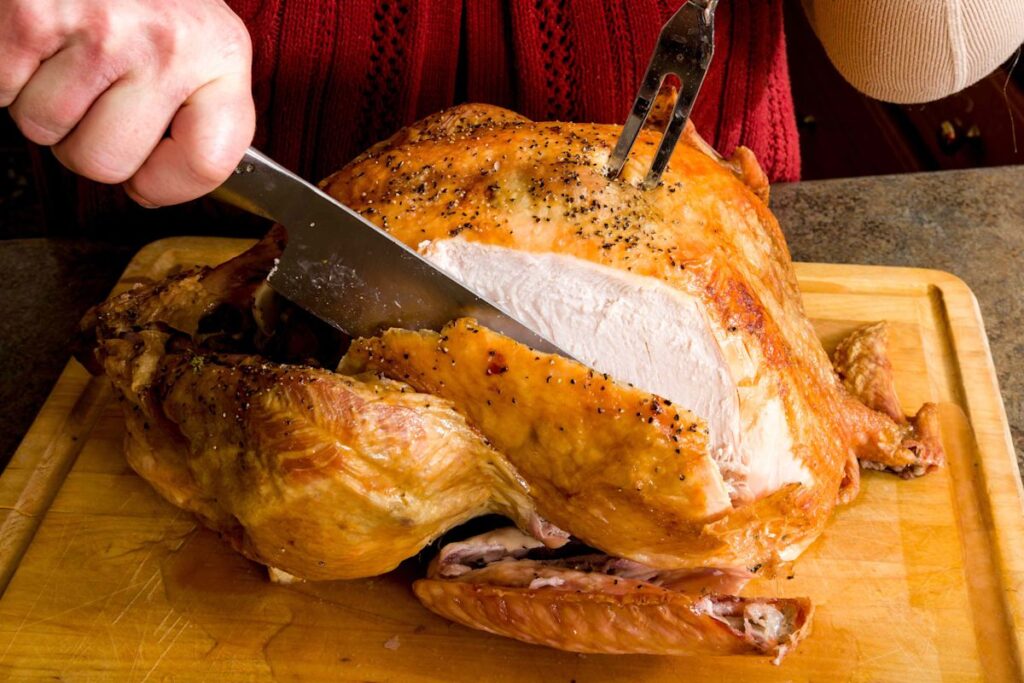
Sometimes, you’ll start to carve the bird and notice that some of the meat is still pink, but does that mean it’s undercooked? Not necessarily, according to Indu Upadhyaya, associate extension professor for food safety and poultry science at the University of Connecticut. I chatted with her to get to the bottom of this holiday conundrum and figure out what to do if you’re seeing pink on Thanksgiving.
Reasons Why Your Turkey Might Be Pink
According to Upadhyaya, there are several reasons your turkey might still be pink when you pull it out of the oven. “The pink nature of the turkey is because of myoglobin primarily,” she says. “Myoglobin is the oxygen-binding protein that is present within the muscle cells for all of us. And it is mainly responsible for the natural color of the meat.”
As the meat cooks, the myoglobin protein unfolds (or denatures, in scientific speak) and changes its structure. While this typically causes meat to lose its reddish color, certain chemical reactions can produce stable pink pigments that remain even after cooking.
For example, if you smoke or grill your turkey you will likely see some pink meat. The smoke “contains some compounds like nitrogen oxides,” says Upadhyaya. “If there are nitrates and nitrites that can react with pink meat pigments, then they also produce stable pink colored compounds which stay in the muscle even after cooking.” Smoked turkey may also have a pink smoke ring, which is totally normal and not a food safety concern as long as the turkey has reached an internal temperature of 165°F.
Another factor can be the area of the bird. You might notice some pink in the thighs, drumsticks, and wings. Why? Myoglobin is higher there because they’re areas of the bird that get used more than a less-used section, like the breast. The higher myoglobin levels give these parts of the turkey their darker color and can also make them appear slightly pink.
The age of the bird can also impact the color of the meat. Upadhyaya says that younger birds can have incomplete mineralized bones. The pigments from the bones can migrate to the muscle tissue, which might translate to pinkish meat near the bones and joints. Older turkeys can have some pink in spots where they have less fat, which protects the meat.
A less common reason for pink turkey is a reaction of the myoglobin to the gasses in electric or gas ovens. Upadhyaya says that is a rare occurrence, but does happen.

Credit: Simply Recipes / Getty Images
How To Make Sure Your Turkey Is Safe To Eat
Although there are many reasons your turkey might be pink when you carve it, there’s one surefire way to make sure that it’s ready to serve. Instead of relying on cues like golden brown skin, clear juices, or loose legs, you need just one thing: a thermometer.
“The color has nothing to do with the actual food safety of the turkey,” says Upadhyaya. “The important part to remember is as long as your turkey is cooked to 165°F across different locations, it is properly cooked.”
Upadhyaya and the USDA recommend taking the turkey’s temperature in the thickest part of the breast and the innermost area of the thighs and wings, avoiding any bones. If it’s not 165°F, it needs to go back in the oven. If it’s up to temperature, then you’re ready to take the bird out and let it rest for 20 to 30 minutes, depending on the size of the turkey.
The upshot? Whether you see pink, white, or brown meat, just grab a thermometer and carve with confidence.
Read the original article on Simply Recipes