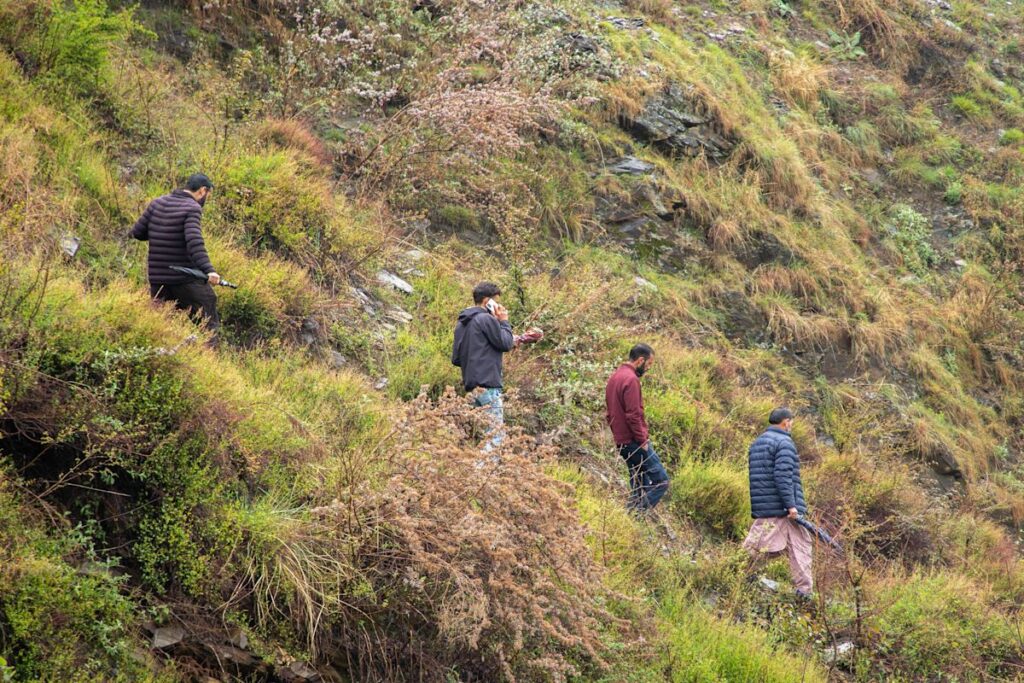
You handled the climb. Coming down felt easier. The next morning, walking downstairs is the difficult part.
Downhill hiking gives your legs a repeated braking task. Your quadriceps help control each step as the knee bends, producing force while lengthening. That is an eccentric muscle action.
A long descent can introduce far more of that work than your legs are accustomed to—even if the hike never felt like an all-out cardiovascular effort.
Advertisement
Advertisement
If most of your preparation happens on flat ground, the downhill section deserves its own attention.
A short exposure changed the response to a longer descent
In a 2017 study published in PLOS One, researchers assigned 36 untrained young men to three groups.
One group completed five minutes of downhill walking a week before a longer downhill session. Another walked on level ground first. A control group completed only the longer descent.
After the 40-minute downhill session, the group with prior downhill exposure had smaller increases in soreness and smaller reductions in knee-extension strength.
The laboratory protocol was demanding: a 28 percent downhill grade, walking at 5 kilometers per hour while carrying an additional 10 percent of body weight.
Advertisement
Advertisement
That is not a beginner hiking prescription. The study supports introducing a small amount of relevant work before a large amount; it does not show that any five-minute walk makes you ready for a mountain descent.
Familiarity can matter for weeks
An earlier 2015 study involving 42 adults tested a shorter downhill session either one or four weeks before a longer one.
Both preconditioning groups showed smaller changes in muscle-damage markers and strength afterward than the group without that earlier exposure.
This is an example of the repeated-bout effect: after an initial exposure, the body can respond differently to similar work later.
Advertisement
Advertisement
It offers a useful preparation principle. It is not proof that soreness has been eliminated, that an injury cannot occur, or that one route prepares you for every other trail.
Practice the descent before making it the longest one
Start with a route whose surface, slope, and distance you can already manage safely. Build experience with controlled downhill walking before adding a long descent, a heavier pack, or difficult footing.
Here is a conservative way to organize that progression:
|
Stage |
What to practice |
What to check before progressing |
|---|---|---|
|
Establish a baseline |
A familiar walk on manageable terrain |
Comfortable movement during and after the walk |
|
Add a small descent |
Include a short, gentle downhill section |
Stable footing and a controlled pace |
|
Repeat the exposure |
Revisit the same route after recovering |
Whether the descent and next-day response feel manageable |
|
Extend one demand |
Add some descent time or route difficulty |
Avoid increasing distance, steepness, and pack weight together |
|
Prepare for the actual hike |
Use terrain and equipment relevant to the planned route |
Consider the entire return trip, not just reaching the destination |
This is an editorial progression framework. It is not a validated schedule, and there is no fixed number of sessions that guarantees readiness.
Read the route beyond its mileage
Two five-mile hikes can place very different demands on your legs.
Advertisement
Advertisement
Look at the elevation profile, sustained descents, surface, expected weather, and time needed to finish. A route that starts downhill can also leave the hardest uphill work for the return.
The National Park Service’s hiking guidance specifically asks hikers to consider whether they have practiced steep climbs and descents or are mainly comfortable on flat paths. It also emphasizes planning the full trip and choosing a hike appropriate to your ability.
On the descent, use a pace that lets you place your feet deliberately. Stop for a break while you can still choose a comfortable place to do it.
Plan the day after, too
If a hike includes substantially more downhill walking than you normally do, leave some flexibility in the following day’s training.
Advertisement
Advertisement
Judge how you move before committing to a demanding leg session. General muscle soreness and localized joint pain are different problems; pain that changes your gait should not be dismissed as evidence of a productive hike.
Record the route, descent, pack load, and your response afterward. Those details help you choose the next outing more intelligently.
Your lungs may be ready for the trail before your legs are ready for thousands of braking steps. Give the descent a place in your preparation.
More from Men’s Fitness
Advertisement
Advertisement
The cited downhill studies used controlled treadmill protocols rather than outdoor hiking trips. The 2017 paper reports Japanese public research funding and no competing interests. The preparation framework is an editorial adaptation, not a tested injury-prevention program. No routes or equipment were tested for this article.
This story was originally published by Men’s Fitness on Nov 7, 2026, where it first appeared in the News section. Add Men’s Fitness as a Preferred Source by clicking here.