

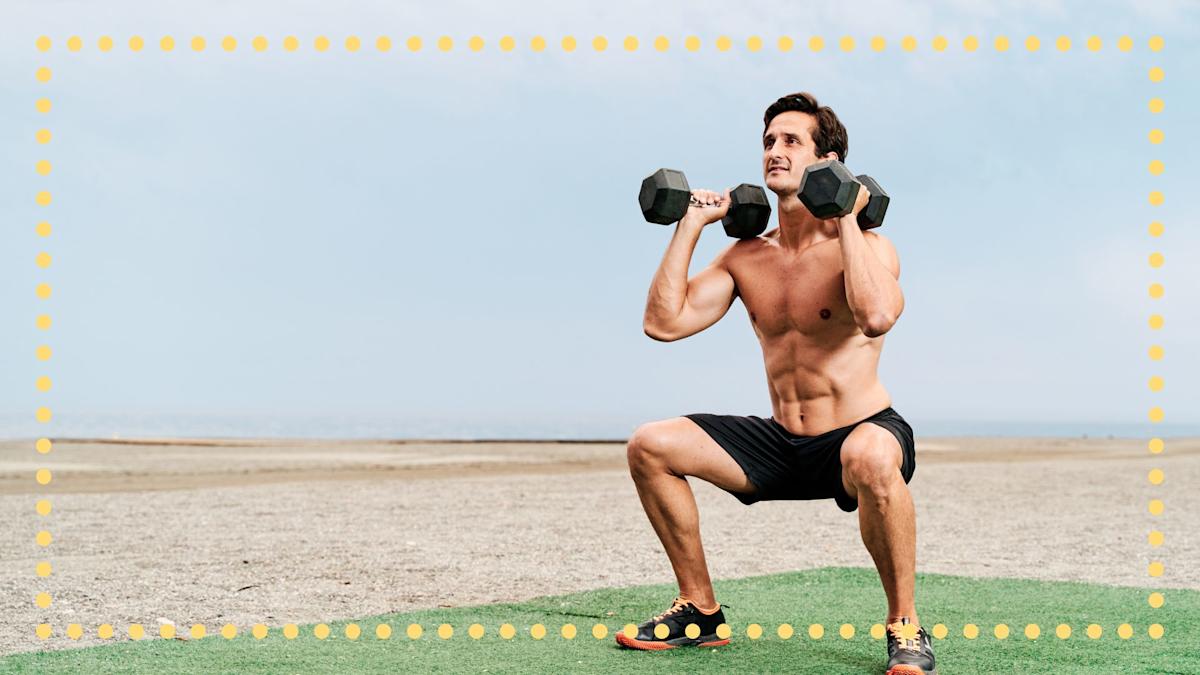
If you could only do one exercise, make it the squat-to-press. Also known as a thruster, this movement combines a full squat with an overhead press in one fluid motion, working your legs, core and shoulders together. Certified personal trainer Renee Simms explains: “While no one movement can efficiently hit every major muscle group in complete isolation, if I had to choose one exercise that comes closest, it would be the squat to press.”
The movement requires only dumbbells or kettlebells, adapts to any fitness level and produces results in 20-minute sessions. This makes it ideal for small living spaces, quick additions to gym workouts or travel when equipment is limited.
When you perform a squat-to-press, your legs and glutes power you out of the squat, your core braces to keep your torso stacked through the transition and your shoulders, upper back and triceps lock out the weight overhead. The coordination that the exercise requires is what sets the thruster apart from most single exercises, which tend to focus on strength, power or conditioning in isolation. The squat-to-press hits all three, and carries over to everyday life. Standing up from a low seat, lifting a bag overhead or carrying groceries are regular motions that all draw on the same patterns as this exercise.
Strength and conditioning research suggests that dynamic moves like the dumbbell thruster trigger a bigger short-term boost in growth hormones than heavy lifting alone. These hormones are essential for keeping your metabolism humming and your muscles defined. By adding thrusters to your routine, you’re essentially flipping a switch that pushes your body into high gear, helping you get more out of every rep. That’s why, as a personal trainer and strength coach, I program thrusters for clients who want maximum return on their training time.
Ready to give it a go? Below, we’ll break down exactly how to safely perform the squat-to-press with perfect form, along with easy tweaks to match your current fitness level. To back up our findings, we tapped Simms and Josh York, CPT and founder of Gymguyz, for their top-tier advice on the exercise. They share why this single movement earns a spot in so many professional programs and how it helps you get the most out of your workout.
How to do a squat-to-press with proper form
The dumbbell version of the squat-to-press is the best starting point because the equipment is easy to grip, can be scaled in manageable increments and works well in confined spaces. Adjustable dumbbells work especially well for home gyms that need weight variety without bulk or clutter. According to Simms, “One of the greatest strengths of the squat to press is its versatility. This exercise can be adapted to accommodate all fitness levels, from beginners to advanced athletes and even the senior population. Equipment options are wide-ranging — a barbell for maximal strength, dumbbells or kettlebells for unilateral control or even a medicine ball for power and coordination.”
How to do a squat-to-press
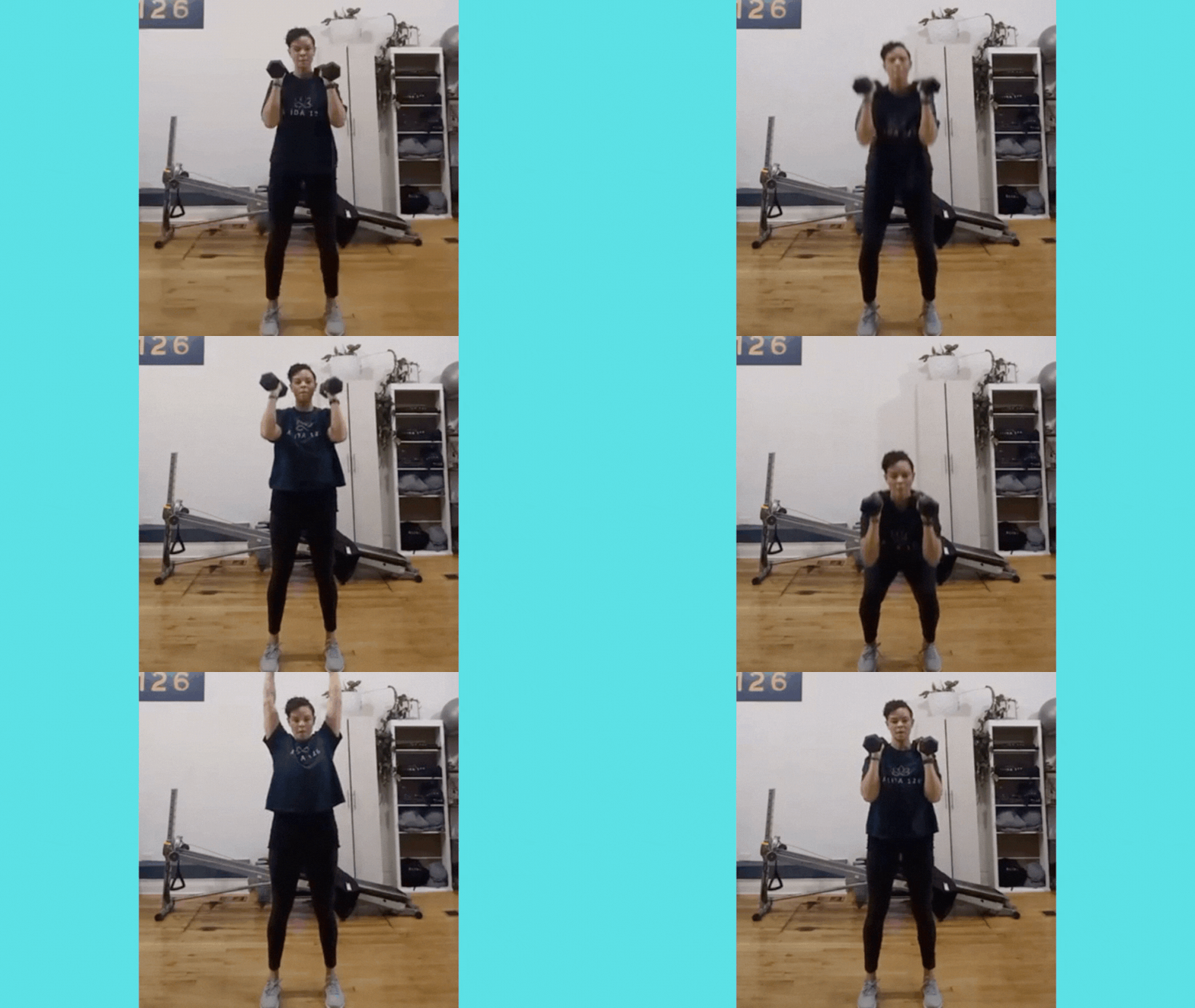
Start with light weight and focus on your form to get the best results.
-
Stand with your feet approximately shoulder-width apart and your toes slightly angled outward.
-
Hold one dumbbell in each hand at shoulder level, elbows positioned slightly in front of your torso, palms facing inward or angled toward each other.
-
Engage your core lightly and maintain your ribcage aligned directly above your pelvis.
-
Initiate the squat by pushing your hips back and down while keeping your chest tall and your weight distributed through your mid-foot. Keep your spine neutral without excessive arching.
-
Descend to a comfortable depth, ideally with your thighs reaching parallel to the ground or lower. Ensure your knees track over your toes without collapsing inward, and keep your heels grounded.
-
Push forcefully through your feet to stand explosively.
-
Harness the upward momentum from your legs to help you drive the overhead press.
-
Press the dumbbells straight up until your arms reach full extension with your biceps positioned near your ears.
-
Remain upright at the top with glutes contracted. Don’t lean your torso backward.
-
Control the dumbbells as you lower them back to shoulder height, then immediately begin your next squat. Keep the movement flowing continuously.
-
Perform 3 sets of 8 to 12 repetitions with 60 to 90 seconds rest between sets.
Make it easier
If the full squat-to-press feels like too much right now, scale it back without losing the pattern. “Modifications make the movement accessible and safe,” says Simms.
-
Bodyweight squat + press: Start with just your body weight. Practice the squat mechanics first, then add an overhead reach at the top to groove the timing. Once that feels smooth, add light dumbbells.
-
Box or bench squat-to-press: “Beginners can use a box or bench as a depth guide, essentially performing a sit-to-stand followed by a press,” explains Simms. “This builds confidence, reinforces good mechanics and reduces joint stress.” Lower yourself to the box, stand back up, then press overhead. It’s the same pattern with a built-in safety net.
-
Single-dumbbell squat-to-press: Hold one dumbbell at chest level in a goblet position, then press with both hands or alternate single-arm presses. This reduces the total load and allows you to focus on controlled movement.
-
Partial range option: Squat to a shallower depth or press to a lower endpoint until your mobility and strength improve. Working within your current capabilities is always smarter than forcing a range you haven’t developed yet.
Make it harder
Once the basic dumbbell thruster feels comfortable, you can ramp up the challenge without changing the movement itself.
-
Heavier dumbbells or kettlebells: Progress the load gradually. Double kettlebells in a front-rack position add a stability challenge on top of the extra weight.
-
Tempo reps: Slow the lowering phase to 3 seconds as you descend into the squat. This increases time under tension and builds greater control.
-
Pause at the bottom: Hold for 1 to 2 seconds at the bottom of the squat before driving upward. This eliminates the stretch reflex, forcing you to generate power from a dead stop.
-
Barbell thruster: “More advanced exercisers can progress to a deep front squat with a smooth, powerful press, increasing both strength and mobility demands,” says Simms. The barbell allows heavier loading, but technique becomes even more critical.
-
Conditioning finisher: Use timed sets, such as 30-45 seconds of work with clean form to turn the squat-to-press into a metabolic challenge.
Looking for more short and effective exercises? Try these trainer-approved options:
Our favorite gear
Here are two of our top picks for home squat-to-press workouts.
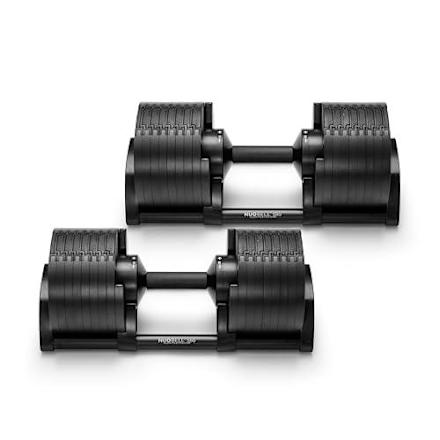
Nuobell
The Nüobell 580s rank as our favorite adjustable dumbbells because they adjust smoothly from 5 to 80 pounds with a simple handle twist. The knurled aluminum grip provides a secure hold even with sweaty hands, and the dumbbells are compact at lighter weights, feeling more like traditional dumbbells than bulky adjustable sets. As you get stronger, you won’t outgrow them because the wide range fits most people’s needs for years of progression. One small drawback, though, is that the plate edges can press into your hands for goblet-style moves.
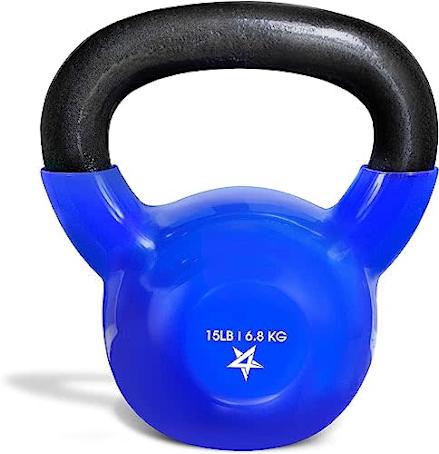
Yes4All
This budget-friendly kettlebell ranks as our top choice for beginners and is ideal for single-arm squat-to-press variations. The lower handle offers better stability and control, keeping the center of gravity closer to your grip. The vinyl coating protects your floors, and the flat bottom makes storage easy. Available in weights as low as 5 pounds, it’s a solid choice for beginners or anyone looking for a kettlebell option without a big investment.
FAQs
Can one exercise replace a full workout?
“No single exercise can perfectly train every major muscle group,” says York. “That’s not how intelligent programming works.” That said, the squat-to-press comes close to a full-body stimulus. If you’re short on time, a few sets of thrusters paired with a pulling movement like rows, along with some core work, can make for a surprisingly complete session.
What weight should someone start with?
Start lighter than you think. A weight you can press overhead for 10-12 clean reps is a good benchmark. For many people, that’s 10-20 pounds per dumbbell. Build your technique first, then add load over time.
Is the squat-to-press strength or cardio?
The squat-to-press is both a strength and cardio move. “The lower body — glutes, quadriceps, hamstrings and calves — does the heavy lifting, powering you out of the squat and driving the movement upward,” says Simms. Heavier weights with lower reps build strength, while lighter weights with higher reps or timed sets push conditioning. Adjust your load and rep scheme based on your goal for that session.
How often should someone do squat-to-press workouts?
Training squat-to-presses one to three times per week works well for most people, depending on your overall program and recovery capacity. If you’re already training legs or shoulders on other days, once or twice weekly is sufficient.
Meet Our Experts
-
Renee Simms, CPT, owner and founder of Alida 126 Personal Fitness, certified personal trainer and master trainer specializing in corrective exercise, functional movement and behavior adaptation
-
Josh York, CPT, founder and CEO of GYMGUYZ; ISSA-certified personal trainer
Our health content is for informational purposes only and is not intended as professional medical advice. Consult a medical professional on questions about your health.