

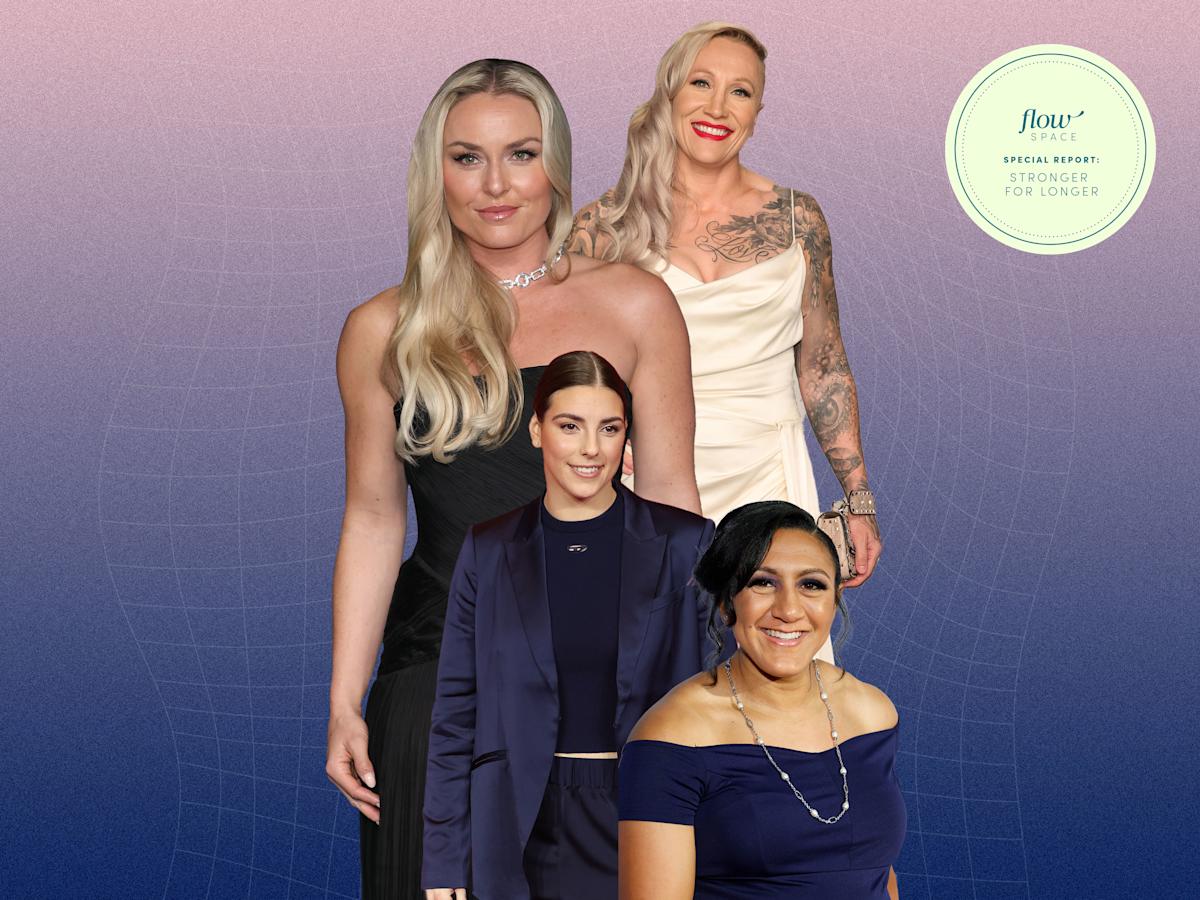
Olympic gold medalist Lindsey Vonn believes her age can be her superpower. She wants “to show people that it’s not a disadvantage to be old.”
This weekend, the 41-year-old professional skier, the first U.S. woman to win gold in alpine downhill, is expected to become the oldest Olympian to compete in the event during the Milano Cortina Games’ opening weekend.
More from Flow Space
-
“If You Slow Down, You Can Hear Your Body Whispering Before It Starts Screaming” & 6 of the Other Best Health Quotes Celebs Gave Us In 2025
“I’ve had a lot of experience as a veteran athlete. I’ve skied these tracks four times more than anyone else. Plus, I like breaking records. So if I’m the oldest woman? So be it,” the pro told People recently.
Though Vonn’s recent injury may affect her competition and performance, her improbable comeback —after five years of retirement and a partial knee replacement — exemplifies what veteran Olympic athletes can teach us. And she’s not the only one. Athletes like 41-year-old bobsledder Elana Meyers Taylor and 40-year-old bobsledder Kaillie Humphries show the strength of women over 40, returning to the Games again and again at peak performance despite setbacks and time off.
So as the world watches the greatest athletes compete, what can we learn from them about strength, resilience, and even aging well?
“When you’re an athlete, you make a lot of sacrifices for things that are short-term enjoyable for the long-term goal,” Brianna Stubbs, a research assistant professor at the Buck Institute for Research on Aging and a two-time world champion in rowing, tells Flow Space. “There’s an awful lot of parallels between the systems that we’re focusing on as an athlete and the systems that we want to keep working really well as we age.”
Here are four insights we can gain from older Olympians’ attributes:
The value of routine
As both a researcher on aging and a former high-performing athlete, Stubbs has a unique perspective on the intersection between aging well and performance training. Routine, she says, is the “big hallmark of people performing at the highest level, and it can be adapted to be appropriate for anyone.”
For high-performing athletes, consistency is essential, particularly for older athletes who have had to build and maintain strength over time. Training sessions are nonnegotiable, and healthy habits are paramount to competing effectively, whether it’s the routine chocolate milk after a strength session or the wind-down ritual before bed that includes meditation.
“There’s something about that athlete mentality that makes things easier because you aren’t making as many choices about what you’re doing,” says Stubbs, who is preparing a talk on what we can learn from older athletes.
Just as an Olympian commits to a rigid schedule or a first-time marathoner begins to block off their weekly long runs, anyone can learn to love consistency if they have a goal in mind. “Goal setting is part of what we do every season, and people should be learning that lesson and applying that to their health,” Stubbs says.
Goal setting is central to establishing a discipline of healthy habits, Stubbs adds, but it doesn’t need to be all-or-nothing. One or two days of training per week is preferable to none. “Start small. Look at where you are and what’s going to be one step in the right direction, rather than looking at what Simone Biles does and expecting that you can do that overnight,” Stubbs says.
As James Clear writes in the renowned book, Atomic Habits, “All big things come from small beginnings. The seed of every habit is a single, tiny decision.”
Strength over size
Stubbs, who is also researching athletes over the age of 65, says older women have long been led to believe that exercise is solely about cardio, like aerobics. “It wasn’t popular to be doing strength. The weight room was a place for men, and women didn’t want to get bulky,” she says. That narrative is changing, and Vonn is an example of it. As she tells People, “I don’t need to be skinny … I just need to be strong.”
Mainstream culture has consistently glorified smallness as ideal for women’s health, but the key to high performance and aging well is strength over size. “Muscle is so protective as we age for our independence and our health,” Stubbs says. “If you are not strong, you are not going to be able to walk up a set of stairs when you’re 85 or 90. Do you still want to be able to pick up a rolling bag and put it in an overhead bin on a plane? How independent do you want to be as you age?” Stubbs says.
It’s why many physicians have advocated for body composition tests that analyze the percentage of body fat and muscle, as opposed to relying on BMI or the scale.
“Building muscle while you can, and protecting yourself against the loss of muscle as you age, is really important,” Stubbs says. “That’s another shared feature of both healthy aging and performance athletes.”
Strength training, which national guidelines recommend at least twice per week, is foundational for countering age-related muscle loss, preventing falls, and lowering the risk of developing chronic conditions, such as cardiovascular disease. Additionally, elite athletes are coached to maximize the benefits of strength training through nutrition.
“A lot of people will tend to under-eat or not quite time what they’re eating right,” Stubbs says, adding that it’s essential to fuel the body with nutrients, protein, and fiber to build muscle after intense exercise. “A lot of people might be tempted to skip refueling after a workout, but that’s where you really reap all of the benefits of the workout.”
The love of a team
Staying socially connected is central to aging well. Social isolation is associated with a 50% increased risk of dementia. The longest study on happiness to date also found that the strength of one’s social connections most heavily predicts someone’s happiness at the end of life. Being an athlete, even in a solo sport, is still about being part of a team, composed of coaches, trainers, and fans.
Hirofumi Tanaka, a professor in the Department of Kinesiology at The University of Texas at Austin, has studied master athletes for years. He has found that, compared with the average person, who has greater difficulty adhering to habits, master athletes have a unique ability to sustain strenuous exercise for years at a time.
“The question is, what is the secret for continuing?” he tells Flow Space. “Turns out, for most of the master athletes, they train in groups, especially under coaches, so they do value those social interactions, go into the training, chat with their fellow athletes, and chat with coaches.”
Tanaka also reports that master athletes, owing to the mood-boosting effects of exercise and the health benefits of social connection, report feeling more positive about their lives than the general population. This mindset can serve as a protective layer against depression, anxiety, and poor mental health, which can lead to poor aging.
If you join the pickleball craze or a group workout class, you may just find yourself showing up more.
The power of grit — and it’s never too late
There’s a lot to learn from older Olympians and athletes about resilience. Many older athletes, celebrated for beating the odds or for being the oldest, return despite setbacks and hiatuses from competition. For athletes who have become mothers, returning to peak strength while balancing training with caregiving can be an added challenge.
41-year-old bobsledder Elana Meyers Taylor told NBC News that being a mother of two and an Olympic athlete has forced her to prioritize what really matters. “It’s this balance between trying to figure out how to get the maximal training in and not maximal amount of time because I literally don’t have the time. We really work on quality over quantity.”
36-year-old hockey player Hillary Knight tells TODAY her prior experience and “exposure to how wild and crazy and awesome the Olympic Games are” has helped her set expectations and show up more powerfully. “I’d like to think I have a good grasp of what that system looks like. That helps me divide up my time and figure out where I need to spend time and energy.”
After knee surgery, Vonn returns to the Olympics with the mantra, “It ain’t over until it’s over!”
Many older female athletes can relate and have had to come back to an uncertain competitive landscape after an injury or setback to climb “further on up that mountain again,” Stubbs says.
It’s a lesson that if you have a passion for something, age is not your enemy. Perhaps it’s the experience and wisdom that is your superpower. In researching older high performers, Stubbs says they consistently maintain a joy for the craft. “They found something that they really love, and that’s why they’re still doing it,” Stubbs says. “There’s a definite enjoyment of what they do and an adaptability to kind of shift things up.”
No matter your age, finding something you enjoy and can become disciplined in is central to creating a healthy habit that sticks.
It’s not about trying to become an Olympian or perfectly emulate their routine. In fact, overtraining entails costs and is detrimental to longevity if you overexert your body or sustain injuries. As Stubbs points out, everything someone may do to win gold may not be everything you should do to age well. “There’s a difference between performance optimization and health optimization,” she says.
Still, the core principles and disciplines that have led Olympians to the grand stage are consistent with ongoing research on what it means to age well and to improve the duration of good health.
“Athletes aren’t perfect [either],” Stubbs says. “If you had a scale, the balance of your good choices had to outweigh the balance of your bad choices. It’s not that there can never be any bad choices. You just want to stack up more on the good.”
Despite having stepped away from competing, Stubbs says she’s still an athlete, in that the mindset continues to serve her whole health today. It’s something we can all learn from.
“If you’ve got that mentality where you care about your body because you want it to be able to do things for you, then it’s fine to identify as an athlete, even if you’re not competing at that sort of level,” she says.