

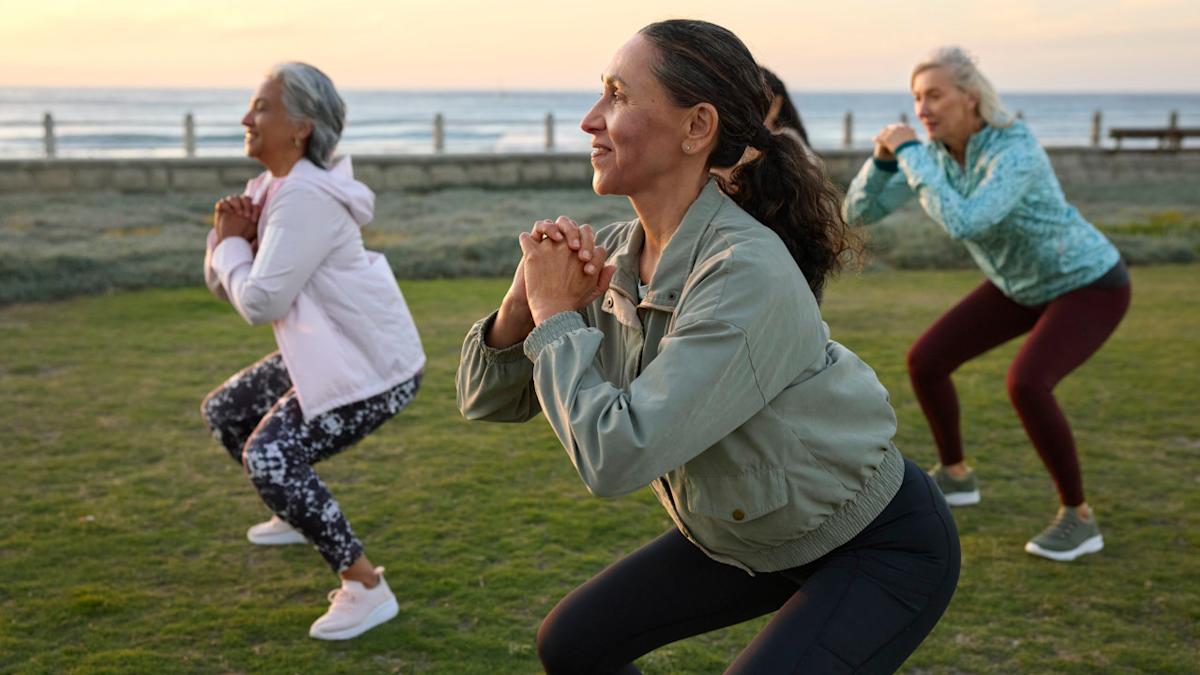
Maintaining strong, healthy bones becomes more important than ever as you age. Preserving bone density helps ward off chronic pain and prevent serious conditions like osteoporosis, keeping you mobile and confident into your golden years. After age 30, you begin to lose lean muscle at a rate of 3% to 8% every decade without regular strength training. In addition, hormones shift, metabolism slows and bone density declines. That’s why it’s essential to weave weight-bearing exercises into your workouts.
What makes weight-bearing movement crucial for preserving and boosting bone density? It makes your bones all-around stronger.
According to Dr. Taylor Dunphy, MD, orthopedic surgeon and sports medicine specialist with Hoag Orthopedic Institute in Southern California, “Bone is a living tissue that is constantly being turned over by cells called osteoblasts (builders of new bone) and osteoclasts (removers of old / damaged bone). Bone density is driven by Wolff’s law, which states that bones become stronger under increased stress and weaker (resorbed) under decreased stress.”
Weight-bearing workouts force your body to train against resistance, thanks to gravity. Whether you’re a total beginner or looking to add functional movement to your training sessions, challenging your body with impact can improve strength and balance, increase cardiovascular and muscular endurance, avoid injury and help manage your weight and metabolism, explains Sarah Pope, Certified Personal Trainer at Life Time Clarendon.
Pope adds, “Improving bone density as we age is most important for constant stimulation of bone remodeling due to the natural aging process. As we age, maintaining a strong ‘frame’ (hips, spine, grip strength and legs) will ensure decreased risks of physical limitations and mental illness occurring.”
To help maximize your workouts, we spoke with experts who share the best weight-bearing moves to perform on a daily basis. From deadlifts to jumping rope, there’s something for every fitness level.
🩺SIGN UP for Parade’s health newsletter with expert-approved tips, healthy eats, exercises, news & more to help you stay healthy & feel your best self💊
7 Best Weight Bearing Exercises for Stronger Bones
Compassionate Eye Foundation/Jonathan Bielaski/Getty Images (Compassionate Eye Foundation/Jonathan Bielaski/Getty Images)
1. Brisk walking or running
Lacing up your shoes and heading out for a brisk walk or run works wonders for the mind, body and soul—research says so! Dr. Dunphy recommends performing this exercise 30 minutes a day. To make it more challenging, consider strapping on a weighted vest that’s 5% to 10% of your body weight.
“[A brisk walk or run] provides repetitive ground reaction force through the tibia, femur and hip; [helps you] maintain lower-extremity cortical bone, [and is] safe foundational stimulus for most age groups,” Dr. Dunphy explains. “Walking alone won’t dramatically increase BMD in younger adults, but it’s excellent for maintenance and fall prevention.”
Related: The One Strength Move Everyone Over 60 Should Do for a Longer Life, According to Trainers
2. Bodyweight squats
The bodyweight squat is a classic move that promotes a stellar lower-body burn—and it’s a great starting point. As you progress, you can incorporate weights to make the movement more challenging. Dr. Dunphy notes that heavy resistance (70% to 85% of your one-rep max) is more effective for stimulating bone growth than high-rep light loads.
-
Begin standing tall, feet shoulder-width apart.
-
Place your hands on your hips or extend them out in front of you.
-
Bend at the knees and hips to lower into a squat, descending until your thighs are parallel to the ground.
-
Drive through your heels to return to standing, squeezing your glutes at the top of the movement.
-
Perform 3 sets of 8 to 12 reps.
Related: ‘I’m 85 and in the Best Shape of My Life—Here’s the Exact Workout Routine I Swear By’
3. Farmer’s carry
The farmer’s carry is a simple yet productive exercise that boosts grip strength, core stabilization, and full-body bone strengthening.
-
Begin by holding a heavy dumbbell or kettlebell in each hand by your sides.
-
Start walking forward with control, keeping your torso still.
-
Perform 3 to 4 sets of 30 to 45-second carries.
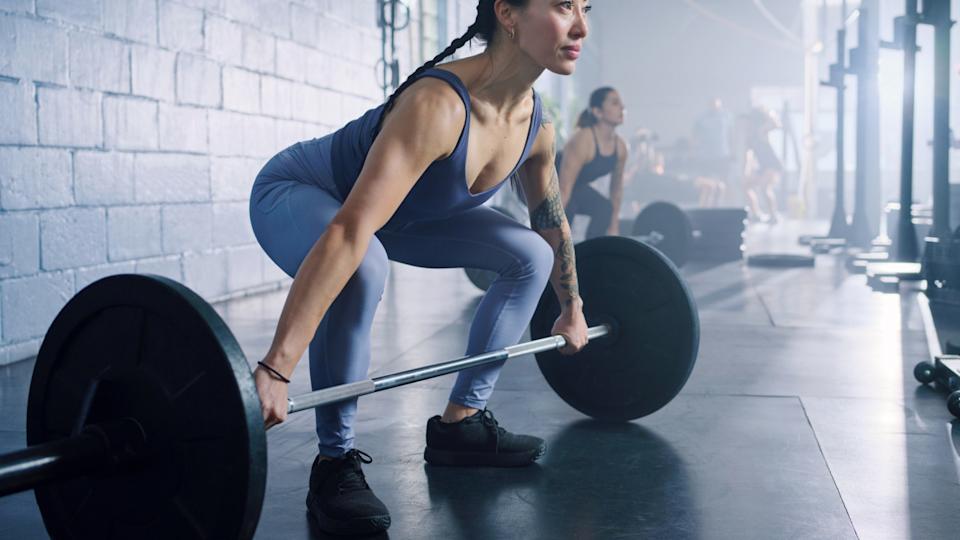
4. Deadlifts
“[The deadlift is] one of the most osteogenic resistance movements when performed safely,” explains Dr. Dunphy.
-
Stand tall with your feet shoulder-width apart, toes pointed out slightly, and a barbell positioned over your mid-foot.
-
Hinge at the hips and bend your knees to grab the barbell. Use an overhand grip just outside knee-width.
-
Activate your core, maintain a tall chest and press through your heels to rise up and lift the barbell.
-
Squeeze your glutes once you reach the top of the movement.
-
Hinge at the hips and use control to lower the barbell toward the ground.
-
Perform 3 sets of 5 to 8 reps, using a moderate to heavy load.
Related: Over 60? This Everyday Exercise Could Be Harming Your Joints
5. Jumping rope
Jumping rope isn’t just a beloved activity for kids. This weight-bearing movement serves as a great workout for both your bones and brain.
-
Begin by standing tall with your feet together.
-
Hold the jump rope handles in each hand with your elbows tucked in.
-
Use your wrists to swing the rope overhead.
-
Lightly jump over the rope, making sure to land on the balls of your feet.
-
Perform 2 to 3 sets of 30 to 60 seconds of jumping.
6. Resistance band rows
“Rows strengthen the upper back and promote proper alignment, supporting spinal health,” notes Josh York, Certified Personal Trainer, Founder & CEO of GYMGUYZ at GYMGUYZ.
-
Start by anchoring a resistance band to a sturdy pole at chest height.
-
Stand tall, feet hip-width apart, holding the handles with both hands as you face the anchor point.
-
Bend your elbows and pull the band toward your body.
-
Squeeze your shoulder blades together.
-
Use control as you extend your arms back to the start position.
-
Perform 3 sets of 12 reps.
Related: The #1 Type of Exercise You Should Start Doing ASAP if You Want To Live to 100, According to PTs
7. Jumping jacks
If your joint health allows for it, jumping jacks offer a low-impact cardio movement that stimulates the bones.
-
Start by standing tall with your feet together and arms at your sides.
-
Jump both feet out into a wide stance while simultaneously lifting both arms overhead.
-
Quickly jump your feet back together while lowering your arms.
-
Continue to perform jumping jacks at a steady pace, keeping the landing soft through your feet.
-
Complete 3 sets of 20 reps.
Final Takeaways
Aging doesn’t mean you’re “getting weaker.” While bone loss occurs gradually, you have more control than you’d think. Weight-bearing workouts are one of the absolute best ways to maintain strong, durable bones.
“When you move your body against gravity, whether that is lifting weights, doing squats or even walking briskly, you are basically telling your body, ‘Hey, we still need this strength,’” says York. “And your bones respond by reinforcing themselves.”
By performing weight-bearing exercise on a regular basis, you’re not only protecting your bones—you’re also boosting balance and stability while sculpting lean muscle. That resilience truly means everything and keeps you doing the activities you love most as you age.
Up Next:
Sources:
-
Volpi, E., Nazemi, R., & Fujita, S. (2004). Muscle tissue changes with aging. Current Opinion in Clinical Nutrition & Metabolic Care, 7(4), 405–410.
-
Dr. Taylor Dunphy, orthopedic surgeon and sports medicine specialist with Hoag Orthopedic Institute in Southern California
-
Sarah Pope, Certified Personal Trainer at Life Time Clarendon
-
Legrand, F. D., Jeandet, P., Beaumont, F., & Polidori, G. (2022). Effects of outdoor walking on positive and negative affect: Nature contact makes a big difference.Frontiers in Behavioral Neuroscience, 16, Article 901491.
-
Josh York, Certified Personal Trainer, Founder & CEO of GYMGUYZ at GYMGUYZ
This story was originally published by Parade on Feb 22, 2026, where it first appeared in the Health & Wellness section. Add Parade as a Preferred Source by clicking here.