


By Paola Portillo, Special for CalMatters
This commentary was originally published by CalMatters. Sign up for their newsletters.
Guest Commentary written by
A year after taking over Children’s Hospital Oakland, the UC San Francisco decision to move critical pediatric care out of Oakland has left East Bay children and families to cope with the consequences.
As a clinical social worker and therapist supporting children with sickle cell disease, cancer and other serious illnesses, I support families who already must manage fear, financial strain, transportation barriers and the immense demands of caring for a sick child.
Families of immunocompromised children are now being told to avoid infection risks and unnecessary exposure, while they’re being forced to take Ubers to access care that used to be available in Oakland. They are being put in the impossible position of choosing between being at the bedside of a critically ill child in San Francisco, or working or caring for other children at home in the East Bay.
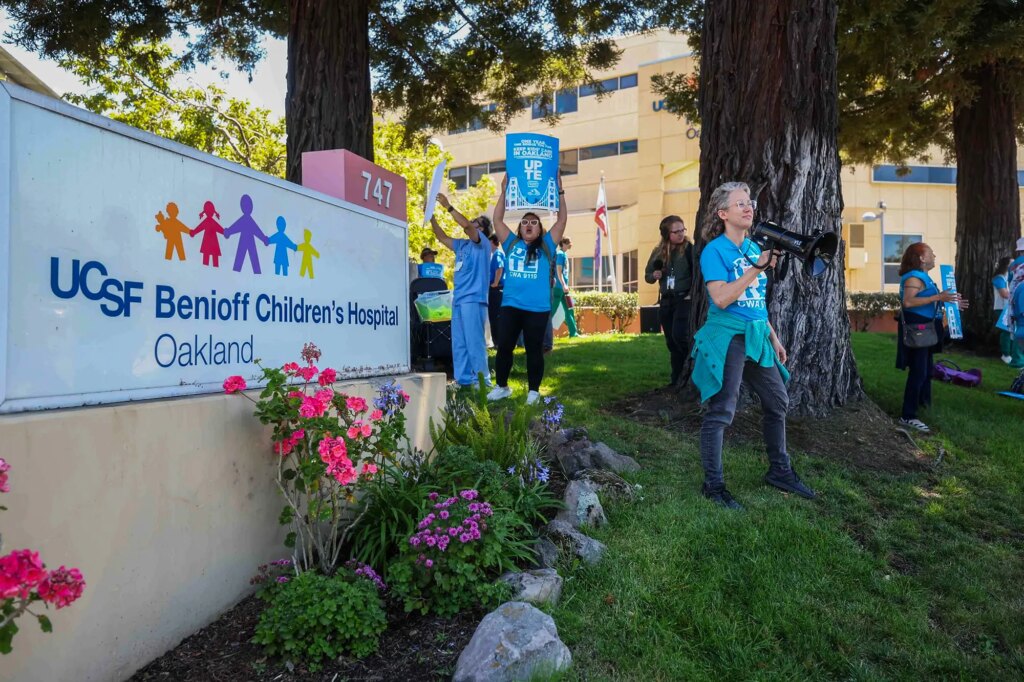
For generations, Children’s Hospital Oakland has been a safety-net institution for the East Bay. Recently, I joined families, community members, elected leaders and more than 100 of my colleagues at the hospital — now called UCSF Benioff Children’s Hospital in Oakland — at a rally to call on UCSF to keep these services in Oakland.
The hospital serves large numbers of low-income families, immigrant families, undocumented families and children covered by Medi-Cal. It is one of only five Level 1 pediatric trauma centers in California, and it’s where families across Alameda County turn when their children need specialized care close to home.
But since UCSF took over, workers and families have watched the hospital move key pediatric services — including bone marrow transplant care, interventional radiology and specialty testing — into San Francisco facilities.
One of the patients I currently work with has received care at the Oakland hospital for years, and built a trusting relationship with their care team. UCSF moved their services to Mission Bay, where they must cross the bridge for appointments with an unfamiliar transplant team.
The patient’s caregiver coordinates Uber rides, wakes them before dawn, helps them fast for hours and rearranges work and family responsibilities for every visit. If complications arise after their transplant, they’ve been told to go to the Oakland emergency department, and then, if admitted, they will be transferred across the Bay — in the middle of a medical crisis.
The decisions made in UCSF board rooms also raise racial justice concerns.
Sickle cell disease overwhelmingly affects Black patients, and Oakland’s Black children and families have long relied on the children’s hospital for specialized, trusted, culturally competent care. Moving pediatric care from Oakland to San Francisco deepens already pervasive structural inequities and serves as a potent metaphor for who our health system increasingly works to serve.
Why should East Bay families be forced to travel across the Bay for specialized pediatric care that has long been available in Oakland?
UCSF has the resources to make different choices. It has invested billions in major expansions, real estate purchases and San Francisco-centered priorities. It cannot credibly argue that Oakland children must accept reduced access, thinner staffing and fragmented care while making those investments elsewhere.
In 2020, Alameda County voters overwhelmingly approved a half‑percent sales tax in part to fund children’s healthcare, including staffing, equipment and pediatric services connected to the Oakland children’s hospital. As services move away from the community voters intended to support, we deserve greater transparency about how Measure C funds are being used.
The Oakland children’s hospital must remain a center of pediatric care for Oakland, Alameda County and the East Bay. UCSF must stop moving critical services, restore specialized care at children’s hospital, and meet directly with workers and families. After all, we’re the ones working alongside our patients during some of the hardest moments of their lives.
Kids and families don’t need more obstacles to receiving life-saving care. But that safety is being stripped away, service by service, decision by decision.
This article was originally published on CalMatters and was republished under the Creative Commons Attribution-NonCommercial-NoDerivatives license.