

Despite the recent unrest in France, the country’s popular Christmas markets are scheduled to take place, many opening in mid-November. Paris alone will offer about a dozen marchés de Noël; this year sees the debut of the Place de l’Étoile-Grande Armée Market and the return of the Champs-Élysées Christmas Market.
Some of the most popular French marchés are held in Alsace, a region with a Franco-Germanic holiday heritage dating to the 1500s. These markets can get crowded—Strasbourg alone attracts some three million visitors during the festive season. To steer clear of a lot of the congestion, follow common-sense rules: visit early in the day, mid-week, and during the quieter opening weeks of les fêtes. Another way to avoid big crowds is by heading to one of Les Plus Beaux Villages de France (the country’s certified most beautiful villages) to experience a Christmas market on a more intimate scale.
PARIS
Paris has numerous Christmas markets.
While Strasbourg is often referred to as France’s “capital of Christmas,” the country’s actual capital, Paris, goes all out for the holidays, with various marchés de Noël throughout the city. The best-known market is held in the Tuileries Garden (November 14—January 3, 2027) with 100 chalets to shop, plus an ice-skating rink for those seeking a winter workout. There’s even a Ferris wheel to take in the City of Light from on high.
Advertisement
Advertisement
Returning this year after a nearly decade-long hiatus is the Champs-Élysées Christmas Market (November 22—January 4, 2027), set close to the hundreds of light-strewn trees on this famous boulevard. For this new engagement, the roughly 200 chalets focusing on French crafts and culinary treats will be set up in the renovated Champs-Élysées Gardens. At night, the market’s lighting will add more luster to the boulevard’s dramatic sound and light displays playing out amid the trees.
The Champs-Élysées with Christmas lighting leading up to the Arc de Triomphe.
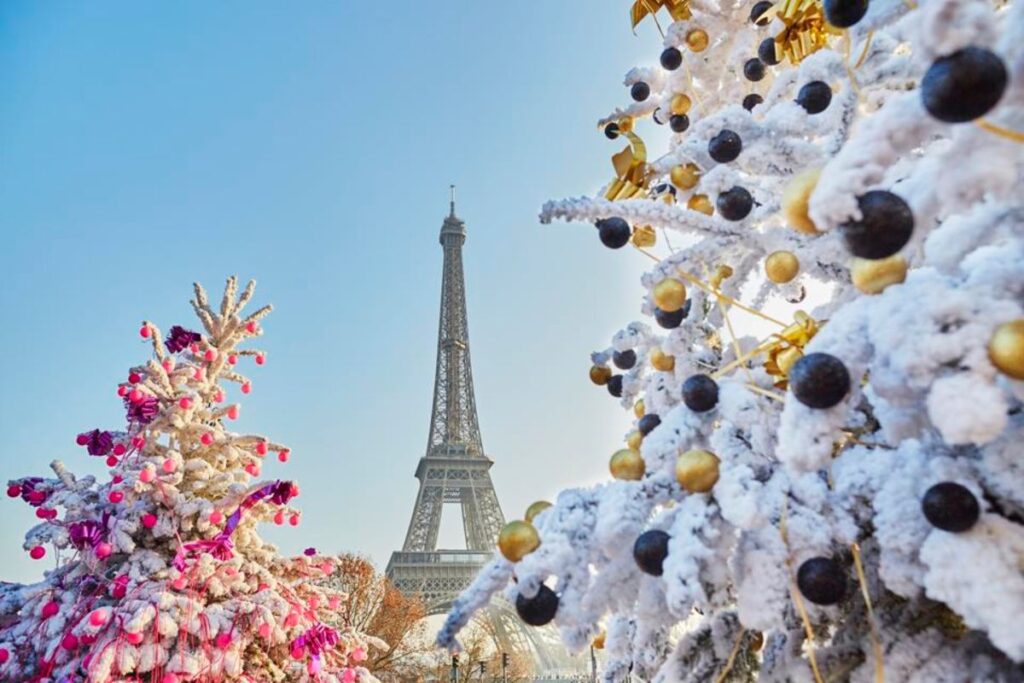
If you still haven’t had enough of the holiday spirit, you can stop by markets at iconic landmarks, like the Notre-Dame Christmas Market (November 26—December 27) at the Square Viviani, known for its exclusively French artisan wares, and the Eiffel Tower Christmas Market (December 5–January 3, 2027) at the Quai Jacques Chirac.
Holiday trees in the Place de la Concorde. (Photo by STEPHANE DE SAKUTIN/AFP via Getty Images)
There are other fairs, like La Défense Christmas Market, November 12–December 31; Saint-Germain-des-Prés Christmas Market (November 27—January 6, 2027); the Hôtel de Ville Christmas Market (December 4—January 3, 2027), and the new Place de l’Étoile-Grande Armée Market (November 20—December 23) located near the Arc de Triomphe.
What to eat and drink: Well, it’s Paris, so the options are endless, but at the fairs expect marrons chauds, the donut-like beignets, the custard canelés pastries, pudding-thick hot chocolate, and even Champagne bars.
REIMS (Grand Est)
Reims’ Christmas market in front of the Notre Dame cathedral. (Photo by FRANCOIS NASCIMBENI/AFP via Getty Images)
Regal Reims—33 coronations of French kings took place here—is the also epicenter of French Champagne with grandes marques like Veuve Clicquot, Taittinger, and Mumm all located in the city. So when visiting the Marché de Noël (November 25—December 27), expect a backdrop of grand architecture with a soaring Gothic cathedral and a palace fit for a king, and at the holiday market chalets serving up the local bubbly. This marché, France’s third largest with about 150 chalets, sprawls along the Hautes Promenades Jean-Louis Schneiter and onto the Esplanade de la Porte de Mars. Not to miss: the multimedia Regalia light show that lights up the facade of Reims’ Notre Dame.
Advertisement
Advertisement
What to eat and drink: Biscuits Roses de Reims, a crispy sponge cookie; the almond biscuits croquignoles de Reims; nonnettes, small gingerbread cakes with a marmalade filling, and, of course, the local Champagnes.
Metz (Grand Est)
Metz attracts between one and two million visitors to its Christmas market (November 20–December 30, 2026), making it France’s second most-popular marché de Noël. Travelers come for a hefty dose of Germanic and French traditions and plenty of culinary samplings (oysters, snails, fondues). Metz is also known for its Sentier des Lanternes (Lantern Trail) in the Square Boufflers with 2000 lamps illuminating a walking path that takes you through various holiday mise-en-scènes. At the Place de la Comédie, a high-end culinary market offers sit-down dining. As in Paris, there’s also a Ferris wheel, here located at the Place d’Armes.
What to eat and drink: Metz is known for its Mirabelle plums, a special cultivar of golden plums, so expect plenty of sweets and jams made with the fruit, as well as eau-de-vie liqueurs. Also try the boulets de Metz, a chocolate and almond pastry; the chocolate pralines; and Saint-Nicolas en brioche, a buttery sweet bread.
Strasbourg (Alsace)
The Rue Mercière in Strasbourg, which was recently ranked as the most photogenic Christmas market in Europe, by Popsa, a photo-curation platform.
Half-timbered houses in Petite France in Strasbourg.
The largest and most visited Christmas market in France, Strasbourg’s Marché de Noël attracts millions each holiday season and runs this year from November 27—December 24. Dubbed the “capital of Christmas” for good reason, the city hosts some 300 chalets that sprawl out over Strasbourg’s squares and streets. Certain events are devoted entirely to artisans and artists, for example, the Noël Onirique, held in the historic Léon XIII Hall, presenting embroidered works, jewelry and watercolors. The OZ Métiers d’Art craft showcase is located in the 18th-century Aubette building, also the site of the Noël de la brocante Antique and Flea Market. The Aubette, on the Place Kléber, the city’s main square, is also where you’ll find Strasbourg’s enormous Christmas tree, called the Grand Sapin.
Advertisement
Advertisement
What to eat and drink: Vin chaud blanc (white mulled wine) and hot apple cider to accompany a slice of schnitzbrot, or Alsatian fruit bread, and pain d’ épices, the regional gingerbread.
Colmar (Alsace)
One of Europe’s most photogenic spots, Colmar, like Strasbourg, lies close to the German border. Thanks to its geography and history, this movie-set ready spot offers a mash-up of the two countries’ architectural, cultural and culinary traditions; think France with a spirited German overlay or Germany with a French twist. The half-timbered houses (maisons à colombage), often in pastel colors, provide a scenic backdrop for the six Christmas markets that are staged in the historic center (November 23—December 29) with about 60 chalets in the Place des Dominicains and roughly 50 at the Place de l’Ancienne Douane. Children have their own dedicated market at Place des Six Montagnes Noires, and foodies head to the Place Jeanne D’Arc for local culinary treats, like charcuterie and schnapps.
What to eat and drink: Tarte aux myrtilles, made with wild mountain bilberries (which are like blueberries); pain d’épices, a honey and spice loaf; and Alsatian pretzels. Try the locally produced Gewürztraminers and Rieslings, the sparkling white or rosé Crémant d’Alsace, and the fruit brandies.
Les Plus Beaux Villages de France (The Most Beautiful Villages of France)
Rochefort-en-Terre (Brittany)
The medieval village of Rochefort-en-Terre.
With evocative centuries-spanning architecture ranging from Gothic to 19th-century styles, Rochefort-en-Terre, like Colmar, is known for an almost stage-set-perfect beauty. The town’s timber-frame and stone houses lining cobblestone streets, which are decorated with white lights during the holidays, provide an especially magical backdrop for the Christmas marché, called La Magie de Noël (November 27—January 3, 2027). The Rochefort-en-Terre market features only a handful of chalets on the Place des Halles, although numerous artisan workshops can be shopped throughout the season.
Advertisement
Advertisement
What to eat and drink: Crepes; kouign-amann, a caramelized butter cake; the gâteau breton, a dense shortbread cake filled with jam or salted caramel; and the local pralines. Drink the hot mulled wine, Breton ciders, and local artisanal liqueurs.
Eguisheim (Alsace)
The Christmas market in Eguisheim. (Photo by PATRICK HERTZOG/AFP via Getty Images)
With its circular layout, cobbled streets and colorful timbered houses, Equisheim, lying a short distance (seven kilometers) from Colmar, is an Insta favorite, made all the more appealing when decked out for the holidays. The market this year runs from November 27—December 30 with roughly 30 artisanal stalls or chalets set up in different parts of the village, like the Place du Marché and Place du Château du Saint-Léon, where you’ll find Eguisheim’s main Christmas tree.
What to eat and drink: The spiced bredele cookies made primarily during the holiday season and the kougelhopf, a raisin and almond brioche cake. In addition to the white or red wine vin chaud, sample the renowned local whites Riesling and Gewürztraminer from Grand Cru vineyards, Eichberg and Pfersigberg.
Lourmarin (Provence)
Night panorama of Lourmarin.
Lourmarins, with a stately Renaissance-era castle, lively café scene and famous Friday market, has long been a sought-after destination in Provence. The town, an hour’s drive north of Marseille, typically runs its holiday marché the weekend before Christmas (this year December 19—20), with about 80 artisan and food stalls. At this market you can find the famous painted Provençal santons (nativity figures made of clay), scented products, and homeware items crafted from olive wood. There’s a walking tour, Un Noël Provençal à Lourmarin, scheduled for the 19th that includes samplings of seasonal foods. Horse-drawn carriage rides for children will also be available during the fair.
Advertisement
Advertisement
What to eat and drink: Gibassier, an olive oil bread with anise seed and orange flavorings; glazed chestnuts; fruit confits, or candied whole fruits; and dates filled with marzipan. Vin Cuit, a dessert wine, is popular at this time of the year.
Les Baux-de-Provence (Provence)
At 245 meters, Les Baux-de-Provence commands sweeping views of the Alpilles mountains and the Camargue wetlands. A medieval fortress village with narrow, steep streets that makes it a challenge to set up the traditional array of holiday huts and chalets, Les Baux hosts a different and intimate take on the Christmas experience. For the Noël aux Baux, a month-long celebration, centuries-old traditions are commemorated with Provençal crèches situated in different areas of the village. A live sheepfold is also set up with a local shepherd tending to his flock, which is lead through Les Baux during the day.
A Santon made by master santonnier, Roger Juve, in Luynes. (Photo by Gérard SIOEN/Gamma-Rapho via Getty Images)
Visitors can also head to the Musée des Santons, displaying historic hand-painted terracotta nativity scenes crafted in Provence, along with figurines from other parts of Europe.
What to eat and drink: Les Treize Desserts, or Thirteen Desserts, consumed on Christmas Eve, a number representing Christ and the twelve apostles. It consists of traditional breads, pastries, nougat, fresh fruit and nuts. Mulled wine, as elsewhere, is the go-to seasonal drink.
Advertisement
Advertisement
This article was originally published on Forbes.com
Source link