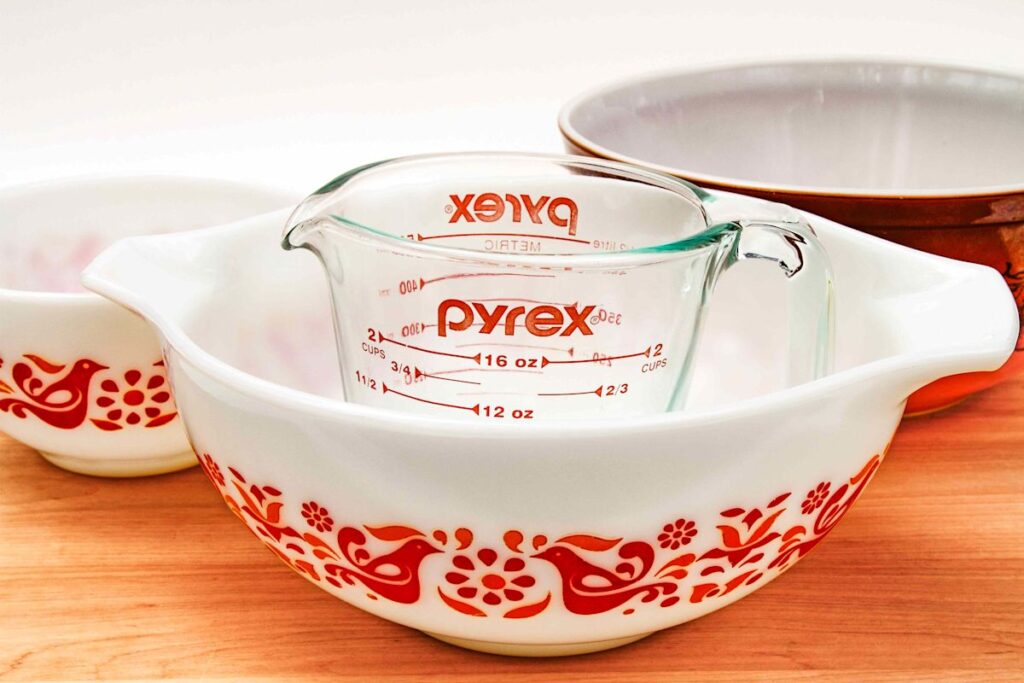
Everyone loves being let in on a little secret. I certainly do. When I heard that vintage Pyrex and modern Pyrex aren’t made from the same glass and one is more likely than the other to suddenly explode, I thought wow, that’s interesting.
Some articles and social media videos say to tell the difference between the two, just look at the logo. If it’s “PYREX” in all caps, it’s vintage and made of borosilicate. If it’s “pyrex” in lowercase, the piece is newer and made of tempered soda-lime glass. Borosilicate is more resistant to thermal shock, and therefore safer … so if vintage Pyrex is what you have, you’re in luck! Right?
Only it’s wrong. Though oft-repeated, this claim is an urban myth. Vintage Pyrex may be cute, but it’s not automatically better.

Credit: Simply Recipes / Amazon
The Truth Behind the Misconception About Vintage Pyrex
Knowledgeable collectors and glassmaking experts have attempted to dispel this story for years, but it simply won’t go away. To understand why it matters, you need to know about exploding Pyrex, which is not a myth. Glass is a brittle material with no flex. As it expands or contracts during rapid heat changes, it can experience what’s called thermal shock and suddenly break.
Originally, Pyrex was made from borosilicate, which is more resistant to thermal shock than the tempered soda-lime glass the company began using in some pieces in the 1940s. Soda-lime glass has its own advantage of holding up better to impacts. New Pyrex pieces are all made from soda-lime glass.
Though you may have read otherwise, the capitalization of the Pyrex logo alone won’t tell you which glass it’s made of. This comes from no greater authority than the company that invented it.
According to a post on Corning Museum of Glass’ Rakow Research Library, “The change from upper to lower case signified a re-branding of the trademark Pyrex in the late 1970s but is not a conclusive way to determine, historically, what type of glass formulation the product is made from.”
It’s Not the Glass, But How It’s Used
Given a choice between borosilicate and soda-lime glass, “both are good options,” says Joseph Taylor of the retailer DankGeek. (“Most of what we sell gets hit with a direct flame every day, so we think about thermal shock and tiny cracks a lot more than most people do,” he explains.) “If used properly, you won’t notice much difference.”
What precautions should cooks take with glass cookware? “During use, avoid drastic temperature changes: no freezer to oven, no cold liquid in a hot dish, no hot dish on a cold or wet counter. Set hot dishes on a dry towel or trivet rather than straight onto a hard surface, and keep glass bakeware off the stovetop and broiler.”
Roughly handled Pyrex can develop micro cracks. These cracks make it more susceptible to thermal shock, regardless of its age. “The first thing home cooks should do is inspect their dishes before use and store them safely. I’d pick a clean old dish over a scratched-up newer one.”
Or vice versa. The key to safer glass cookware isn’t baking in grandma’s Pyrex exclusively. It’s common sense.
Read the original article on Simply Recipes