

For decades, solo travelers looking to book an organized tour have faced an infuriating compromise: either pay a punishing “single supplement” fee that jacks up the trip price by 50 to 100 percent, or accept roommate roulette with a complete stranger.
At Women Travel Abroad, where the average guest is 60 years old, owner and CEO Katherine Butler-Dines is proving that mature travelers are officially done with both options. Looking ahead at 2027 bookings, the biggest shift driving sold-out departures isn’t a hot new destination or a flashy hotel perk—it’s the promise of private, solo rooms as the standard baseline, with zero penalties and no shared-space anxiety.
“Single occupancy as the default is the single biggest differentiator for our brand,” Butler-Dines explains. “And it’s something that once you realize that that exists in the world, women keep coming back to us because they’re like, ‘I don’t want to have to deal with a roommate and I really value that I can just show up and have my own room.'”
Advertisement
Advertisement
While the no-roommate model originally started to avoid interpersonal drama on the road, Butler-Dines found it solved some of the most stressful operational issues in the entire group travel industry.
“When we send a group of people, we’re not having to worry about, oh, are they going to get along? Are people going to be coming to us at 10 p.m. at night saying my roommate snores?” Butler-Dines says. “Those are the sorts of things that make a trip stressful for an unnecessary reason. And I think it’s stressful for the traveler to be matched with a random person.”
To make guaranteed single rooms possible without passing along markups, the company sidesteps massive chain hotels in favor of independent, locally owned boutique properties that happily block 10 to 11 individual rooms per group.
“As a traveler, you have a much more authentic experience when you’re staying at a boutique hotel versus a Marriott,” Butler-Dines says. “You know what you’re getting with a Marriott, which is the benefit. Some people really care that the shower is going to look a certain way, the bathroom is going to be a certain way, king-size bed is going to always be there. Totally valid. [But] if you are someone who values immersing yourself in the local culture, staying at locally owned boutique hotels is going to give you a much more authentic feeling of the destination.”
Advertisement
Advertisement
By partnering with charming properties that reflect their surroundings—like family-run seaside stays where guests wake up directly over the water—travelers get both the privacy of their own room and an immersion into the neighborhood that standardized corporate chains simply can’t match.
Related: How Travel Expert Jen Ruiz Turned a Mediterranean Breakup Into Her Next Big Chapter
Why Capping Groups at 10 Unlocks Real Dining and Flexibility
A room of one’s own is only half the battle. The other major trend reshaping how women over 55 travel is a rebellion against massive 40-person motorcoach tours. By capping every departure between eight and 10 guests, small-group operators can deliver an experience that feels like traveling with friends rather than being herded through a turnstile.
Nowhere is that difference more obvious than at the dinner table.
Advertisement
Advertisement
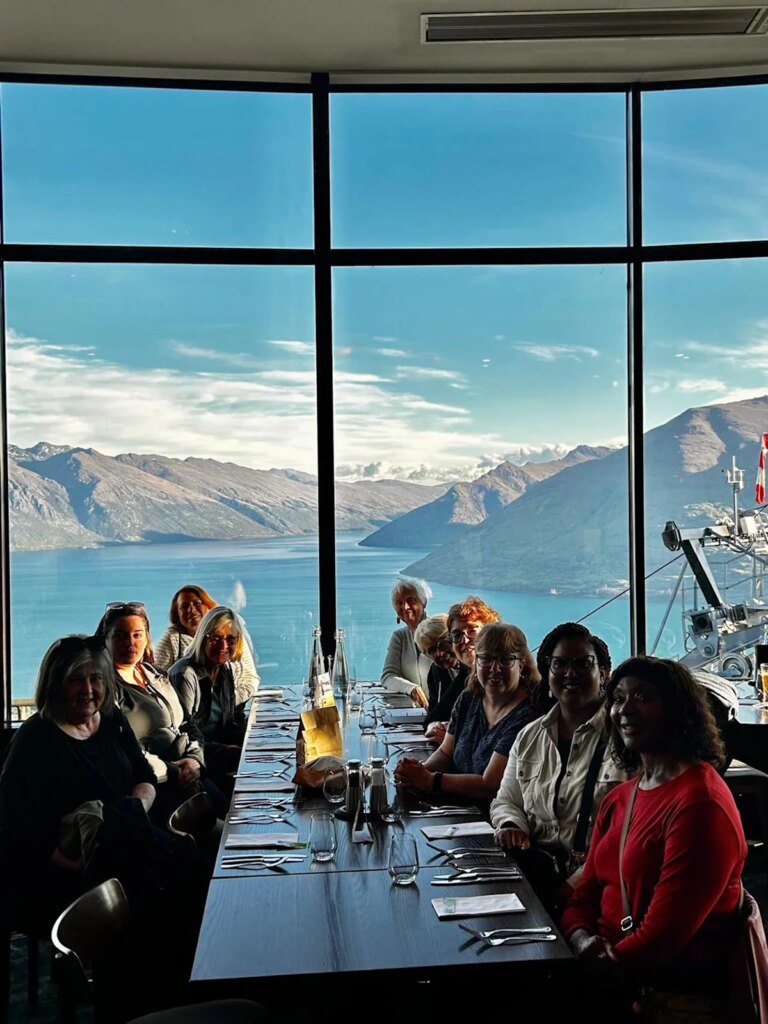
“When you have more than 10 people, and again, we have 10 travelers plus two trip hosts, so really it’s 12 people. We are still at the size where we can go into almost any local restaurant and get seated,” Butler-Dines explains. “Twenty people, especially in Europe, especially at smaller local restaurants, like you’re going to end up eating at the hotel every night. Or what most larger tour groups do is they just don’t include meals because they’re like, ‘We can’t figure out where to take you for dinner that fits everybody.'”
For solo travelers, that shared evening meal is crucial.
“People who are solo travelers, one of the biggest fears they have is dining alone and figuring that out,” Butler-Dines says. “And so they really want to have dinner as a group every night. And if our groups were bigger than the 10 travelers plus two hosts, we just wouldn’t be able to eat at local authentic restaurants.”
Keeping groups nimble also protects downtime. A guided morning walk through Florence that takes four hours with a dozen people can stretch into an exhausting eight-hour marathon with a crowded tour group.
Advertisement
Advertisement
“With a small group, you get back to the hotel at two o’clock and you have three hours of free time before you meet for dinner,” Butler-Dines says. “Versus if you were with a big group, you’re not going to get back to the hotel until 5:00 or 5:30, and you’re going to be exhausted. The flexibility of the timing of a small group is really important to us.”
Related: Traveling Solo After 55? Travel Advisors Share the 3 Crucial Details to Check Before You Book
Why Seasoned Travelers Over 60 Are Shifting to Food and Wine
For women in their sixties who have already checked off the marquee tourist landmarks—who have already posed in front of the Eiffel Tower, wandered through the Colosseum, and navigated the major European capitals—the desire to sprint through a region just to snap postcard photos has completely vanished. Instead, experienced travelers are increasingly booking immersive culinary and wine itineraries.
“If you’re a really well-traveled person, but you’re looking for something very immersive, doing a food and wine tour, whether it’s with us or somewhere else, is really good for that,” Butler-Dines says. “I love food. I love discovering a destination through its food. And I think that you might have been to France, but going to Bordeaux or our cruise through Provence, those regions can feel very different, or are even better, when you’re going with a focus on taking cooking classes, on going to local vineyards.”
Advertisement
Advertisement
Rather than rushing between scenic overlooks, the focus shifts to unhurried, hands-on experiences. On an Amalfi Coast itinerary, for example, guests take three different regional cooking classes over the course of a week. In Bordeaux, itineraries are built around intimate vineyard tastings where travelers connect directly with local winemakers.
“If you’re really well-traveled, but you’re looking for something that is very immersive—where you’re going to come home having really learned about a country, a culture, its people—then a culinary-focused tour, a food and wine type tour, is really good for that.”
By ditching roommate anxiety, swapping 50-passenger buses for cozy neighborhood tables, and exploring destinations through local kitchens and cellars, travelers over 55 are sending a clear signal for 2027: true travel luxury isn’t about doing more—it’s about having the space, time, and comfort to savor every minute.
Related: We Asked 3 Travel Advisors the Best Caribbean Island for Travelers Over 60—They All Said the Same Place

This story was originally published by Parade on Oct 26, 2026, where it first appeared in the Travel section. Add Parade as a Preferred Source by clicking here.
Source link