The COVID lockdown left many people eager to fill unexpected free time in their days. Some discovered new hobbies or found comfort in the ritual of sourdough baking. I became obsessed with perfecting specific recipes, making small tweaks over and over until it was just right. First, it was tiramisu, until I turned my attention to breakfast.
Previously, breakfast was a cup of yogurt balanced on my lap and eaten one-handed in Boston morning traffic—my steering wheel had the splatters to prove it. With nowhere to go, breakfast stopped being purely utilitarian and became an egg-centric project I could dive into. I made batch after batch of scrambled eggs, comparing them side-by-side to find the technique that yielded the creamiest curds and the fat that produced the best flavor.
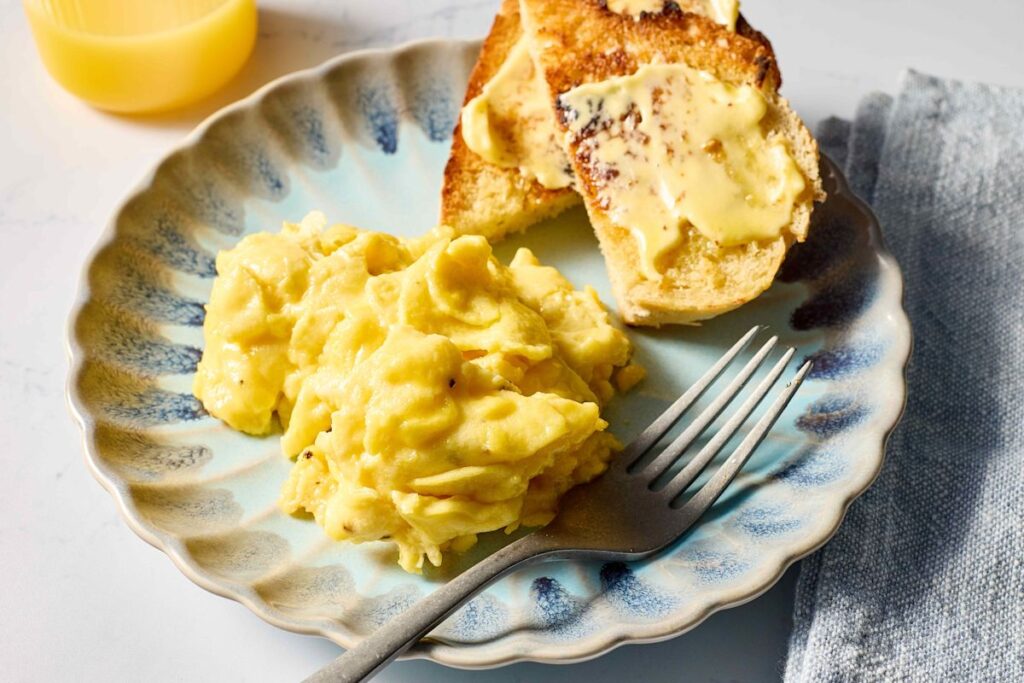
All that testing and research led to me realizing what I had been doing wrong with my eggs, and it wasn’t about fancy ingredients or spatula swagger. Waiting to salt eggs until after they cook is the one mistake that leads to a dry, rubbery scramble.
Why You Shouldn’t Wait To Add Salt
Salting your eggs before cooking is more than just a one-ingredient scrambled egg upgrade; there’s food science at work, too. The proteins in raw eggs are compact, folded bundles that naturally want to repel water and create a tight network as they cook, resulting in eggs that are rubbery and weepy at the same time. Dissolving salt into raw eggs dampens the proteins’ tendency to repel one another. They start bonding earlier, at lower temperatures, forming a looser scramble that holds moisture instead of pushing it out, for creamy rather than bouncy curds.

Credit: Simply Recipes / Photo by Jake Sternquist / Food Styling by Shannon Goforth / Prop Styling by Dera Burreson
How To Make Tender Scrambled Eggs
Whisk a few pinches of salt into your eggs and let them sit for 10 to 15 minutes, giving the salt time to dissolve and evenly disperse. After sitting, the eggs will look darker and more translucent. I take the time to savor my coffee like it’s 2020 and I have nowhere to be.
Pour the salted eggs into a cold nonstick or well-seasoned cast-iron skillet, add cubes of cold butter, and cook gently over low heat, stirring continuously. Starting in a cold pan evenly heats and cooks the eggs, and cold butter slows things further, melting gradually into the eggs as you stir. All that creamy butter ends up in the curds rather than pooling around them.
Read the original article on Simply Recipes