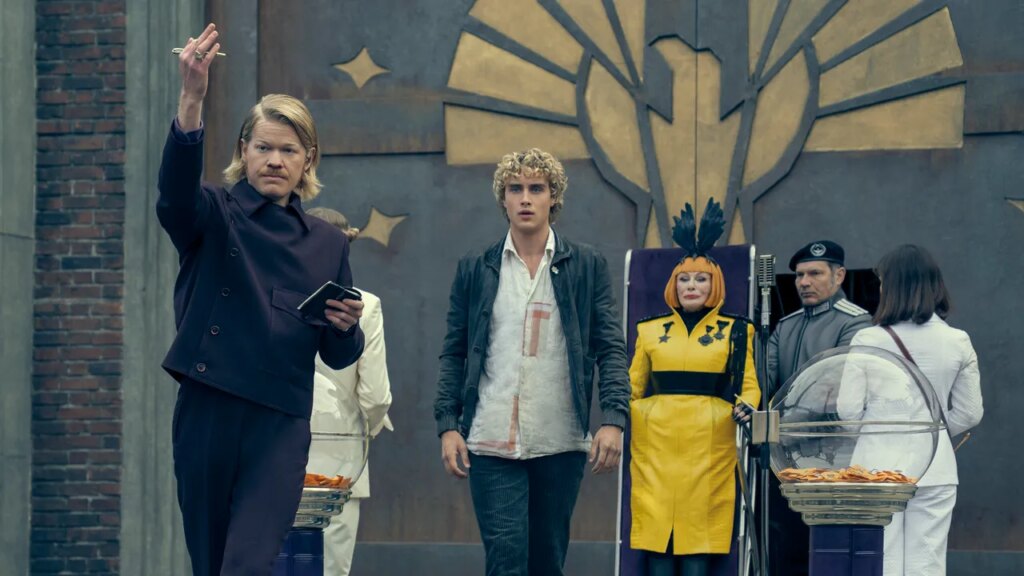
Though the dystopia is set in a future North America, the previous prequel, The Ballad of Songbirds & Snakes (2023), drew from the architecture of 1940s and ’50s postwar Berlin to depict evil President Snow’s rise to tyranny. Set forty years later, Sunrise explores Panem at a new stage of its evolution. Designed by returning production designer Uli Hanisch, the film follows Haymitch from his impoverished mining district, which barely evolves throughout the series’s sixty-five year timeline, to the opulent Capitol, whose extravagance is expressed through a 1970s-inflected visual lexicon.
“I realized the ’70s fall right smack in the middle between that movie and the originals, so we could lean into that,” says Lawrence. Hanisch and his team incorporated references to Andy Warhol, Studio 54, and the decade’s psychedelic color palette, appropriating its progressive spirit to convey the Capitol’s opulence and authoritarianism—and, particularly in the arena, using the aesthetic as a means of deception. “To turn the ’70s style from something progressive, liberal, young, and open-minded into something evil is a twist,” says Hanisch. “But that is the key to the entire film’s design.”

The stylistic choice is also a poignant nod to Collins’s original inspiration for the book series. The 1970s marked a transformation in American television: as color TVs became ubiquitous in households across the country, sporting spectacles, variety shows, and beauty pageants flourished, establishing cultural touchstones that would help shape the contemporary reality programming Collins critiques and satirizes in The Hunger Games. “I was flipping through the channels one night between reality television programs and actual footage of the Iraq War, when the idea came to me,” Collins recalled in a 2018 interview with The New York Times. The juxtaposition inspired her to explore just-war theory for young people through an authoritarian dystopia in which mass entertainment is an instrument of political control.
From an abandoned rural steel mill to authoritarian monuments from postwar Berlin, the film draws on politically charged German sites to capture Panem at a pivotal stage in its political and architectural evolution.
Source: www.architecturaldigest.com
Source link