

It was Monday morning, and as the fog unfurled from the harbour, the bells in St Anne’s Church heralded the start of a busy day for legislators at Maryland State House. Around the rotunda, people began to gather, betraying the hive of activity behind the white curtains of the state capital.
And yet, navigating the cobbled circles and colourful wood-panelled houses of Annapolis, a sense of quiet and peacefulness is pervasive. It might be around the corner from Washington DC, but the noise and crowds feel miles away.
More than 68 million tourists visited the United States in 2025 (four million of them British) – and yet unassuming Maryland, tucked away on the East Coast, saw barely 418,000 of them. It’s an astonishing statistic, especially considering the state’s nickname – “America in Miniature”. This should, surely, be every visitor’s first port of call?
The Maryland State House, Annapolis, dates back to 1772, making it the oldest US state assembly in continuous legislative use – iStockphoto/Amy Sparwasser
It’s a richly deserved moniker. Packing an astounding breadth of natural landscapes into 10,460 square miles, Maryland also sits at a crossroads between the icy Northern States and mellow South, a position which has made it a pioneer of, and unique witness to, American history.
Advertisement
Advertisement
Take the national anthem, The Star-Spangled Banner, which was composed on its soil. Several Civil War battles were won and lost here, too, and revolutionary characters made and unmade, between the fertile, brackish waters of the Chesapeake Bay on one side, and the looming shoulders of DC on the other.
Baltimore: changing times in Charm City
Maryland is, fundamentally, a tale of three cities. Baltimore, its most populous, may once have struggled with high crime rates, disparaging headlines, and the lingering shadow of TV crime drama The Wire, but has worked hard (and is toiling still) to shake this image.
Next year, the National Museum of Railway History & Innovation (formerly B&O Museum) will have a $38m (£28m) transformation to mark its bicentennial. A similar revamp promises to revive the Edgar Allan Poe House on the unloved edge of downtown Baltimore, while the American Visionary Arts Museum is an art gallery with no rules, spurred on by the human urge to create and communicate. No place better encapsulates the soul of the so-called “Charm City”.
Baltimore has worked hard to shake the image of the city portrayed in the gritty TV drug-fuelled crime drama The Wire – iStockphoto
Baltimore’s contribution to American history is strongly felt at Fort McHenry. Every year on Defenders Day, Sept 12, crowds descend on the hilly grounds surrounding the military stronghold, joined by hundreds of characters in period costumes who march and fire cannons to mark the victory over British troops in the War of 1812, a triumph that inspired Francis Scott Key to write The Star-Spangled Banner.
Annapolis: the British connection
Thirty miles south is Maryland’s state capital, Annapolis, a city that owes its prosperity to the Chesapeake Bay, which is both a source of self-sufficiency (in the shape of oysters and crabs) and, as the largest estuary in the States, a strategic seaward connection. This maritime history is best soaked up from the water (aboard the Darling Charters “picnic boat”, for example, preferably at sunset), where you’ll bob serenely with the silhouette of the US Naval Academy on one side, and the towering Maryland State House, with its white and grey cupola, glistening on the other.
Sunset is the perfect time to sail on Chesapeake Bay, and explore the maritime history of Annapolis – The Image Bank RF/Richard T. Nowitz
The State House is at the heart of one of Annapolis’ many “circles” – a civic design borrowed by Francis Nicholson, a former governor of Maryland, from London’s reconstruction after the Great Fire of 1666. It should come as no surprise that Maryland, named after Charles I’s wife, Queen Henrietta Maria, and Annapolis itself – named after 18th-century monarch Queen Anne – had a strong connection to the Crown throughout the Early Modern period.
Advertisement
Advertisement
The links don’t end there. On a Watermark walking tour, I learned that the state flag reveals its identity as a prominent former American colony for the British (number four out of the original 13), with the Calvert coat of arms, which forms part of it, representing Yorkshireman Lord Baltimore, Maryland’s first proprietor. It also reflects the state’s sense of purpose in the aftermath of the Civil War.
Out of the 68 million tourists that visited the US in 2025, only 418,000 travelled to Maryland – iStockphoto/Jeremy Poland
“The black and gold of the Union soldiers shares space with the red and white for the Confederates,” the guide explained. “When it was created in 1904, it was a way to address the unhealed scars of the Civil War. It said: it’s time for peace now, we can all come together under one flag.”
Frederick: ‘creativity takes the wheel’
But it is 75 miles away in the state’s third city, Frederick, and the hilly terrain surrounding it, that Maryland’s role as buffer zone between the two sides comes fully into view. South Mountain State battlefield, 20 minutes down the road from the urban centre, is a sombre example of the many battles fought within the state.
And the War Correspondents Memorial Arch in Gathland State Park, dedicated to war correspondents across the world, is the legacy of a Civil War reporter, George Alfred Townsend, who was keen to record the horrors so they would not be repeated. For the true history buff, there’s also Mount Olivet Cemetery (where anthem-author Scott Key is buried), and the Museum of Civil War Medicine, set to reopen on Memorial Day 2027 after a significant refurbishment.
Mount Olivet Cemetery is the final resting place of Francis Scott Key, the lawyer who penned the American national anthem, The Star-Spangled Banner – CHP
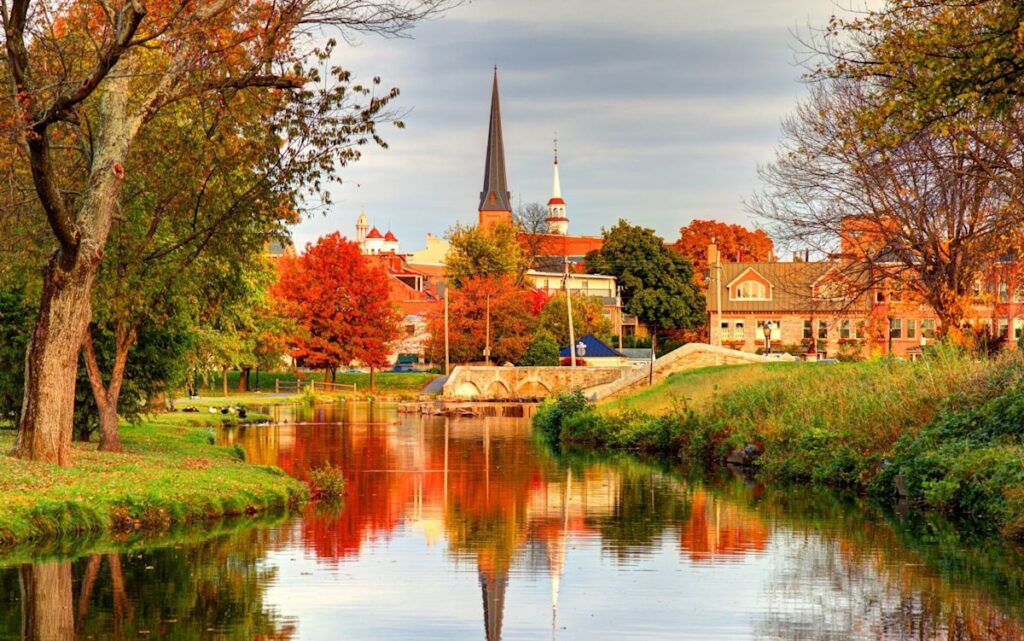
But there’s more to Frederick than history. It was here – away from the imposing presence of Annapolis, and the devil-may-care attitude of Baltimore – that I felt most enveloped in Maryland’s vibrancy. In Frederick, creativity takes the wheel among its parks and monuments (best experienced from the top deck of an original 1960s double-decker bus, brought over from London), the lily-pad-filled Carroll Creek Canal, and the tree-lined boulevards filled with cafes, wine bars and boutiques. All that curious urbanity is backed by the mighty Appalachian Mountains, rising in the distance. This is, truly, America in miniature – and the finest parts of it, at that.
Advertisement
Advertisement
Rory Buccheri was a guest of the Maryland International Marketing Partnership: Maryland Office of Tourism, Visit Baltimore, Visit Annapolis & Anne Arundel County and Visit Frederick.
Purely America offers a seven-day road trip through Maryland from £1,379 per person, including direct-return international flights from London Heathrow to Baltimore, car rental throughout, and six-nights’ accommodation (two at the Marriott Owings Mills Metro Centre in Baltimore, two at The Visitation in Frederick, and two more at The Governor Calvert House at Historic Inns of Annapolis).
Try full access to The Telegraph free today. Unlock their award-winning website and essential news app, plus useful tools and expert guides for your money, health and holidays.
Source link