


MIAMI (AP) — For nearly 10 years running, Lesley VanNess never missed the South Beach Wine & Food Festival, a…
MIAMI (AP) — For nearly 10 years running, Lesley VanNess never missed the South Beach Wine & Food Festival, a beachfront bacchanal of celebrities, booze and bites that tens of thousands of attendees pay hundreds to thousands of dollars to join.
It was about access, the chance to nosh and gab with the likes of Rachael Ray and Bobby Flay, people she otherwise could experience only via the hands-in-pans purview of the Food Network.
“I’d get the Food Network Magazine and there would be advertisements for it. I’m like, ‘0h my god! You could go to that? Go to these great events and meet these celebrity chefs?’,” said VanNess, a 44-year-old former restaurant owner from Iowa. “I’m in!”
That was during the food festival heyday, a decade-long stretch starting around 2010 when copycat events popped up everywhere, creating a circuit-like scene for A-list chefs (and ample wannabes).
Then came social media, a force that melted barriers between fans and food celebs. People like VanNess realized that instead of crowding into football field-size tents to chance a chat with Flay, they could just DM him.
Or better yet, they could tune in to online #instafood chatter to perhaps discover the next Ray or Flay, a whole new level of social cred unlocked.
VanNess hasn’t been back to South Beach since at least 2020. “I’d rather see them on social media or go to their restaurant,” she said.
What chefs and foodies want
Last weekend, the South Beach Wine & Food Festival turned 25, cementing it as one of the elders of the festival scene, along with its sister event, the New York City Wine & Food Festival, and the Food & Wine Classic in Aspen, Colorado. By all accounts, all three are going strong. But many smaller festivals have disappeared, victims of the pandemic, slumping ticket sales, soaring food and labor costs, and chef disinterest.
So, are food festivals still relevant?
“South Beach and New York, they fill a niche and I can see them going on forever. But food events and food festivals are going in a whole other direction,” said Mike Thelin, one of the founders of the now shuttered Oregon festival Feast Portland.
Festivals’ success long hinged on the need of chefs, wineries, mixologists, food producers, and what only now are known as food influencers to reach a wider audience. In 2026, that’s an antiquated notion.
“In 2010, they wanted to get on the map,” Thelin said. “They don’t need that anymore.”
Seeking that local connection
That doesn’t mean festivals are dead. There’s a recalibration happening, he explained. What many call “white tent affairs,” a not-so-subtle nod to South Beach’s events that stretch along the sands of the Atlantic, are fading.
“If I’m going to a certain region, I want to know what makes that region special,” Thelin said. “I don’t want to go into a giant white tent that’s devoid of geography and drink a bunch of wines from California if I’m in Washington or Tennessee.”
Taking their place? A host of small, hyper-focused events grounded in people and place. Events like AAPI Food & Wine, a 3-year-old Oregon and New York City-based festival that highlights the work of Asian Americans and Pacific Islanders.
“The foodie scene has changed so much,” said Lois Cho, one of the founders of that event, which draws about 1,000 attendees a year. “People didn’t realize wine and black bean noodles and izakaya and all these different Thai dishes — they had no idea they paired. Creating a different narrative and community where you can connect with people, those are the types of events we’ll see now.”
Social media, she said, unlocked so many overlooked voices.
“And a lot of people haven’t caught on because it’s been a lot of cookie-cutter events for the last 20 years,” she said.
It’s been a similar story for the Southbound Food Festival, which celebrates the culinary scene of Birmingham, Alabama. Started in 2022 and stretching over a week every fall, the event pulls support not just from chefs, but also the region’s art and music scenes.
“There’s less appeal today with these TV chefs. Great chefs are everywhere,” said Nancy Hopkins, one of the event’s founders. “People come to celebrate and uplift Birmingham.”
The OG festivals still draw crowds
Still, as Thelin said, the South Beach Wine & Food Festival and it’s New York sibling aren’t going anywhere anytime soon, white tents, Food Network faces and all. Tickets to nearly all of South Beach’s 110 events, which featured 500-plus chefs and food personalities, sold out this year. In its quarter century, the festival has raised more than $45 million for the Florida International University Chaplin School of Hospitality and Tourism Management.
Lee Schrager, the force behind the two festivals, said the South Beach blueprint remains relevant today.
“There’s something very different about DM’ing Bobby Flay than going to an intimate dinner at a table of 10 that he’s doing that’s sold out in three days,” Schrager said. “Social media has made everyone available, but can you touch and feel it?”
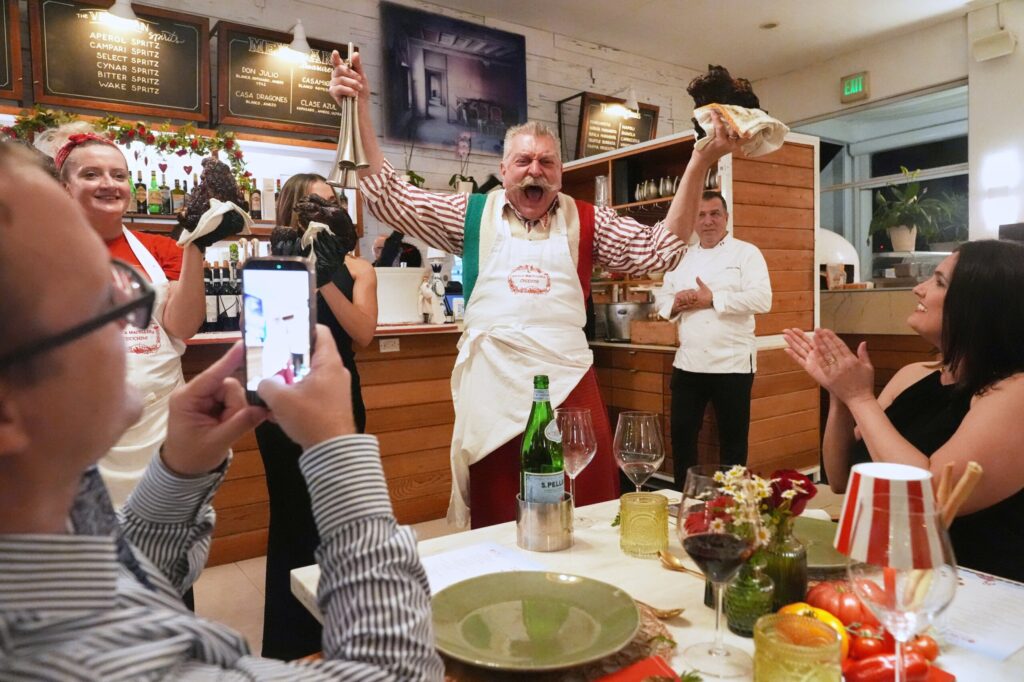
The first South Beach event, attended by only 10 chefs, was little more than a wine tasting. This year, more than 30,000 people attended. Martha Stewart hosted a luncheon at Joe’s Stone Crab, Italian celebrity butcher Dario Cecchini tossed slabs of beef into an eager dinner crowd, and Ray reprised her Burger Bash, where everything from Kool-Aid pickles to foie gras adorned smashed wagyu patties on potato buns.
Schrager acknowledged that most smaller festivals can’t operate the way his do, including hosting events he knows will sell tickets even if they ultimately lose money. He said he sold $7 million in tickets this year and brought in $6 million in sponsorships — and netted just a little over $1 million.
“It’s a good number in the festival world, but it’s not a great return if you’re running a profit business,” he said.
Ray, who has participated in nearly every South Beach and New York festival, continues to show up. It’s about loyalty to Schrager, who took her seriously when much of the food world didn’t. But it’s also about in-person access to fans.
“I love talking to people, being with people, having people climb all over you, hang on you, give you a compliment,” she said. “I love being in the real-life experience.”
Copyright
© 2026 The Associated Press. All rights reserved. This material may not be published, broadcast, written or redistributed.