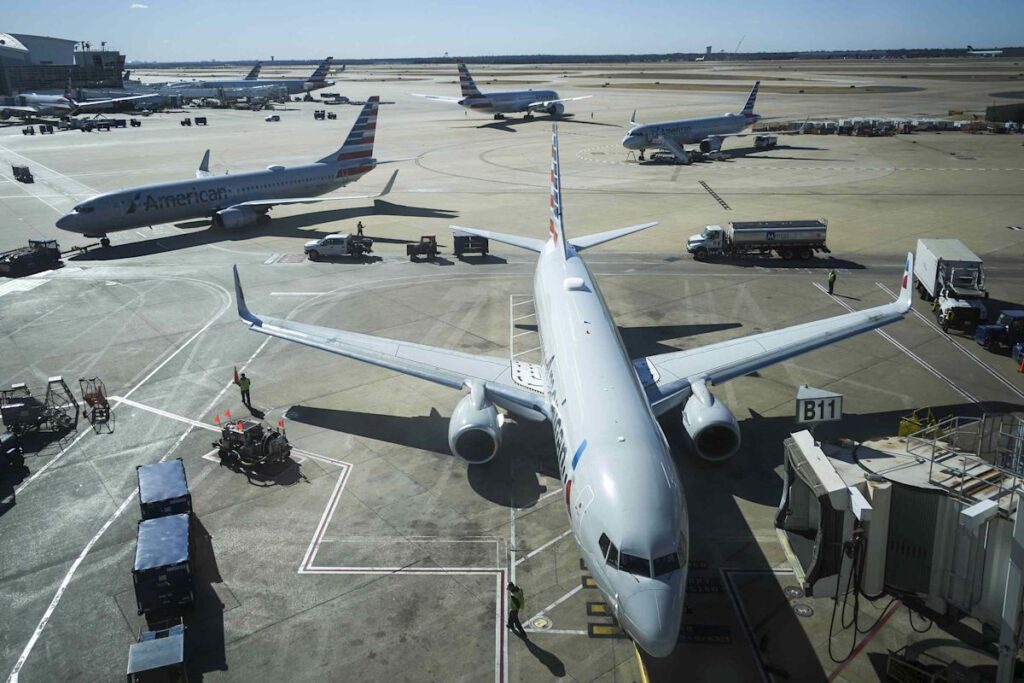
A nationwide Federal Aviation Administration (FAA) ground stop was lifted Friday evening, hours after communication issues with air traffic control caused the rare halting of flights.
The FAA said departures could resume, the Associated Press reported, however Transportation Secretary Sean Duffy said the process of getting air traffic back on track was “going to be slow.” Duffy added the issue was caused by an “incredibly old” air traffic control system, while Homeland Security Secretary Markwayne Mullin said there was no indication the failure was related to a cyberattack.
“There was never any lives at risk,” Mullin said. “There was no flights at risk. FAA was able to handle it. We did it out of an abundance of caution.”
Advertisement
Advertisement
The FAA initially halted flights Friday afternoon following a “communication issue impacting all Air Route Traffic Control Centers,” Duffy wrote in a post on X. At the time, the FAA said the ground stop was “due to extraordinary circumstances and for reasons of safety,” per the Associated Press.
Even as flights resumed, the widespread stoppage caused mass flight disruptions. As of Friday evening, more than 9,000 flights had been delayed within, into, or out of the United States and more than 6,200 canceled, according to data from flight tracking service FlightAware. Of those, Chicago O’Hare International Airport (ORD) was the most severely affected with cancellations recorded on more than 700 incoming and outgoing flights.
Prior to the nationwide order, Reuters reported the FAA had initially stopped air traffic in Chicago, citing air traffic control communications issues there.
Delta Air Lines had the most cancellations of any individual carrier with more than 900 flights nixed, accounting for 24 percent of its schedule, per FlightAware. That was followed by United Airlines with 21 percent of their scheduled flights canceled and American Airlines with 17 percent of scheduled flights canceled.
Advertisement
Advertisement
The decision to issue a full nationwide ground stop is an unusual one. The last time the FAA took such a step was January 2023 when a key FAA computer system malfunctioned, per the AP. Prior to that, the FAA hadn’t issued a similar ground stop since after the Sept. 11, 2001, terrorist attacks.
The widespread issues come as the Department of Transportation (DOT) prepares to implement a new rule that will create a new category airline carriers can use to categorize flight issues outside their control. With the new rule, cybersecurity attacks and unexpected government system shutdowns or failures that directly affect the ability of an air carrier to conduct flights safely will no longer be classified under an airline’s control. That rule is now scheduled to go into effect on Feb. 1, 2027.
Read the original article on Travel & Leisure