Robert Pattinson leaves his Twilight teen-heartthrob image in the dust here. And what better way to shake off the persona of a sparkly vampire than by letting the rough, windblown post-apocalyptic Australian frontier sandblast it off? There is not much glitter in The Rover, the 2014 film from director David Michôd (Animal Kingdom), a grim, gritty addition to the genre that makes the world of Mad Max look downright cheery in comparison.
Do not go into The Rover expecting an action spectacle. There are indeed shootouts and scenes that are best described as car chases, but Michôd plays them for tension, not high-octane thrills. He wrote the screenplay from a story he developed with fellow Aussie Joel Edgerton (Warrior), as the film’s production notes make clear.
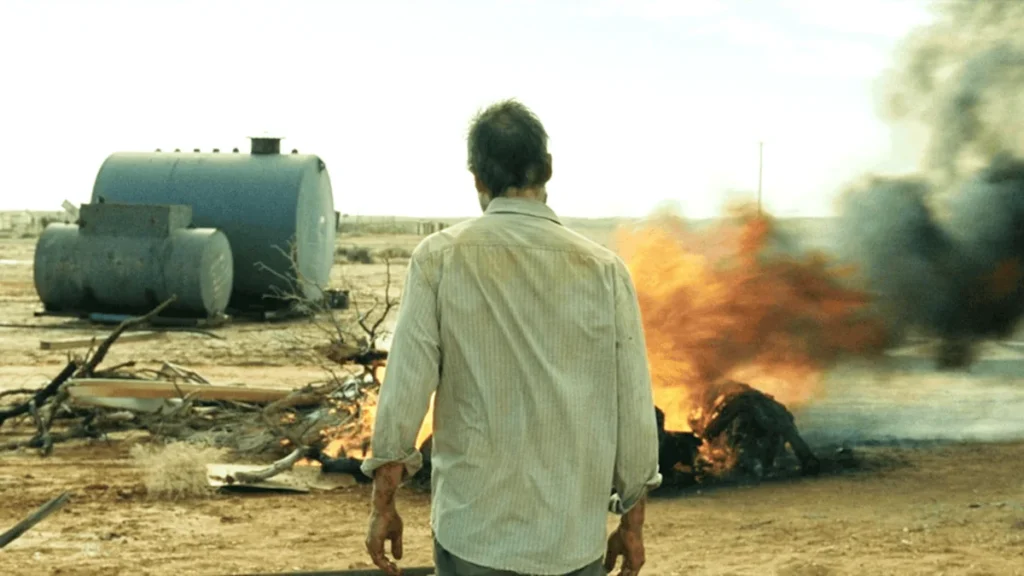
Each element of The Rover—from the gorgeous cinematography to the ever-evolving score that runs the gamut from indie rock twee to discordant sounds that resemble metal being torn apart—is designed to create an atmosphere of tight, increasing pressure. This is not a lightning-fast movie. The Rover is a deliberate, gradual burn, methodical in every detail, especially when it comes to pace.

The narrative follows Eric (Guy Pearce), a traveler on the lawless frontier of Australia ten years after a massive economic collapse leaves the country in turmoil. When a trio of outlaws on the run steals his car, he embarks on a mission to get it back.
Along the way, he picks up Rey (Pattinson), a simple man-child who is far too soft for this world and happens to be the brother of one of the carjackers. Shot and left for dead, Rey is also in search of his brother (Scoot McNairy) and former companions.
Eric rarely speaks in The Rover, but when he does, he says the grim, grizzled things you expect out of the mouth of someone who has been through what he obviously has in his time on the road. Rey is the talker of the duo, filling in the silence with words because his wounded, damaged mind can’t handle the silence or being left alone to dwell on the things he’s done. You can’t call what develops between them along their Heart of Darkness style journey a friendship, but you can tell that it is as close as a real connection as Eric has managed in a long, long time.
Both of The Rover leads are fantastic. Stoic and near silent, Pearce may have little dialogue, but he manages an incredible expressiveness with subtle, minimal movements. Under his calm, controlled exterior is a burning ferocity that is an ever-present companion.
Pattinson totally leaves behind any hint of glamor playing the naïve Rey, who has depended on the efforts of others to last as long as he has in this world. At times, his constant narration annoys you, but you’re never too enraged and recognize his bluster as the harmless chatter of a dopey, injured puppy, eager to please and looking for acceptance.
All of The Rover‘s world-building and character development is woven into the narrative. In this place, a man’s life is only worth so much. You’re never sure why Eric is so hung up on retrieving his car, but he is, and you learn more about him by what he does rather than what he says.
That battered world has a more uncomfortable foundation than a convenient nuclear apocalypse. In a Cinema Australia interview, Michôd explained that he wanted the collapse to grow plausibly out of existing economic forces, shaped by what he had observed after the financial crisis. He also described the story as a fable about the need for human connection. That makes the scraps of functioning society important: this place has not simply vanished. People still have to live in it, and Eric and Rey have to decide what another person is worth when almost everything else has fallen apart.
He illustrates that he is a crack shot, which casts a dim light on pieces of his past that remain in the shadow. Looking at a train rolling past shows that at least some semblance of infrastructure remains, it isn’t much, but it is enough to indicate that there is more out there than this.
There’s one specific detail that The Rover features that I appreciate so, so much. The teeth are all kinds of screwed up. That may sound weird, but I can’t tell you how many times I’ve seen a post-apocalyptic movie—westerns are also bad about this—where everyone has a perfect row of pearly whites.
Dentists aren’t as plentiful as they once were, and no one is making toothpaste anymore. It’s a small detail, but one that totally pulls me out of the moment and the scene, and is often symptomatic of a larger lack of attention to detail. Lucky for us, that’s not the case in The Rover, a movie full of broken, beaten, weathered characters who genuinely look the part of people who have survived the collapse of society.
The end of The Rover invites argument rather than easy agreement. Personally, I think it is perfect.
First, I totally identify with it on a personal level. Without getting into specific details, it encapsulates who Eric is as a person and how he approaches the world and the individuals around him. I’ve already been sucked into one argument over this, and I’m down for another round, so if you’ve seen The Rover and want to discuss the end, hit me up.
If you have any interest in post-apocalyptic stories, or just strong speculative drama with a grim, bitter edge, The Rover should immediately jump to the top of your must see list. Stunning in its own right, this is another illustration of David Michôd’s talent, and it has a spot on my list of favorite movies from 2014.