

Kitchn and Yahoo may earn commission from links in this article. Pricing and availability are subject to change.
Credit: Andrea Rivera Wawrzyn
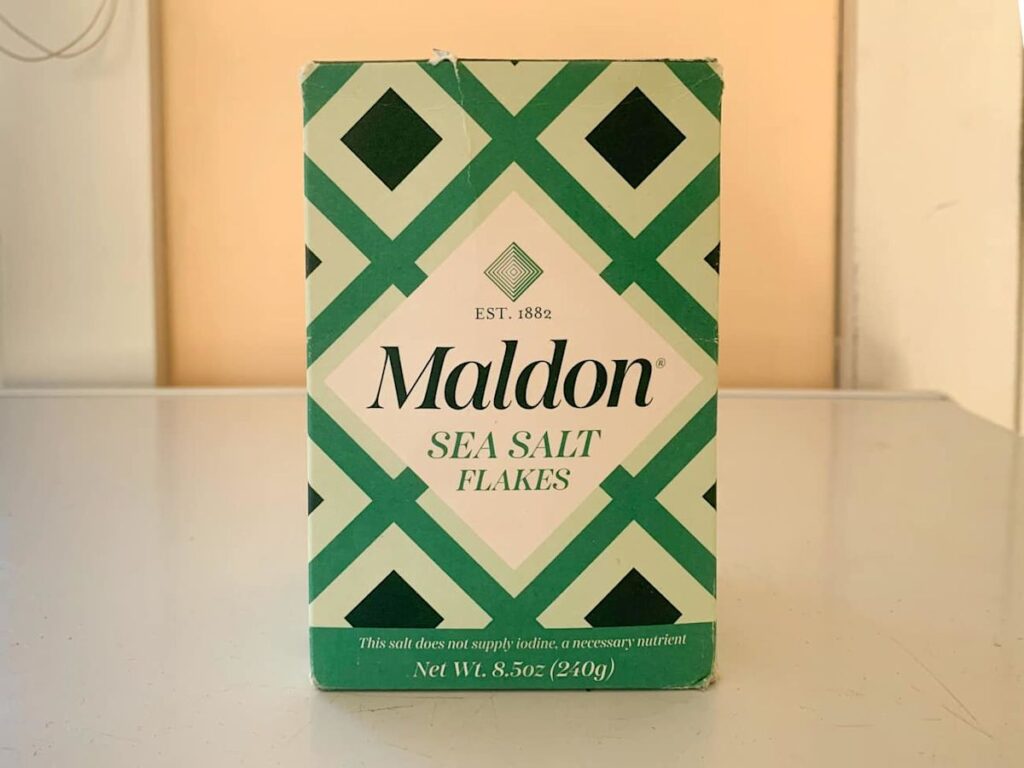
When it comes to flaky sea salt, most people will say there’s only one choice: Maldon. The 144-year-old salt brand has built its reputation on quality taste and texture, and has become a go-to choice for that final sprinkle. Its signature green diamond-patterned box has earned a spot on the kitchen trophy shelf, right next to Diamond Crystal.
That makes the news that Maldon Salt Company’s authenticity is now in question all the more surprising. On November 15, The Observer reported that the English sea salt is apparently being made with “imported German rock salt.” The salt brand prides itself on sourcing sea salt from the Blackwater Estuary River in Essex, England, and practicing the same traditional artisan methods since 1882. There has apparently never been a disclosure of rock salt or German imports in its products before. Here’s what we know.
What Exactly Is Maldon Salt?
Maldon Salt is famous for its pyramid-shaped salt crystals, which many people refer to as “flaky salt.” It’s mainly used as a finishing salt, known for its delicately crunchy texture that comes from its unique shape. According to the company website, Maldon has been “harvesting our world-famous sea salt flakes” in the coastal English town since 1882, relying on traditional artisanal technique passed down through four generations of master salt makers.
The method involves heating and evaporating seawater until it forms large crystals of salt and then hand harvesting it. The process “is unchanging yet ever-changing, constant yet continuously challenging,” according to Maldon’s website. “However, the salt always remains the same.”
Credit: Photo: Alex Lepe ; Prop Stylist: Tom Hoerup
Why Maldon Salt Is Facing Controversy Right Now
The Observer reported on November 15 that Maldon salt is not made solely using sea salt harvested in Essex, England, but also incorporates German rock salt. According to The Observer‘s reporting, Maldon Salt has been adding rock salt to “filter and enrich the seawater.”
After approaching Maldon Salt for this story, The Observer claims that the company updated its website to describe its production method as “salt-on-salt” for the first time: “Once we’ve drawn this seawater, it is settled and filtered, then prepared as brine using our long-established salt-on-salt process, in which natural ancient sea salt forms part of the brine making, to enrich the seawater with natural minerals. The brine is then carefully heated and evaporated in open pans.” This “ancient sea salt” is presumably the imported German rock salt.
Sources in the story claim that once salts have been mixed together, there is no way to separate them again. Meaning, the additional German rock salt may be in the final product. This raises the question of whether Maldon sea salt can actually be labeled as such. Even though rock salt is added to the production of Maldon’s sea salt, apparently the labeling as “100% sea salt flakes” is correct. Maldon Salt considers that rock salt was once a part of prehistoric seas, so it is no different from sea salt currently suspended in seas.
The Food Standards Agency (FSA) also concluded that Maldon Salt complies with all relevant food regulations, as there is no legal definition of sea salt in the U.K. Canada, however, defines sea salt as “made from seawater and not mining.” If you look at Maldon’s product on Costco’s Canadian website, it is labeled as “Maldon Salt Flakes,” and the ingredient list says “salt flakes.” The product on Costco’s U.S. site is labeled as “Maldon Sea Salt Flakes,” and the ingredient list says “sea salt flakes.”
While Maldon has not made an official statement yet, its update on the website indicates it is standing firm in its “salt-on-salt” practices for creating its famous sea salt flakes. Moreover, it’s unlikely the inclusion of rock salt in Maldon Salt’s product will affect the taste or how it’s used in kitchens. This is a different issue — it’s one where home and professional cooks might not be getting what they think they are paying for. Now, is this controversy the result of a lack of strong legal food definitions or a business cutting costs? We’ll have to keep following to see.
Will you still use Maldon salt? Tell us about it in the comments.
Further Reading
Unlock Weekly Recipes You Won’t Find Anywhere Else
The Secret to Better Baked Potatoes? Cook Them Like the British Do
I Tested 7 Ways to Hard-Boil Eggs and Found a Clear Winner
Sign up for The Kitchn’s Daily newsletter to receive our best recipes, posts, and shopping tips in your inbox.
Source link