

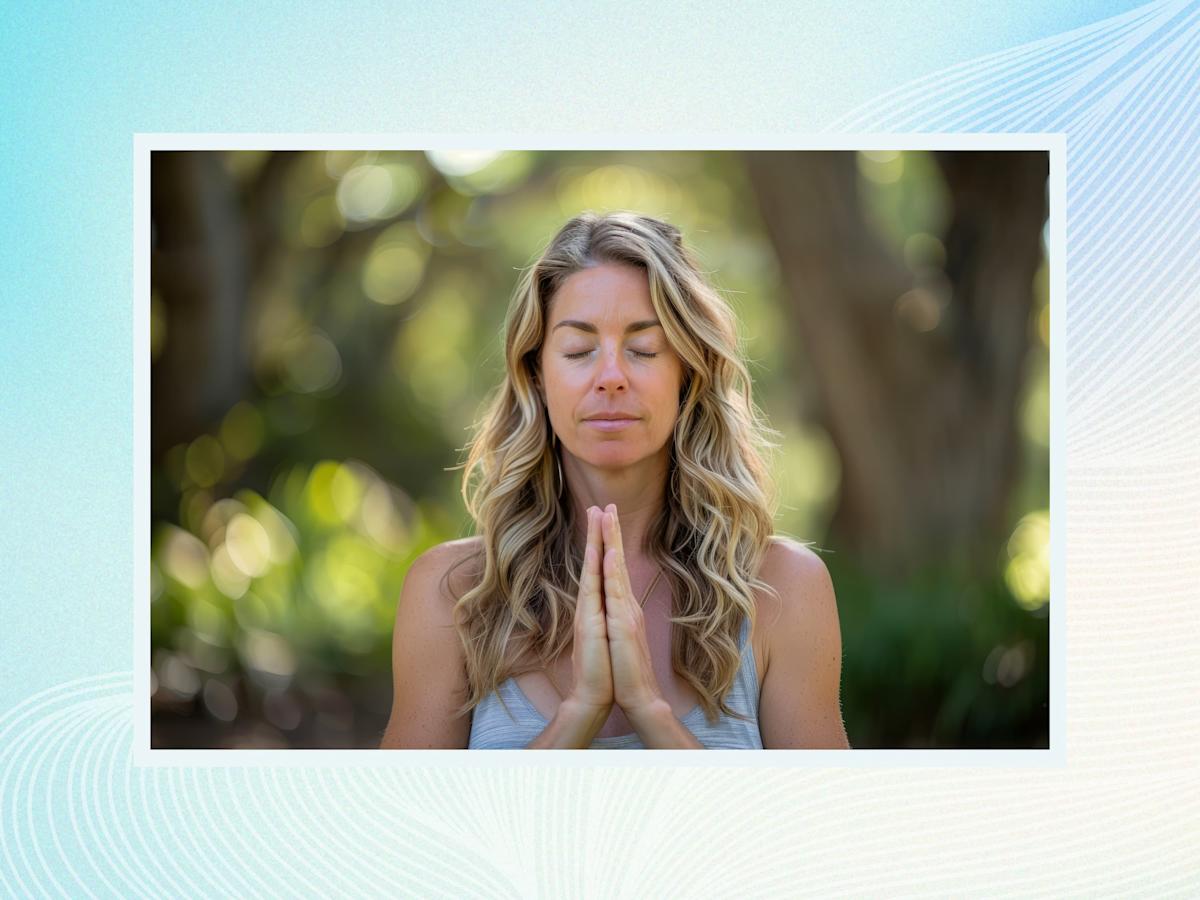
Did you know that somatic exercises, which focus on internal body awareness and movement, can help reduce chronic pain, improve posture and even boost mental well-being? The other good news? You can do this all from the comfort of your own home.
These gentle, mindful movements are becoming increasingly popular for their ability to reconnect you with your body and promote healing—no intense workouts or special equipment required.
More from Flow Space
-
54 Foods That Reduce Anxiety
Whether you’re curious about how somatic therapy works or looking for simple practices to try at home, here’s what you need to know to get started, plus nine somatic exercises to do.
What Is Somatic Therapy?
The term “somatic” comes from the Greek word “soma,” meaning “body.” It makes sense then that somatic exercises are a form of movement therapy focused on enhancing body awareness and improving the mind-body connection.
These exercises aim to help people become more attuned to their physical sensations, movements and posture to reduce tension, improve mobility and alleviate chronic pain.
Unlike traditional exercise routines that often emphasize external goals like strength or endurance, somatic exercises prioritize the internal experience. They involve slow, mindful movements that help you notice and release patterns of tension and stress within your body. This approach can be especially beneficial for those dealing with chronic pain, stiffness or stress-related issues.
“The intention of somatic therapy is to move to feel,” says Sue Choi, a somatic movement therapist and author of When Things Stick: Untangling Your Body from Old Patterns. “You’re moving in ways that impact how you feel in the moment, with close attention to internal signals as guides. That’s why yoga is somatic.”
While yoga is inherently somatic, most physical exercise typically focuses on changing the body—whether it’s raising your heart rate, building muscle or achieving external goals like speed or steps. The emphasis is often on action rather than feeling.
Somatic exercises instead seek to shift your attention and intention. Choi notes that exercise can become somatic when the focus is more about connecting with your body’s internal sensations rather than hitting external objectives.
How to Get Started With Somatic Therapy
If you’re new to somatic exercise, Choi suggests starting on the ground rather than standing, which can make it easier to tune into your body and notice how it responds to movement. Yoga is a great place to start, she says, especially if you’re having trouble connecting movements with internal sensations.
“You can start right away because it’s not skill-based, it’s attention-based,” Choi says. “You can do the smallest of things. However, I would recommend learning how to bring that somatic intelligence into standing and walking.”
According to Choi, building this kind of connection with your body can be life changing, as it gives you a reliable way to return to yourself—especially during moments of stress or disconnection.
However, she notes that people with a history of physical trauma may be triggered by somatic practices, especially moves done lying on your back. If this is you, know that it may take more time to build that connection with your body. It can also be especially helpful to have psychological supports in place to manage any emotions or sensations somatic exercises unearth.
“I work with people to find their resources first, not just to feel into their body for the sake of it,” Choi says. “That’s why a standing meditation practice can work when sitting doesn’t. For example, if you’re in your 50s and have never addressed your history of sexual abuse, it helps to have professional psychological support before addressing overwhelming sensations in the body.”
8 Somatic Therapy Exercises to Try at Home
As for which somatic exercises to try? Choi says her favorites include yoga, tai chi and the Alexander technique.
“These are terrific because they train you to be upright, which is when most stress responses in people are triggered,” she says.
Box Breathing
Dr. Brian Tierney, a psychologist with a doctorate in somatic psychology, also known as the Somatic Doctor, explains that there are few one-size-fits-all somatic practices because they’re often tailored to an individual’s emotional and psychological needs. However, he notes that some classic techniques offer significant benefits for a broad range of people.
“Box breathing is a great example—it helps focus the mind, energize the body and regulate emotions,” Tierney tells Flow Space. “The technique is simple: visualize a 2D box or square, with each side representing a phase of the breath—inhale, hold, exhale, hold, then repeat.”
To try this, start with six seconds per phase. Practice for at least three minutes to experience the mind-body-emotion benefits.
Stomping
Stomping isn’t just reserved for tantrums; it’s one of Tierney’s favorite somatic exercises. But please note, it’s best done in a private setting where you can release pent-up energy.
You might even try this outside.
“It’s especially nice to stomp on soft soil in nature to protect your ankles,” Tierney suggests. “This exercise is great for people who struggle with standing their ground because they tend to bury, numb or otherwise derail their authentic verbal expression of truth.”
Tierney explains that “standing one’s ground” is more than just a figure of speech—it’s an actual skill that can diminish over time, especially in those who habitually avoid conflict. Stomping can help shake off numbness in the legs and clear emotional blockages, enabling a person to remain steadfast more effectively.
“Music with vitality can also help get things moving, and you should stomp continuously for multiple sets of about two minutes,” he adds.
Find Your Center of Balance—At Your Desk
Shay DuBois, a licensed psychotherapist specializing in trauma and anxiety, starts by having clients find their center of balance while sitting at their desks. This helps because she says it can alert people to all the tension they’re holding, which they may not realize until it catches up with them.
“I have them scoot to the front of their chair and place their feet on the ground,” DuBois says. “Then, I ask them to lean forward and notice the muscles in the front, sides and back of their body that are holding them up. Next, they lean backward without touching the back of the chair and do the same thing.”
DuBois says this exercise helps clients become more aware of sensations in their bodies and gives her insight into whether they have difficulty dropping into their body.
Finally, she guides her clients to slowly rise, adjusting their pelvis if needed, as they seek a position where their spine feels naturally suspended without relying on the front or back muscles. Clients often notice their shoulders drop and their breathing deepens, leading to a physical calm that also promotes mental tranquility.
Cardio
For anxious clients who are in relatively good health, DuBois recommends one to two minutes of cardio to quell anxiety. While typical cardio is not inherently somatic, Try doing some jumping jacks, bouncing on a trampoline or running in place.
“Anything that gets the heart going a little from the exercise,” she says. “By getting our body into a state where we expect our heart to beat faster and our breathing to be elevated, we can also trigger a calming down response.”
For anxious clients who are in relatively good health, DuBois recommends one to two minutes of cardio to quell anxiety. While typical cardio is not inherently somatic, it can still be used in a somatic way by adjusting your focus and intention. Try doing some jumping jacks, bouncing on a trampoline or running in place.
Rather than pushing for speed or performance, shift your attention to how your body feels during the movement. Focus on your feet connecting with the ground, the rhythm of your breath and the physical sensations in your limbs as you move. This internal awareness helps release nervous energy and allows the nervous system to down-regulate. Moving mindfully—at a pace that supports presence over intensity—turns even short bursts of cardio into a grounding, regulating practice.
These small adjustments help transform a traditional workout into a somatic experience. Breathwork can play a key role: coordinating movement with slow, steady breathing and extending the exhale can activate the parasympathetic nervous system. Let your attention drift inward, scan for tension and allow your movements to support its release.
“Anything that gets the heart going a little from the exercise,” DuBois says. “By getting our body into a state where we expect our heart to beat faster and our breathing to be elevated, we can also trigger a calming down response.”
Dancing
If you’re a Grey’s Anatomy fan, you may remember Meredith Grey and Cristina Yang’s tradition of dancing it out to relieve stress, heartbreak and anger.
Jillian Amodio, a licensed master social worker at Waypoint Wellness Center, sex educator and author of Nurturing the Inner Child: A Guided Workbook to Heal Your Soul, wants you to do this, too. Put on some music, and dance as a somatic exercise.
“Dance and movement can be incredibly healing for both the mind and body,” Amodio explains. “Music is a universal language. The rhythm and beat speak directly to the soul. The body feels the music and can’t help but sway along.”
To do this, simply put on some music and start moving. Whether you watch a basic YouTube tutorial to learn some steps or simply add a little sway and bounce as you make your way up the stairs, focus on just feeling. Pick music that’s slow and melodic or upbeat and energizing.
“Move your body to music in a way that feels right for you,” she adds. “Listen to your body and move in a way that feels intuitive and comfortable.”
Skipping
Additionally, Amodio recommends skipping instead of walking because there’s “something uniquely magical and child-like about the act of skipping,” she notes.
It’s fun, and the added task of coordinating your steps and speed can help you mind connect to your foot movements.
Walk Barefoot
There’s a reason walking barefoot on sand or grass feels centering. “Grounding themselves by walking barefoot is an experience many people find joyful, pleasurable, and reminiscent of childhood,” says Amodio.
But this doesn’t mean run outside barefoot to grab your DoorDash order. “I am talking about intentionally forgoing the shoes and spending time being fully present and connected to the earth beneath your feet,” she says.
Doing this exercise is simple: find a good spot, take off your shoes and stand or walk around. Let your senses take over and notice how it feels to touch the ground.
Add a meditation if it feels right, too. Take 10 minutes to do meditation Amodio recommends: find a quiet, comfortable place and set an intention such as “I’m grounded” or “I’m connected” and press through the oles of your feet. Take deep breaths in while thinking about inviting in feelings of peace and comfort then slowly exhale.
Standing Twist
Dr. Clary Tepper, a clinical psychologist and physician wellbeing coach, recommends trying a standing twist sequence as one of your somatic exercises.
Here’s how to do it: stand with feet shoulder-width apart and relax your arms at your side. Let your arms swing naturally as you gently twist from side to side. Aim for between 10 and 15 twists on each side and gradually increase your range of motion as your muscles loosen.
As you’re doing this, take note of how it feels. Tepper said to “notice the interplay” and “observe without judgement.” As you swing, think about: how your spine feels and where it moves freely and feels stuck and how you feel as your arms swing and you pick up speed.
Full Body Stretch and Release
Here’s another easy somatic exercise to try, courtesy of Tepper: a full body stretch and release, which is exactly what it sounds like and is essentially like a spinal rolldown you’d do in a yoga class.
Position yourself with your feet shoulder-width apart and reach up toward the ceiling by stretching your arms over your head. Hold the post for five to 10 seconds and release, allowing your body to flop forward like a rag doll. If you want, stand on your tip toes as you extend your arms. After you’ve slumped forward, stay there for 10 to 15 seconds and then return to standing by slowly rolling up, vertebrae by vertabrae as you would in yoga.
As you do this, pay attention to how your body feels when it’s moving and the difference in sensations when it’s tense and relaxed. Do a mental scan from your head to your toes and consider which emotions crop up.