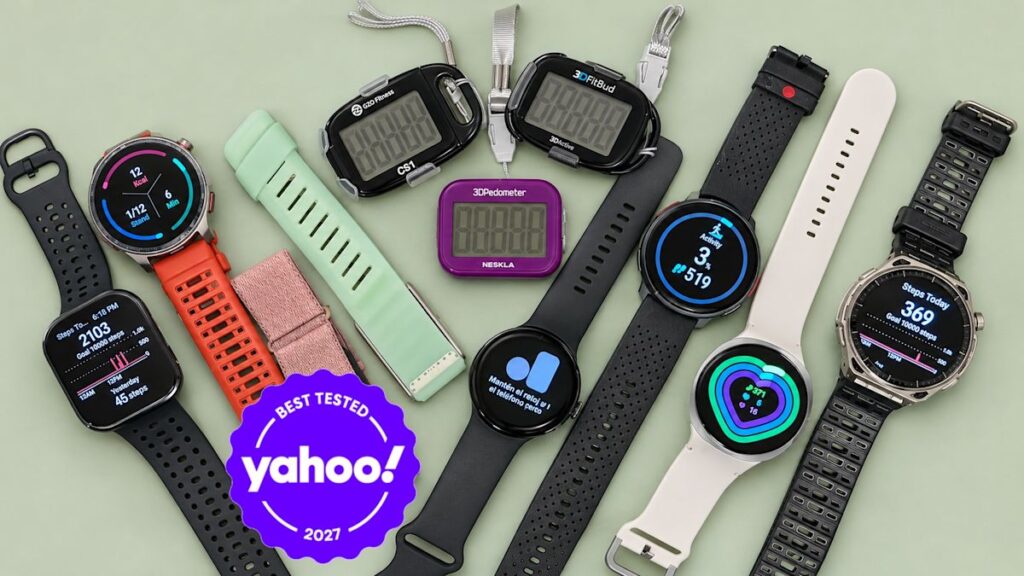


If you’re ready to start walking confidently toward your fittest life, it can be helpful to know exactly how many steps you’re taking. In fact, research indicates that wearing a pedometer may motivate you to stay more active to hit your daily walking goals. With onscreen nudges and step totals that climb with every errand, dog walk and workout, these handy tools aren’t just another gadget you have to keep charged — the best pedometers can support your overall health. To find the top performers in a sea of options, we put 19 pedometers and smartwatches to the test and spoke with three experts to get their input on which features to prioritize.
Quick Overview
Best overall
Amazfit Bip 6 Smart Watch
Best basic pedometer without an app
3DFitBud Simple Step Counter Walking 3D Pedometer
Best budget pedometer
Ozo Fitness Clip-on 3D Pedometer
Best for runners
Garmin Forerunner 55
Best for seniors
Fitbit Charge 6
“The best step counter depends on your specific needs and budget, whether you’re a casual walker, an athlete or someone looking for a comprehensive health and fitness tracking solution,” says Nicholas Randall Voorhees, a certified personal trainer. So whether you’re chasing 10,000 steps (ambitious, but doable) or just trying to beat yesterday’s total, the right pedometer may be a worthwhile investment. You’ll find options at every price — from fuss-free clips with long battery life and no apps, to smart wearables that sync with your phone and show your data at a glance.
After logging countless steps (well, technically they were quite countable), we narrowed the field and selected our winners. Here are our picks for the best pedometers for 2027.
Best overall pedometer for 2027
Laura Williams
Wear: Wrist | Step sensor: Accelerometer | Steps on the device: Yes, 1.97-inch AMOLED | App required: Yes, Zepp | Data stored: Synced to Zepp app | Battery: 14 days | Water resistance: 5 ATM | Heart rate and GPS: Yes / Yes, single-frequency | Subscription: None required; advanced insights need Zepp Aura
When you’re looking for a pedometer that offers the best of all worlds, the Amazfit Bip 6 checks practically every box. Yes, it absolutely counts your steps, tracks distance and offers continuous heart rate monitoring to gauge your daily activity. But it also seamlessly connects to your smartphone, has an integrated speaker and microphone for Bluetooth phone calls, has on-watch GPS and offline mapping, and only needs to be charged about once every two weeks. And all those features are available for less than $100.
Our tester has been an Amazfit fan for a long time, and while her favorite tracker is the Balance 2 (featured below), she says this is a solid contender, especially for the price. “Look, I’m going to be hard-pressed to retire my Balance 2 — it has more accurate GPS and I prefer the more durable sapphire glass and the round shape — but for anyone who wants a great pedometer with extra features at an affordable price? This, hands down, is the one.”
- Under $100
- Strong battery life
- Built-in GPS
- Big, bright screen
- Single-frequency GPS
- Strap is awkward to fasten
- Advanced insights cost extra
More pedometers we like for 2027
Laura Williams
Wear: Clip-on or lanyard | Step sensor: 3D sensor | Steps on the device: Yes, large display, one button | App required: No | Data stored: None | Battery: About 12 months | Water resistance: None | Heart rate and GPS: No / No | Subscription: None
The 3DFitBud Simple Step Counter proves that basic isn’t a bad word. This lightweight and budget-friendly pedometer offers straightforward step counting with remarkable accuracy, featuring a large, easy-to-read display that’s visible even in squinty sunlight. Its single-button operation makes it practically foolproof, something that Frayna points out is perfect for users of any age who want simplicity, not bells and whistles.
While it doesn’t track calories, heart rate or store historical data, that’s precisely what makes it appealing for users seeking a pure step counter.
- Affordable
- Intuitive navigation
- No need to charge
Laura Williams
Wear: Clip-on, with lanyard | Step sensor: 3D sensor | Steps on the device: Yes | App required: No | Data stored: None | Battery: Integrated; up to 12-months | Water resistance: Splash resistant | Heart rate and GPS: No / No | Subscription: None
As the least expensive product we tested, we have no complaints about this simple pedometer from Ozo Fitness. It can clip to your hip or be worn on a lanyard. It also has an integrated spot where you can hang it from a bag if you don’t want to physically wear it when you’re running errands or out for a hike.
Accuracy is sharp — within one or two counts of our mentally tallied steps — and the lack of high-tech features means its integrated battery is long-lasting. Although we can’t attest to the manufacturer’s claims, it should last about a year. You can choose between four colors — black, pink, purple or blue. Its one-button function makes it easy to reset from day-to-day, although it’s important to remember it has no integrated memory — once you delete a day’s records, they’re gone for good, so if you want to keep track, it’s worth keeping a fitness journal or an online spreadsheet for your data.
- Affordable
- Three ways to wear it
- No need to charge
- Simple, 1-button function
Amazon
Wear: Wrist | Step sensor: Accelerometer | Steps on the device: Yes | App required: Yes, Garmin Connect | Data stored: Synced to Garmin Connect | Battery: Up to 2 weeks; less with GPS | Water resistance: 5 ATM | Heart rate and GPS: Yes / Yes | Subscription: None
The Garmin Forerunner 55 is way more than just a step counter. It ranks as our best pedometer for runners thanks to its advanced fitness tracking in a sleek package that combines exceptional accuracy and comprehensive features with top-of-the-line battery life.
“The Forerunner excels at tracking a wide range of activities, including running, cycling, swimming and even stress levels,” says Voorhees. It also monitors distance, pace and goals, giving runners detailed performance insights.
Advanced features like heart rate variability (HRV), VO2 max and recovery metrics make it ideal for serious runners. Another perk for folks who like to go the distance: The Forerunner has exceptional battery life too, outperforming most smartwatches. “That’s a huge plus for outdoor adventurers and athletes who need reliable data over long periods,” says Voorhees.
Built with premium materials such as fiber-reinforced polymer, this durable tracker should withstand heavy use. However, it has a few drawbacks.
One Amazon reviewer wrote: “The screen is not the brightest (but that helps with battery life) and the menus are a little tricky to navigate (at first).” It’s true. There’s definitely a learning curve to mastering the Forerunner’s numerous settings and features, the advanced capabilities justify the effort.
If you’re less tech-savvy or prefer something simpler, a basic pedometer might be a better fit. But for runners wanting GPS and other high-tech features, this device delivers exceptional value.
- Great for athletes
- Strong battery life
- Durable
- Complicated setup
- Dim screen
Amazon
Wear: Wrist | Step sensor: Accelerometer | Steps on the device: Yes | App required: Yes, Fitbit / Google Health | Data stored: Synced to app | Battery: Up to 7 days | Water resistance: 50 meters | Heart rate and GPS: Yes / Yes | Subscription: Some metrics need Premium
Who says fitness tracking has to be complicated? The Fitbit Charge 6 proves that simpler can be smarter, making it our top wristband for seniors. With clear displays, an intuitive interface, straightforward controls and seamless data syncing, it delivers the essentials without unnecessary fuss. In fact, the Fitbit Charge might just be one of the most accurate step trackers around. Studies indicate that the Charge consistently performs well in step-counting accuracy trials, although these trials are far from comprehensive when it comes to testing available pedometers.
“The Fitbit app provides clear insights into activity, sleep, heart rate and more, with the added benefit of a supportive community,” Voorhees says. (The Fitbit Community platform lets users share tips, troubleshoot together and connect with others on similar wellness journeys.)
In fact, when our tester’s 77-year-old mom asked to borrow a pedometer, she passed this one along. Her mother reported being a little wary of trying a tracker she had to sync with her phone, but after about a week she reported back, “I’m surprised! It’s actually very easy to use, and it offers so much information. Very helpful for step tracking but also for understanding my daily sleep patterns.”
Bottom line: The Charge 6 is a reliable fitness tracker that covers all the essentials (plus some), making it a practical, smart choice for anyone looking to stay active and informed about their health.
- Simple to use
- Lightweight
- Built-in GPS
- A week of battery
- Some metrics locked behind Premium
- Touchscreen less reliable than the side button, especially with gloves
- Some reports of heart rate inaccuracy
Laura Williams
Wear: Wrist band | Step sensor: Accelerometer | Steps on the device: No screen; steps appear in Garmin Connect | App required: Yes | Data stored: Synced to app | Battery: Up to 10 days | Water resistance: 5 ATM | Heart rate and GPS: Yes (continuous) / No standalone GPS | Subscription: None
While our tester states that she needs a watch and smart features when it comes to selecting a fitness tracker, she understands why screenless trackers may be the right choice for some users, “I have been known to obsess a bit about my numbers — if my goal is 10,000 steps and I find myself at 9,250 at 10:00 p.m., I’m not above pacing my house for 15 minutes to rack up those last steps.” If that’s you — someone whose Type A goal-tracking can border on unhealthy — the Garmin Cirqa Smart Band might just be the perfect solution.
This subscription-free wearable tracks all the metrics you likely want to track — steps, distance, intensity, workouts, continuous heart rate and heart rate variability, respiration rate and blood oxygen, as well as sleep trends — but you have to actually take the time to open up the app and seek out the data, rather than having it always at the ready on your wrist.
While we tested a few screenless bands, including the ever-popular Whoop, we ultimately preferred this subscription-free option — it’s more affordable all-around and doesn’t skimp on key data. “I’m surprised by how much I like this band,” our tester shared. “Personally, I still need a watch, but if I were going to go screenless, the screen is the only thing you end up missing out on with this tracker. It even has a vibrating alarm to help you wake up in the morning, and you can set it to auto-track workouts by pushing the on-device button rather than having to open the app.”
Of course, $200 isn’t a price to scoff at, and if you need built-in GPS or stair counting, you won’t find those features here.
- No subscription
- 10-day battery
- Water-resistant to 5 ATM
- No distracting screen
- Can’t check steps on your wrist
- No built-in GPS or barometric altimeter for stair counting
Laura Williams
Wear: Wrist | Step sensor: Accelerometer | Steps on the device: Yes | App required: Yes, Polar Flow | Data stored: Synced to app | Battery: About 5 days in smartwatch mode | Water resistance: 3 ATM | Heart rate and GPS: Yes / Yes | Subscription: None
If you want to track your heart rate alongside your step count, you’re going to be hard-pressed to find a better option than the Polar Ignite 3, our top pedometer choice for heart-rate tracking. It’s GPS-enabled and packed with advanced workout metrics, making it ideal for runners, cyclists and anyone serious about fitness. Plus, it’s user-friendly.
“Polar is known for its heart rate monitoring accuracy and fitness tracking, making it a great choice for athletes — or anyone interested in detailed performance tracking, like recovery scores and training load,” says Voorhees.
What sets the Ignite 3 apart is its personalized training recommendations, which adapt to your performance. Combined with recovery scores and training load insights, it’s like having a personal coach on your wrist.
One reviewer who has claimed to have tried most of the fitness trackers on the market, calls the Polar Ignite 3 the “best fitness tracker,” adding that it’s “fast to charge, easy to link to mobile and other devices. Good bright backlight and comfortable to wear.”
- Good for tracking health data, such as heart rate
- Fast charging
- Comfortable
- Not particularly stylish
- Heavy on data for casual walkers
- Battery depends heavily on GPS use
Laura Williams
Wear: Wrist, 42 g, 1.5-inch AMOLED with sapphire glass | Step sensor: Accelerometer | Steps on the device: Yes | App required: Yes, Zepp | Data stored: Synced to Zepp app | Battery: 21+ days typical per Amazfit; about a week with heavy GPS and always-on display | Water resistance: 10 ATM | Heart rate and GPS: Yes / Yes, dual-band | Subscription: None required
If you’re tired of constantly charging your fitness tracker, the Amazfit Balance 2 delivers exceptional battery life without sacrificing functionality. Our tester charged this watch only four times over three months of consistent use, and when it needs power, it recharges quickly — even 15 minutes provides enough juice for a run. This alone makes it stand out in a market where many smartwatches require daily or near-daily charging.
Beyond the impressive battery, the Amazfit Balance 2 excels as an all-around fitness tracker and smartwatch. The GPS functionality is particularly accurate for distance tracking, and the interface is straightforward and easy to navigate. Daily step count and distance metrics are clearly displayed on the watch face, while long-term data is easily accessible through the app. The traditional silicone watch band is comfortable and adjustable, and the sapphire glass touchscreen has proven durable with no signs of wear after months of use. Heart rate monitoring is consistent when the watch is positioned correctly — not too tight or too loose.
It’s also worth noting that our tester loved this watch so much that she was excited to upgrade to the Amazfit Balance 3. Ultimately, though, after testing the latest model, she realized she preferred the Balance 2 for its slightly smaller size, slightly longer battery life and more seamless navigation across watch face screens.
- 21-day battery
- Accurate GPS
- Easy interface
- Comfortable for all-day wear
- Alarm settings occasionally reset
- Undercounts steps while pushing a stroller
Factors to consider when buying a pedometer
The best pedometer should provide the features that match your needs — whether that’s simple step counting or advanced activity tracking to keep you motivated, to monitor progress and to achieve your health and fitness goals. Here are the key considerations to keep in mind before making your pick:
Accuracy
“Pedometers that use 3D or multi-axis sensors tend to be more accurate than simpler devices,” says Voorhees. That’s important to keep in mind, since misleading data can affect how you track progress and set goals. Look specifically for the type of sensor used, and prioritize those that have a 3D tri-axis accelerometer.
Display
A user-friendly display means you can quickly glance at your data and stay motivated without fumbling with buttons or digging into your mobile app. “It’s especially helpful when you’re on the move,” says Frayna. That said, if you want to track your steps without the distraction or pressure of an always-on screen, screenless monitors like the Garmin Cirqa and Whoop may be a good choice. You still collect the data, but you decide when you want to monitor it and when you simply want it running in the background.
Features
Common features include step, distance and calorie tracking, with more advanced capabilities like ANT+ sharing across devices, heart rate monitoring and GPS tracking usually accompanying models that sync with your smartphone or an app. While extra features add value to your device, you might not need them all, as they can bump up cost and complexity. For instance, some trackers also report METs (metabolic equivalents of task), a measure of how hard your body is working, but if your main goal is steps, you can safely ignore it. While data can be helpful, too much of it can be confusing, especially if your main goal is simply to track your steps.
Battery life
Some batteries hold a charge for a few days to several months, while others rely on replaceable batteries. “Ideally, you should look for one with at least a few days of battery life or more to avoid constant charging,” says Voorhees. A pedometer with longer battery life will help ensure you can track your activity without interruption.
Style
Clip-ons, rings, wrist-worn devices and more — pedometers come in various styles. Choose one based on your comfort and typical activities. For example, a ring-style tracker might interfere with weight lifting. “A clip-on pedometer may not always be accurate if it swings or falls off, while wristbands — which stay on your body — can provide continuous tracking,” explains Voorhees.
Water resistance
While some pedometers are strictly for dry environments, many offer varying degrees of water resistance. Basic water-resistant models can handle sweat and rain, while more rugged devices can withstand swimming and intense workouts. If you’re active outdoors or in humid conditions, consider a device with appropriate water resistance.
Advertisement
Advertisement
Look for the IP water-resistance rating, which appears something like IP67 or IPX7. The first digit rates protection against dust, and the second against water. (If a digit is replaced with an X, the device wasn’t tested for that category.) For water, a 4 means it can handle splashes, such as sweat or light rain; 5 and 6 mean it can withstand water jets, such as heavy rain or a shower; 7 means it’s safe for temporary submersion in shallow water, up to about three feet for 30 minutes; and 8 means it can handle deeper, longer submersion, to a depth set by the manufacturer. A 9 rating is different: it means the device can withstand high-pressure, high-temperature water jets, not deeper submersion.
Many watches and fitness trackers use ATM ratings instead. One ATM equals about 33 feet (10 meters) of static water pressure, so a 5 ATM device is suitable for swimming in shallow water but not for diving or high-speed water sports.
Data storage and analysis
Many pedometers store your data for later analysis, allowing you to monitor trends and adjust your goals accordingly. “Some will sync with apps or websites to track long-term progress and generate reports on steps, calories burned and distance traveled. If you want to track your progress over time, data storage and analysis features are vital,” explains Voorhees.
Price
Very basic pedometers start around $15, while advanced fitness trackers can cost several hundred dollars. “Decide on your budget, then look for a device that offers the best features within that range,” says Voorhees. “Higher-priced models often include extra features like heart-rate monitoring or GPS, but if you’re just looking for basic step tracking, a budget model may be sufficient.”
Standalone pedometers without an app
If what you’re searching for is a straightforward pedometer without an app or smart features, these are the models we tested for this article.
Pedometer | Wear | Sensor | Data stored; extra features | Battery | Weight | Dimensions |
|---|---|---|---|---|---|---|
3DFitBud Simple Step Counter | Waist clip or lanyard | 3D sensor | None | Integrated lithium ion battery; About 12 months | 0.84 ounces | 2.4″L x 1.6″W x 0.4″H |
OZO Fitness clip-on 3D pedometer | Waist clip, lanyard or clipped to bag | 3D sensor | None | Integrated lithium ion battery; About 12 months | 0.776 ounces | 2.6″L x 1.6″W x 0.47″H |
Realalt 3DTriSport | Waist clip or lanyard | 3D sensor | 30-day memory; timer, distance tracked, calories burned | Integrated lithium ion battery; About 12 months | 3.52 ounces | 3″L x 0.4″W x 1.3″H |
Neskla 3D pedometer | Waist clip or lanyard | 3D sensor | None; 10-step error prevention (only tracks steps after 10 consecutive) | Integrated lithium ion battery; About 12 months | .935 ounces | 1.96″L x 1.57″W x 0.9″H |
How we chose
We tested 19 pedometers and smartwatches to determine the best options for 2027, consulting with three industry experts throughout our evaluation process. Each device was assessed in real-world conditions for accuracy, battery life, features and overall value. Our testing included daily walks, gym sessions and simply running errands to ensure these pedometers perform reliably across different scenarios and meet diverse needs and budgets.
FAQs
How accurate are pedometers?
Pedometers can be very accurate for step counts, but only when the sensor type, placement, and your activity intensity line up. Waist-worn pedometers tend to miss steps at slower speeds or when your movement is uneven, and wrist-worn trackers can swing the other way and overcount because arm motions like gesturing or eating get tallied as steps. For the most accurate results, fasten a wrist tracker on your nondominant hand and keep it snug to cut down on false positives. Using a clip-on or waist device? Attach it firmly at the waistband near your hip, and avoid holding it or relying on it for accuracy while using a mobility aid. Newer multi-sensor models that pair motion with heart-rate data generally deliver the most reliable numbers across activities.
Are wrist pedometers accurate?
Generally, yes. Wrist-worn trackers can be reasonably accurate for step counts, though results vary by device. A 2022 review of 31 studies found that models such as the Fitbit Charge and several Garmin watches performed well relative to reference counts. with more accurate versions using a 3D tri-axis accelerometer. That said, it’s important to wear or use the pedometer according to the instructions. For best results, wear it above your wrist bone and keep it snug but comfortable.
Can a pedometer help me lose weight?
Yes, though the effect is usually modest and hinges on how you use it. A study in the British Journal of Sports Medicine found that step-tracking devices helped people lose an average of 3 to 6 pounds when used consistently for 3 months or more, especially when paired with goal setting and feedback. The strongest results showed up when participants also adjusted their diet or worked with a health professional. “Some pedometers include calorie tracking as well, which can also help keep track of weight loss goals,” explains Frayna. But it’s important to understand that information provided on calorie burn is estimated and suggestions for calorie intake should be viewed as guidelines, not precise measurements.
What are the benefits of tracking my steps, and how many steps should I aim to take daily?
Regular walking is one of the easiest ways to boost your health, and step tracking helps you stay honest and engaged. Think of your daily count as a simple scoreboard that turns vague goals into visible progress you can act on. Large studies in the JAMA journals suggest that racking up to about 10,000 steps a day is linked to lower risks of heart disease, cancer, and dementia. But benefits begin around 4,000 steps per day, and every additional 2,000 steps can cut the risk of premature death by roughly 8 to 11% with benefits leveling off somewhere around 9,000 to 10,000 steps. A pedometer won’t do the walking for you, but it can be a strong motivator that turns your movement into trackable, daily wins that support your heart, brain and metabolic health.
Do I need a pedometer if I have a smartphone?
Not necessarily. Many smartphones include built-in step tracking, eliminating the need for an additional device. While both options work well, smartphones and wearables can complement each other, depending on your tracking preferences and fitness goals.
Can I use a pedometer for activities other than walking?
While traditional pedometers are designed specifically for counting steps, modern fitness trackers offer expanded features “for everything from simple things like running or strength training to specific sports like basketball or pickleball,” as Zack Dzingle, a personal trainer at Bay Club in Portland, Ore., explains. Consider your exercise routine when choosing between a basic pedometer or a more versatile tracker.
What is the difference between a pedometer and an activity tracker?
A pedometer is primarily designed to count steps, offering a straightforward way to monitor daily movement. Meanwhile, an activity tracker counts steps and provides advanced features, including sleep monitoring, heart-rate tracking, workout analysis and more comprehensive fitness data. The choice between the two depends on the level of detail and functionality you’re looking for.
Other products we tested
Realalt 3DTriSport Walking 3D Pedometer: While Frayna notes that “it has high-end technology that will make for reliable data tracking,” its lack of app connectivity makes progress monitoring difficult, and some users report tricky setup.
Bellabeat Ivy+: Designed to resemble a piece of jewelry, this tracker seamlessly blends fashion with function, delivering accurate tracking for everything from stress levels and menstrual cycles to steps and overall fitness. The downside? It’s pricey ($380) and may feel bulky on smaller wrists.
Amazfit Band 7: This was one of our favorite overall picks due to its low profile and stellar battery life combined with nice fitness tracking features and a wallet-friendly price. Unfortunately, it has been discontinued.
Omron Walking Style IV Step Counter: Our previous pick for “best basic pedometer,” the model has since gone out of stock at all retailers with no indication whether it will be made available in the future.
Google Pixel Watch 5: Our tester tried the Pixel Watch 4 and the Pixel Watch 5, and while she appreciated the health-tracking features, especially when integrated with the Google Pixel phone, ultimately she found the watch’s shorter battery life and higher price tag outweighed the benefits. However, it does cover all the fitness basics. It tracks your steps, heart rate and sleep patterns. The Google Pixel Watch also stands out for its advanced features like fall detection, emergency SOS and built-in GPS that accurately tracks your running or walking routes. However, it needs frequent charging (about once a day) and its price is prohibitive if all you’re looking for is a standard pedometer.
Apple Watch Series 11: For iPhone users, the Apple Watch stands out as a good option, blending fitness tracking with additional smart features. “It’s very practical and compatible with other Apple products. Plus, it includes GPS, calorie tracking and [push notifications] on your progress,” says Frayna. Of course, if you’re just looking for a step tracker and you don’t need the additional bells and whistles, spending several hundred dollars for a watch that needs daily charging may not make sense.
Oura Ring 4: The Oura ring excels at sleep and recovery tracking, while offering basic fitness features. Though it does count steps, limitations like phone-dependent GPS, no display and manual data entry for some activities make it less ideal for fitness-focused users.
Amazfit Balance 3: While our tester is a diehard Balance 2 fan, she just couldn’t be swayed by the brand’s updated watch. It’s slightly larger and heavier, she found the battery life to be a bit less robust and the interface wasn’t quite as user-friendly.
Whoop 5.0 MG: If you’re looking for next-level health monitoring in a wearable, the Whoop MG delivers features, including ECG and blood pressure insights and atrial fibrillation detection. However, for most people, these extra features may be unnecessary and the annual membership costs more than $350. It also lacks a screen for keeping an eye on your daily activity as you move around. If you’re looking for a screenless monitor with high-tech features, the price may be worth it, but if you just need a basic pedometer, the Whoop 5.0 MG is likely overkill.
Neskla 3D Pedometer: Very similar to the other app-free pedometers we tested, the price is affordable and the functions are simple and easy to use. The one feature we didn’t love was the 10-step error prevention. While it makes sense in theory — the steps only start tracking after the first 10 consecutive steps — for people who do a little movement here, a little movement there, the accuracy ends up lacking.
Meet our experts
Zack Dzingle, personal trainer and assistant general manager of fitness at Bay Club in Portland, Ore.
Sandra Gail Frayna, physical therapist and founder of Hudson Premier Physical Therapy & Sports
Advertisement
Advertisement
Update, November 24, 2026: We checked all product prices and availability. Our No. 1 pick for the best pedometer has been updated to the Amazfit Bip 6.
Our health content is for informational purposes only and is not intended as professional medical advice. Consult a medical professional on questions about your health.
Source link