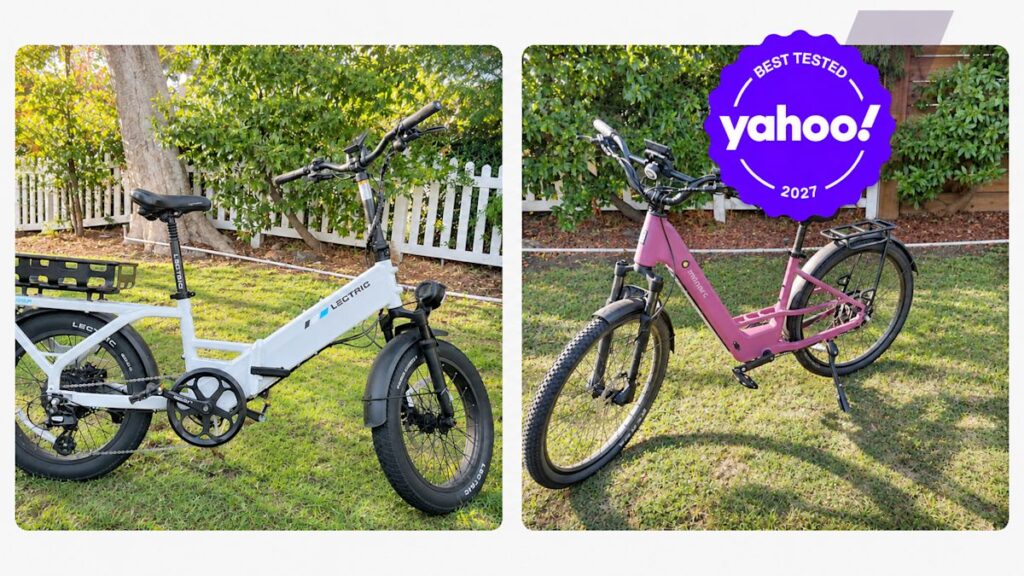


An e-bike might not totally replace your car (yet), but the best e-bikes can replace a lot of your car trips — the commute, the grocery run or school drop-off. And you don’t have to be a “bike person” to make the switch. In a 2026 study of e-bike owners, people who had rarely ridden a bike before buying an electric one were among the most likely to swap car trips for e-bike rides.
Quick Overview
That was true in my house. Our regular bikes mostly collected dust, but once we got e-bikes, my husband started riding to work, and we started heading to the beach regularly and taking after-dinner rides just because.
Why does an e-bike stick when a regular bike doesn’t? “I like to say that e-bikes take the rough edges off of a typical bicycle trip — hills, riding with traffic — so more people are picking it up,” says Christopher Cherry, a study coauthor and professor of civil and environmental engineering at the University of Tennessee.
The riding gets easier. The shopping doesn’t. There are three classes of e-bike, and many bikes are sold only online, which makes test rides hard. Plus, it’s tempting to shop on motor power and range alone. That’s a common mistake, says Benedict Wright, education manager at Bicycle Colorado, a nonprofit working to make biking safer for everyone who rides. “I really try to emphasize proper use-case, safety, durability and serviceability instead,” he says.
To help you find the right ride, we tested 17 e-bikes ranging from about $1,300 to nearly $6,000 and talked to three experts. Every pick is safety-certified, and five can be ridden as Class 1, the type allowed on most bike paths. Here are the ones worth your money.
Best e-bikes, at a glance
E-bike | Best for | Price at publication | Top speed | Throttle |
|---|---|---|---|---|
Monarc Tracer Step-Thru | Most riders | $1,799 | 28 mph | Yes |
Lectric XP4 750 Step-Thru | Tighter budgets | $1,299 | 28 mph | Yes |
Urtopia Carbon 1 Pro | Pedal-only riders | $1,899 | 20 mph | No |
Specialized Turbo Vado SL 2 6.0 EQ Carbon | A splurge | $5,800 | 28 mph | No |
Lectric XPedition 2.0 | Families | $1,799 | 28 mph | Yes |
Lectric XP Trike 2 | Balance concerns | $1,499 | 14 mph | Yes |
Best overall electric bike
Nathan Powell
Class: Adjustable to 1, 2 or 3 | Certification: UL 2849 | Frame style: Step-through | Claimed range: Up to 130 miles with both batteries | Weight: About 75 lb. | Max load: 420 lb. | Rider height: 5’2″ to 6’3″ | Warranty: 5 years
This is the bike we’d tell most people to buy. It became our tester’s go-to commuting bike, and the one the rest of the family kept borrowing. “It’s a very comfortable bike and smooth to ride, with a solid build,” our tester said. It feels more like a classic bike than a gadget, so you just hop on and go. But if you want tech, it’s there: The companion app pairs with add-ons like a rear radar ($89) that alerts you to cars coming up behind you.And it’s not just us: Consumer Reports gave it top marks for acceleration and hill climbing.
Front shocks and wide tires soak up potholes and helped our tester “feel safe even on sandy sidewalks.” At about 75 pounds, it’s no lightweight, though our tester found that, while heavy, “the bike isn’t cumbersome.” That heft is why its extra-strong brakes matter: A heavier bike needs more stopping power, especially going downhill. That’s exactly what Wright looks for. “I focus on the quality of the brakes in particular,” he says. The one hiccup: The throttle needed a reset a couple of times.
Range and charging: It comes with a second battery, so you can charge one at your desk and keep riding on the other, or just stop thinking about range. Our tester, who biked roughly three to four miles a day, only needed to charge the bike once a week.
Tune-ups and repairs: Monarc sells direct, and whether a local shop will work on it “would almost certainly vary from shop to shop and device to device,” Wright says. Check Monarc’s service network to ensure there’s an authorized repair shop near you before you buy.
- Second battery included
- Built-in turn signals and brake light
- Charge can be capped to extend battery life
- App pairs with add-ons like a rear radar
- Throttle needed a reset a couple of times
- Heavy
More electric bikes we like for 2027
Holly Pevzner
Class: Adjustable to 1, 2 or 3 | Certification: UL 2849 | Frame style: Step-through | Claimed range: Up to 85 miles | Weight: 71 lb. | Max load: 330 lb. | Rider height: 4’10” to 6’3″ | Warranty: 1 year
This folding e-bike with a low step-through frame is the best e-bike we tested for the money. It packs a lot of bike in: strong hydraulic brakes, smooth pedal assist, a crisp color display and a built-in rear rack that holds 150 pounds. It folds to fit in a car trunk or RV, and Lectric often throws in free extras with purchase, like a phone mount, bike lock, brighter headlight and a rack extender that lets you add a child seat or buddy seat.
One of our testers also trusts it with his two teens, both over 16. “I feel comfortable allowing them to ride it, especially since it’s got fat tires and I can cap the speed,” he said. Everyone found the seat “very comfortable,” though one rider swapped it for Lectric’s wider, plusher $59 upgrade.
The main trade-off is heft. “It’s a heavy bike that’s trickier to maneuver than the about-same-weight Monarc,” said our tester, who rode both for months. It’s also not especially compact when folded. And one tester noted that it “doesn’t perform well on rocky ground.”
Range and charging: Our tester charged it about once a week, roughly every 20 miles.
Tune-ups and repairs: Lectric partners with more than 500 bike shops and ships parts with instructions for simple at-home fixes. After seven months of regular riding, our tester’s XP4 was ready for its first professional tune-up.
- A lot of bike for the price
- Strong hydraulic brakes
- Folds for travel and storage
- Can carry a passenger with add-ons
- Heavy; bulky when folded
- Doesn’t perform well on rocky ground
Rick Broida
Class: 1 | Certification: UL 2849 | Frame style: Step-over | Claimed range: Up to 81 miles | Weight: 41 lb. | Max load: 240 lb. | Rider height: 5’3″ to 6’5″ (three frame sizes) | Warranty: 2 years on key components
🏆 Also won: Best lightweight electric bike in our best commuter bikes roundup
Our former top pick is nearly as light as our splurge choice for about a third of the price. Purists will like this: Even with the pedal assist off, our tester loved the ride. When you want a boost, the motor kicks in harder the harder you pedal, so it feels like your own legs get stronger, not like you’re being pushed. Switch to Turbo, its highest assist level, and “a fit cyclist can motor up most hills even in the hardest gear,” according to Consumer Reports testing. Tech fans get perks like fingerprint unlock, voice commands, GPS tracking and a built-in speaker, all managed through a companion app. (GPS tracking and navigation are free for the first year, then $39 a year.)
One catch for tall riders: The brand claims the bike is suitable for people up to 6’5″, but our tester found the large frame “barely tall enough to accommodate my 6-foot frame, even with the seat at maximum height.”
Range and charging: Our tester got about 55 miles per charge, well short of the claimed 81, and he’s not alone. “Lots of online reviews noted the bike rarely fulfills its 81-mile promise,” he said. On the plus side, the battery pops out, so you can charge it indoors.
Tune-ups and repairs: Urtopia has more than 750 partner stores in the U.S. that offer local service and support. Check its store locator for one near you before you buy.
- Smooth pedal assist
- GPS tracking and motion alarm
- Fenders, kickstand and rear rack included
- Range falls short of claims
- Not well suited to taller riders
Holly Pevzner
Class: 3 | Certification: UL 2849 | Frame style: Step-over | Claimed range: Up to 5 hours of ride time | Weight: 39.7 lb. | Max load: 275 lb. | Rider height: 5’1″ to 6’4″ (four frame sizes) | Warranty: Lifetime on frame (when registered), 2 years on motor and battery
This was the bike nobody wanted to give back. Our tester said riding it felt like he “was driving a sports car.” The motor delivers power so “smoothly” that the “comfortable and responsive” ride “almost feels like a regular bike, but better.” And don’t let the 320-watt motor fool you: It still hits 28 mph. Simply put, “it’s really fun to ride.”
At under 40 pounds with a carbon frame, it’s light enough to carry up a few stairs. It’s a splurge, no question. “I love everything about this bike: smooth ride, easy to handle, lightweight and stunning,” our tester said. “But it’s very expensive. I didn’t feel comfortable putting my 17-year-old on a nearly $6,000 bike.”
The EQ (“equipped”) version adds fenders, lights, a kickstand, a front rack mount and a rack that fits a child seat. You also get strong hydraulic brakes, Apple Find My tracking and a motor lock to deter thieves. The Specialized app lets you fine-tune the motor and track stats like heart rate.
Range and charging: The battery can last up to five hours of riding, and our tester never had any issues. “I would lose about 10% of the battery going to and from work, which was about four miles,” said our tester. There’s an optional add-on battery extender ($450).
Tune-ups and repairs: Specialized sells through local bike shops, so the shop where you buy the bike can also service it, motor and all. That’s exactly what Wright recommends: When friends ask which e-bike to buy, “I tell them to visit their local bike shop,” he says.
- Light for an e-bike
- Smooth, natural-feeling pedal assist
- Comes with fenders, lights, a rack and built-in theft tracking
- Pricey
- Battery not removable for charging
Holly Pevzner
Class: Adjustable to 1, 2 or 3 | Certification: UL 2849 | Frame style: Step-through | Claimed range: Up to 120 miles with both batteries | Weight: 83 lb. | Max load: 450 lb. | Rider height: 4’11” to 6’5″ | Warranty: 1 year
This is our beach, school-run and grocery-haul bike. The star is the long rear rack, which is built to haul kids, cargo or both. (There’s even an add-on surfboard rack.) Our testers set it up to carry older kids or an adult. You can add a wraparound safety rail or a child seat for little ones, or bags for cargo. It also costs a fraction of what most cargo e-bikes do, and it often comes with seat cushions, the safety rail and footrests.
“This is a heavy bike, like a truck, but I appreciated the heft and fat tires for stability,” said our tester. Front shocks and responsive pedal assist keep it steady even when it’s loaded. “It’s a surprisingly smooth ride for the size,” he said. Consumer Reports agreed, giving its braking, acceleration and hill-climbing top marks.
It does take some muscle. Our tester recommends that only a “strong and experienced” rider take the handlebars. And at 6 feet 5 inches long, with a kickstand that you release by pushing the bike forward, it “can be difficult to find enough space on a bike rack.”
Range and charging: The two batteries drain together, which is supposed to keep power steady longer. You can charge them right on the bike, but the standard charger is slow. (At times, the fast charger is included as a freebie.) “I love that we can ride to the beach and back, which is about 24 miles to and from, and never have to even check the battery, because I know I’ll be fine,” said our tester.
Tune-ups and repairs: Start with a call to Lectric support. The team can ship parts with how-to instructions for simple fixes, or point you to one of its 500-plus partner shops. Getting there is the tricky part, since it may not fit in your car.
- Costs a fraction of most cargo e-bikes
- Stable, smooth ride even when loaded
- Long range
- Many configuration options
- Heavy and long
- Hard to fit on bike racks or in a car
Korin Miller
Class: Adjustable to 1 or 2 | Certification: UL 2849 | Frame style: Step-through | Claimed range: Up to 50 miles | Weight: 86 lb. | Max load: 415 lb. | Rider height: 4’10” to 6’2″ | Warranty: 1 year
If wobbly wheels and balance worries have kept you off a bike, this is your ticket back. The XP Trike 2 rolls on three wheels, so it stays steady at stops and takes the worry out of getting on and off. And once you’re seated, you’ll want to stay there: It has the “comfiest seat” of any bike we tested — “wide and cushiony,” according to our tester. That kind of ease keeps people riding, which matters more as we age. E-bikes “can be a powerful tool to extend physical activity for aging populations,” Cherry says.
This trike is built for cruising, not racing. The quiet motor tops out at 14 mph, a pace that feels relaxed and in control rather than slow. “The suspension is smooth and the tires are sturdy,” said our tester, “allowing you to cruise over just about any surface.”
Instead of a kickstand, a trike has a parking brake to keep it from rolling while you climb on or load up. And there’s lots of room to do just that. “The cargo space is massive,” said our tester, noting it’s a good idea to upgrade with rear and front baskets ($119) to capitalize on all that space.
The drawbacks? The steering is a little tight, and while it folds, it’s never really compact.
Range and charging: It can go up to 50 miles on a charge, and at its easy pace, that’s a lot of riding. You can charge it without taking the battery off the trike, and the standard charger takes five to seven hours.
Tune-ups and repairs: At 2 feet 6 inches wide and 86 pounds, it’s a lot to haul into the shop. While Lectric has more than 500 partner bike shops, not every one is set up for three wheels, so call ahead.
- Very comfortable
- Foldable
- Lots of room for cargo
- Steering is a little tight
- Heavy
- Bulky when folded
Before you buy: what matters (and what doesn’t)
Some specs are worth sweating, and some aren’t. Here’s where our experts say to focus.
Advertisement
Advertisement
Start with how you’ll ride. E-bikes “allow you to keep up with traffic, to overcome hills, travel farther, carry more people or things,” Cherry says. Decide which of those you need most, since commuting, hauling kids and weekend cruising call for different bikes.
Pick the right class. Many states sort e-bikes into three classes:
Class 1: Pedal assist only; motor stops at 20 mph
Class 2: Throttle to propel bike forward; motor stops at 20 mph
Class 3: Pedal assist; motor stops at 28 mph; often not allowed on bike paths and trails
Some bikes, including four of our picks, are adjustable. Through the bike’s settings, you can switch classes by turning the throttle on or off and capping the top speed at 20 or 28 mph. That way, one bike can follow the rules wherever you ride.
Advertisement
Advertisement
Anything that tops 28 mph or comes with an off-road mode is likely an e-moto, which may need a license and registration. PeopleForBikes tracks e-bike laws by state.
Look for a safety certification. UL 2849 means the bike’s entire electrical system, including the battery, has been tested. UL 2271 covers the battery alone. The label should be on the bike itself, and legit brands list it on their sites.
Don’t get blinded by power. “Power and range matter, but most riders don’t need a super powerful motor, and the average bike ride for most people is not longer than the range of a solid, standard e-bike,” Wright says. Case in point: Our splurge choice hits 28 mph on a 320-watt motor.
Check the fit. Once you know what you need, make sure the bike fits you. Look up its rider height range and riding position: upright cruiser, sporty hybrid or bent-over road bike. Better yet, take one for a spin. “In my opinion, nothing beats a test ride and a recommendation from a knowledgeable salesperson at a physical retailer,” Wright says.
Before you check out
Found the one? A few practical steps can save you money and headaches.
Advertisement
Advertisement
Research rebates. E-bike incentives are more common than you might think. “There are currently over 115 programs in North America,” says John MacArthur, sustainable transportation program manager at the Transportation Research and Education Center at Portland State University, whose team keeps a running list of e-bike incentives.
Budget for gear. Plan on a helmet, a sturdy lock and lights if your bike doesn’t come with them. Look for a CPSC sticker on the helmet, which shows it meets the U.S. safety standard for bike helmets. And if you are going the cargo e-bike route, be sure to add up all the extras you’ll need to buy before hitting “add to cart.”
Expect some assembly. Most bikes bought online arrive mostly built. Urtopia says its bikes are 90% assembled and take about 15 minutes, and Lectric advertises tool-free setup. If you’d rather skip it, some brands, like Specialized, can deliver your bike fully built or have it ready at a local shop.
Know the return rules. Return windows are short and strict. Lectric and Monarc take bikes back within 14 days only if they haven’t been ridden, and they may charge up to $300 to restock. Urtopia also allows 14 days, minus a return fee. Specialized is the most flexible on our list, with a 30-day satisfaction guarantee (store credit if you’ve ridden it).
Plan for repairs. Some bike shops won’t work on e-bikes bought online, or they’ll fix the tires and chain but not the battery or electronics. Before you buy, ask the brand which shops service its bikes. Lectric and Monarc both list service networks on their sites, Urtopia has partner stores, and Specialized sells through local bike shops.
How to ride and charge safely
E-bikes catch a lot of flak for being dangerous. After all, U.S. emergency rooms treated an estimated 59,200 e-bike injuries in 2024, up from an average of about 6,300 a year from 2017 to 2021, according to the Consumer Product Safety Commission (CPSC). But that doesn’t mean e-bikes are riskier than regular bikes. “In general, there’s not a lot of evidence of the increased safety risks of riding an e-bike vs riding a bike or driving,” says MacArthur. A few habits go a long way:
Ride like drivers can’t see you. Crashes with cars are the leading cause of e-bike deaths, so wear a helmet, use lights and stick to routes with bike lanes when you can.
Think twice before handing one to a young teen. “Parents should think carefully about a young person’s ability to ride a normal e-bike in traffic as they would a bicycle,” Cherry says. Many brands, including Lectric, require riders to be at least 16.
Advertisement
Advertisement
Charge with care. Battery fires are rare but serious. The Electrical Safety Foundation International recommends:
Only use the charger that came with your bike, and buy replacement batteries from the manufacturer.
Plug directly into a wall outlet, not an extension cord.
Don’t charge overnight or while you’re away, and unplug when it’s done.
Charge away from doors and exits, so a fire can’t block your way out.
How we chose and tested
We’ve tested 17 e-bikes to date, riding them on daily commutes, errands, school runs and beach trips. We rated each on ride quality, comfort, braking, range, build value and how easy it is to get serviced.
Value got extra attention this time. Our picks range from about $1,300 to nearly $6,000, but we focused on the sweet spot in between. That’s where Wright says you get the most for your money. Below about $2,000, he’d be “much more cautious.” Above it, “you’re paying for bells and whistles that are nice to have but not integral to the core safety or functionality of the bike.” Our splurge choice is here for riders who want those extras.
Advertisement
Advertisement
We also raised the bar on safety: Every pick must now be certified to UL 2849, which covers the bike’s entire electrical system, including the battery. Along the way, we interviewed three e-bike researchers and educators, and we’ll keep retesting as models and availability change.
Other e-bikes we tested
Priority Current Plus: This is a clean, low-maintenance commuter with a grease-free belt drive. It was our former Class 2 commuter pick, edged out by the Monarc’s included second battery and lower price.
Cannondale Cargowagen Neo: Our former cargo pick is a sturdy kid-hauler our tester loved for day care runs. But the XPedition costs far less, and the Cannondale is out of stock.
Bluejay Premiere Lite: This throttle-free cruiser with a pretty Dutch-style build was our former cruiser pick. Bluejay notes its bikes use UL 2849-compliant components, but we couldn’t confirm that the whole bike is certified.
Advertisement
Advertisement
Aventon LR Abound: This roomy cargo bike comes at a low price, but its range drops from 60 miles to about 35 with people and gear on board, and the XPedition hauls more.
Lectric XPeak High-Step 2.0: This all-terrain bike arrived fully assembled, and one tester called it a “beast on wheels.” But it’s a mountain bike, which is too niche for this list.
Solar Scooters E-Clipse 2.0: It has no pedals, so it’s an electric motorcycle, not an e-bike, and you need a motorcycle license and registration to ride it.
Five e-bikes that previously appeared on our best electric bike list are discontinued, out of stock or do not meet our revised safety standards, including the JetCurrent Pro and the Evry Journey 250W.
Electric bikes FAQs
What is the No. 1 e-bike?
There’s no single best e-bike for everyone, but our top pick is the Monarc Tracer Step-Thru. It’s comfortable, well-built, comes with a second battery and costs $1,799. The right bike for you depends on how you’ll ride: For hauling kids, see the Lectric XPedition 2.0; for a tighter budget, the Lectric XP4 750; and for balance concerns, the Lectric XP Trike 2.
Are e-bikes dangerous?
Not inherently. A lot of the scary e-bike headlines don’t actually involve true e-bikes. Instead, “many of the concerns and anecdotal evidence related to current crashes and injuries involve bikes that fall outside the Class 3 system, such as e-motos,” MacArthur says. He adds that “many more people are killed by or in cars every year.”
Can you get a good e-bike for under $1,000?
It’s possible, but be careful. “Certainly there are safe and reliable e-bikes under $2,000, but I’d be much more cautious as a consumer at that price point,” Wright says. At lower prices, expect heavier frames, smaller batteries and less reliable brakes. Before you buy, check that:
Advertisement
Advertisement
The whole bike is certified to UL 2849, not just the battery (UL 2271).
It has hydraulic disc brakes, which deliver strong stopping power with a light squeeze and hold up better in the rain than rim brakes, according to engineering research.
A shop near you will service it.
The return window is clear.
Do you still have to pedal an e-bike?
On a Class 1 or Class 3 bike, yes; the motor helps only while you pedal. Class 2 bikes add a throttle that lets you ride without pedaling.
Meet our experts
Christopher Cherry, professor of civil and environmental engineering at the University of Tennessee and e-bike researcher
Benedict Wright, education manager at Bicycle Colorado, a nonprofit working to make biking safer for everyone who rides
John MacArthur, sustainable transportation program manager at the Transportation Research and Education Center at Portland State University
Our health content is for informational purposes only and is not intended as professional medical advice. Consult a medical professional on questions about your health.
Source link