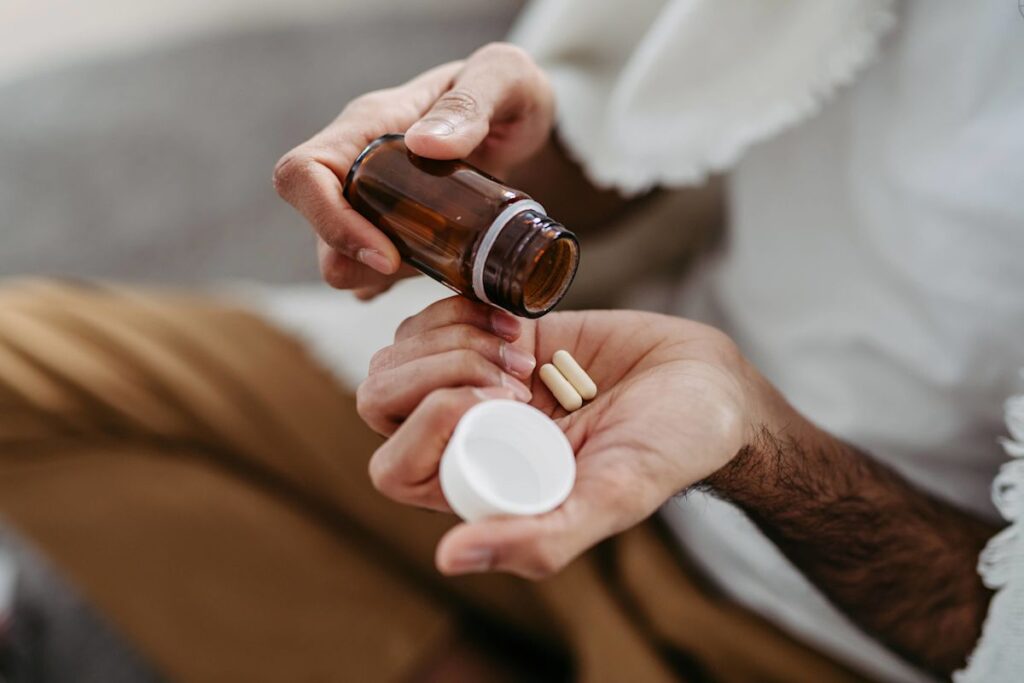
At some point, ibuprofen became part of the post-leg workout stack for many lifters. Grab a protein shake, add a scoop of creatine, and take two Advil for your sore quads.
While this approach may seem like a proper part of recovery, it isn’t that simple. The soreness you’re trying to reduce with ibuprofen runs on the same inflammatory signaling your muscles use to rebuild, so the pill meant to speed up recovery may actually end up working against it.
“If you have unexpected DOMS that’s affecting daily function, taking a dose is fine,” says Graeme Matthewson, MD, FRCSC, a board-certified, fellowship-trained sports medicine orthopedic surgeon at Matthewson Orthopedics and Peak MD Regenerative. “But if you find you’re taking it on a regular basis, something else is going on, and something needs to change in your training, your recovery, or both.”
Advertisement
Advertisement
Here’s what the research shows, how much ibuprofen you should take, and what to use instead for better recovery.
Want the latest fitness advice and workouts to tackle any adventure? Sign up for our Blueprint newsletter.
The Surprising Reason Muscle Soreness Helps You Build Size
Delayed-onset muscle soreness (DOMS) shows up 24 to 48 hours after intense training sessions, peaks, and then fades. It’s most pronounced after eccentric work (the lowering half of a rep), and after anything your body hasn’t done in a while.
Research shows that intense strength training, especially the eccentric kind, puts enough stress on your muscle fibers to trigger an inflammatory response that clears out damaged tissue and kicks off your body’s repair process. The ache you feel is part of that process, and it’s the same process that rebuilds the muscle stronger.
Advertisement
Advertisement
If you do the same workout a few weeks in a row and the next session hurts less, it’s because your muscles have already adapted. So think of muscle soreness as your body giving you feedback. It’s a good indicator that you gave your muscles something unfamiliar to adapt to, which is the entire point of training in the first place.
How Over-the-Counter Painkillers Interfere With Muscle Gains
Ibuprofen works by shutting down an enzyme pathway that produces compounds your muscles use as part of their repair instructions.
“Ibuprofen works by inhibiting COX-1 and COX-2, which blocks prostaglandin production,” explains Matthewson. “Prostaglandins are part of the normal response to training and play a role in muscle protein synthesis and satellite cell activation. Satellite cells are the stem cells that donate nuclei to muscle fibers as they grow.”
Studies suggest that in young men after heavy eccentric work, maximum over-the-counter doses of ibuprofen or acetaminophen suppressed the expected rise in muscle protein synthesis at the 24-hour mark, and that NSAIDs have been shown to inhibit satellite cell proliferation after eccentric exercise.
Advertisement
Advertisement
“The inflammatory response after training is part of the signal to remodel and grow, so blunting it can reduce the adaptation,” says Matthewson.
Related: New Research Claims Restricting Protein Extends Lifespan. Here’s Why Lifters Shouldn’t Cut Back
The Exact Daily Dose That Can Limit Muscle Growth
“In young adults taking 1,200 milligrams a day, the maximum over-the-counter dose, for eight weeks of training, quadriceps growth was about half of what the control group saw,” Matthewson says. “A study using 400 milligrams after each session for six weeks found no effect on hypertrophy or strength, and a single maximal dose of ibuprofen hasn’t been shown to blunt the post-exercise signaling response. Two Advil after a leg day is 400 milligrams.” The eight-week trial that Matthewson is referring to found that quadriceps growth increased by 3.7 percent in the ibuprofen group against 7.5 percent in the low-dose comparison group.
So while taking two Advil after a brutal leg day may be considered safe, the risk lies in making a habit of it, such as consuming 1,200 milligrams a day, every day, for months. And since most people don’t keep track of how much ibuprofen they’re taking, this habit can become dangerous if left unchecked.
Over time, regular high doses of ibuprofen can irritate your stomach lining, raising your risk of ulcers and gastrointestinal bleeding, and can strain your kidneys, especially if you’re dehydrated after an intense leg training session. Additionally, NSAIDs like ibuprofen can raise your risk of heart attack and stroke, and that risk increases with higher doses and longer use.
Smarter Ways to Bounce Back Faster After Heavy Squat Sessions
You may assume that swapping ibuprofen (Advil) for acetaminophen (Tylenol) would solve the problem, but that’s not the case. “Acetaminophen isn’t a clean alternative,” says Matthewson. “It suppresses post-exercise muscle protein synthesis just as much as ibuprofen.”
Advertisement
Advertisement
Next time you feel sore after leg day, opt for these healthier recovery options instead of relying on medication:
-
Volume Adjustment: If every session leaves you wrecked, your program needs changing, not medicating. Research shows that reducing sets or reps for a week gives your muscles and joints time to catch up on repair, so you’re training on recovered tissue instead of stacking fatigue on top of fatigue.
“For genuine pain, an occasional standard dose of either is reasonable and unlikely to affect your gains,” Matthewson says. “I wouldn’t take them routinely before or after every session. If you need an anti-inflammatory every day to get through training, that isn’t soreness, and it should be evaluated.”
Related: How Much Alcohol Does It Take to Sabotage Muscle Growth? Here’s What the Science Says
When an Occasional Pill Is Fine (and When to Change Your Routine)
Taking two Advil (roughly 400 milligrams of ibuprofen) when you’re sore after a hard leg day won’t cost you any muscle gains, but consuming 1,200 milligrams of ibuprofen a day might. It also won’t help alleviate soreness. If you’re reaching for the bottle every session, treat that as information about your training program rather than a problem to medicate, and talk to your doctor before changing how you use any medication.

This story was originally published by Men’s Journal on Nov 4, 2026, where it first appeared in the Fitness section. Add Men’s Journal as a Preferred Source by clicking here.