

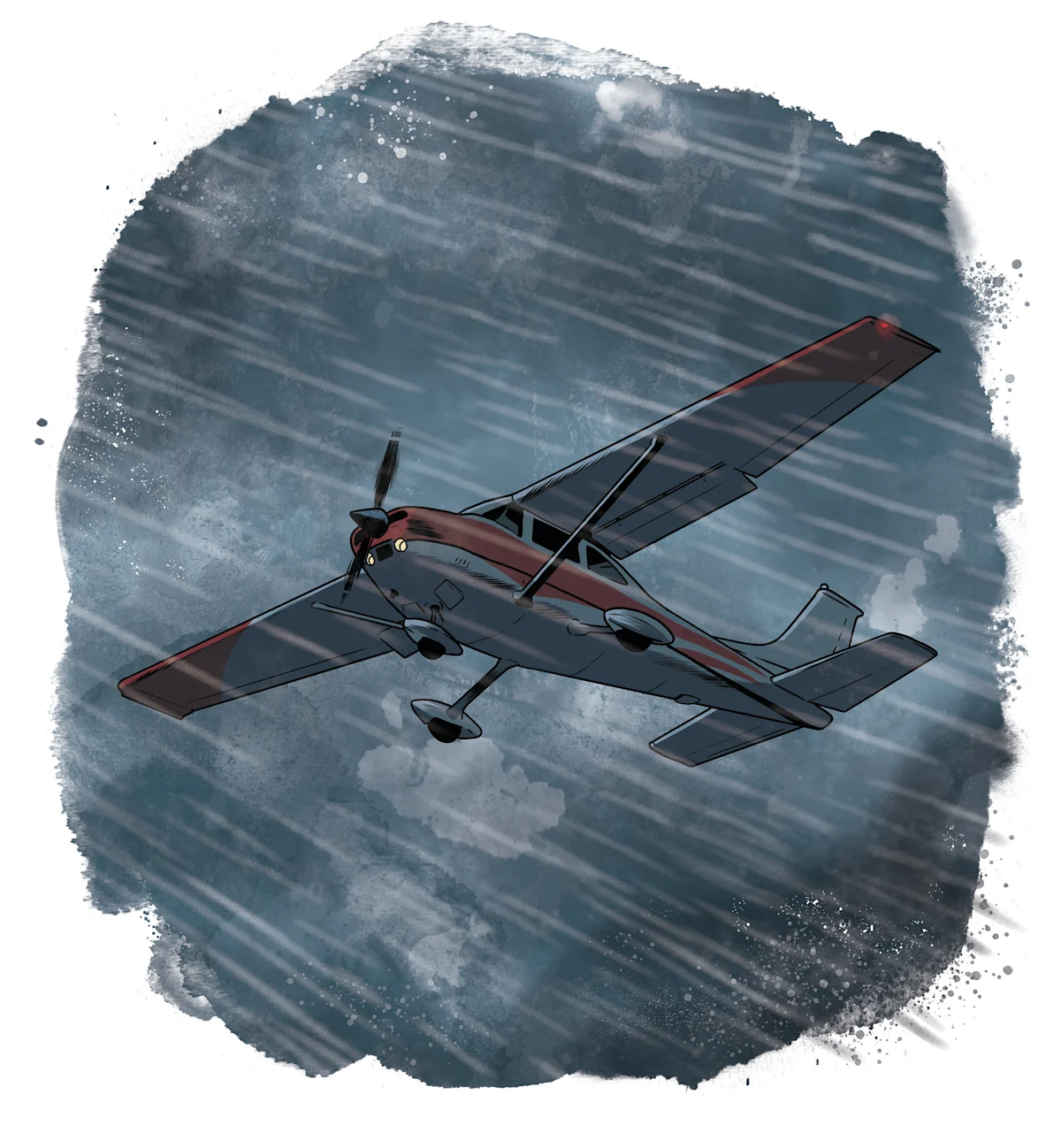
The plan was simple enough. My girlfriend-now my wife-and I were going to fly to the Bahamas to meet up with my brother, his wife, and my dad. The plan was to first connect with my brother in Fort Myers, Florida, then hop over to Palm Beach, and finally fly to Freeport. I should note that I always file IFR on these types of trips.
The first leg, from Georgetown Executive Airport (KGTU) in Texas to Gulf Shores International Airport (KJKA) in Alabama, was uneventful. We fueled up and received a weather briefing that indicated the usual convective activity over Florida, but our proposed IFR route looked fine.
This Article First Appeared in FLYING Magazine
If you’re not already a subscriber, what are you waiting for? Subscribe today to get the issue as soon as it is released in either Print or Digital formats.
Subscribe Now
It was 2004, and my Cessna 182 did not have any weather-reporting capability. This was before ADS-B and all the other tools now at a pilot’s disposal. We took off from Gulf Shores with an IFR route to Fort Myers that hugged the Florida coast at 7,000 feet.
The flight was going great with beautiful weather along the coastline.
Then ATC made me an offer I should have refused. Once we were over Panama City, Florida, controllers presented a direct route to Fort Myers.
At the time, I was a low-time IFR pilot and didn’t think it through. All I thought was, “Great, I can save some time going direct,” and I accepted. (I did the math later, and it only saved about 12 minutes.)
If I had thought about it for even a second, it would have been clear this was a bad idea. We were in a single-engine airplane and would be miles offshore in international waters. It was all legal, but there was no way we would be able to glide to shore if something went wrong.
We did have flotation gear since we were heading to the Bahamas. However, we didn’t have any personal emergency locator (ELT) devices or a raft-only life vests. Another factor working against us was that, at 7,000 feet and that far offshore, communication with ATC was increasingly spotty the farther out we flew.
But the worst part was yet to come.
The flight over the water was smooth, and the airplane was performing nicely. Then, up ahead, I saw a line of clouds. It hadn’t been in the forecast, but then again, I had changed our route of flight, which would have hugged the shoreline.
ATC never reported any convective activity, so I decided to continue into the clouds. I was instrument rated. I could handle this.
Once in the clouds, it started getting darker, but there was nothing to indicate any issues.
Then all hell broke loose. We had entered a line of heavy showers, and it started raining buckets. The turbulence was so severe that I slowed down to maneuvering speed and turned off the autopilot, given that it couldn’t handle the rapid altitude changes. I hand-flew the plane and focused on keeping the wings level while my girlfriend clung to the dashboard.
Water was coming in through all the vents. At this point, it was time to communicate with ATC, and I asked for vectors out of the mess. I suspect this was the first time they realized I was in serious weather, and they gave me direct to Bradenton.
There’s still much debate between my now-wife and I about how long we were in the rain squalls, but we broke out of the clouds near Bradenton. Interestingly, we flew over the very same beach I used to play on as a child when visiting my grandmother in Florida. We landed at KFMY (Page Field) about 20 minutes later. It was nice to be back on the ground.
I’ve told this story many times, and the usual feedback is that it was foolish to fly a single-engine airplane over water and out of gliding distance to shore. I can’t argue with that. But there were other mistakes as well.
We didn’t have a raft, only life vests. We had no personal ELTs attached to ourselves. And once we were over the water, we weren’t even wearing the vests. A Cessna 182 will most likely flip when landing in water, and we would never have been able to retrieve those vests from the back seat.
There were a couple of other issues-staying at 7,000 feet where communication was spotty and there is less altitude to return to shore, and assuming ATC would report weather issues ahead. That’s my responsibility-and honestly, thinking back, I didn’t ask. When I saw that line of clouds, I should have requested a direct route back to the shoreline to get around the weather over land.
So here’s what I learned:
» Don’t blindly accept a route change from ATC without first understanding the repercussions.
» Don’t expect ATC to keep you out of bad weather.
» Avoid flying single-engine aircraft over open water. If you do, plan accordingly by carrying proper floatation devices and wearing personal ELT devices.
This column first appeared in the November Issue 964 of the FLYING print edition.
Editor’s note: If you’ve learned about flying through a harrowing experience of your own, we’d love to hear your story for potential publication in a future I Learned About Flying From That (ILAFFT) column. Send us the details at editorial@flyingmag.com.