
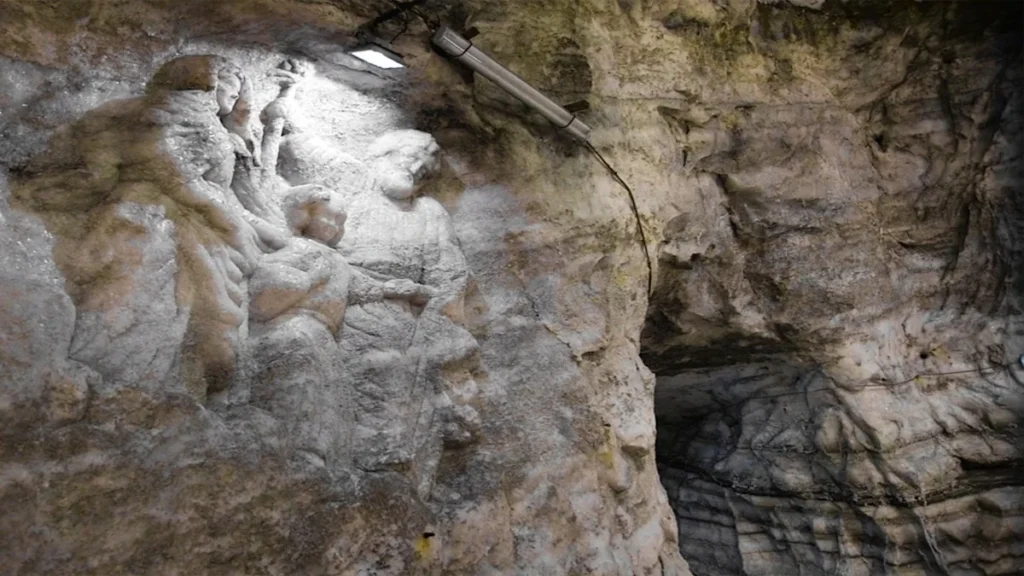
Beneath the rocky landscape of Realmonte in Sicily, Italy, lies an extraordinary underground world where industrial mining meets religious devotion. Deep inside one of Europe’s largest salt mines, workers have carved a cathedral directly into the walls of solid salt. The remarkable space features an altar, steps, and a crucifix, creating a place of worship far below the surface. Surrounding it are kilometres of tunnels decorated with natural patterns formed millions of years ago. This unusual cathedral demonstrates how a working mine can become a place of beauty, history, and spiritual significance.
Reaching the underground cathedral requires travelling through an extensive network of tunnels that stretches for approximately 62 miles. These passages reveal the geological history of the region, with striking concentric circles and bands running through the salt walls. The patterns were formed around five million years ago as ancient seawater evaporated, leaving behind thick deposits of salt. Over immense periods of time, these deposits became part of the bedrock that miners now excavate.
The coloured bands within the rock provide clues about the conditions under which the salt layers formed. Lighter rings are associated with periods of warmer weather, while darker bands indicate cooler conditions. Together, these natural formations create a visually distinctive environment that resembles an enormous underground artwork. Although the patterns were not deliberately designed, their regular shapes and contrasting colours give the tunnels a remarkable appearance.
Advertisement
Advertisement
Deeper within the mine, visitors encounter the cathedral carved by the workers themselves. Rather than constructing a separate building from stone or brick, the miners shaped the surrounding salt into a sacred space. The result includes an altar, steps, and a crucifix, demonstrating the craftsmanship required to transform an industrial environment into a place of worship.
The cathedral is dedicated to Saint Barbara, the patron saint of miners. Her association with mining makes her a meaningful figure for the people who work underground and face the challenges of extracting valuable materials from the earth. The cathedral can accommodate approximately 800 worshippers, allowing large gatherings to take place within this unusual setting. Religious services held underground connect the daily working lives of miners with their spiritual traditions.
Beyond its cultural and religious importance, the salt mine is a major contributor to the local economy. It produces approximately 500,000 tonnes of salt annually, making it an important industrial site in the region. Salt has long been a valuable resource, used in food production, preservation, and various industrial processes. The mine’s extensive tunnels and deposits represent both a geological resource and a source of employment for the surrounding community.
What makes the Realmonte salt cathedral especially remarkable is the contrast between its practical surroundings and its spiritual purpose. The mine is a place of extraction and heavy labour, yet within its depths lies a carefully shaped sanctuary that inspires reflection and admiration. Natural geological patterns provide the backdrop, while the miners’ craftsmanship gives the space its distinctive character.


