

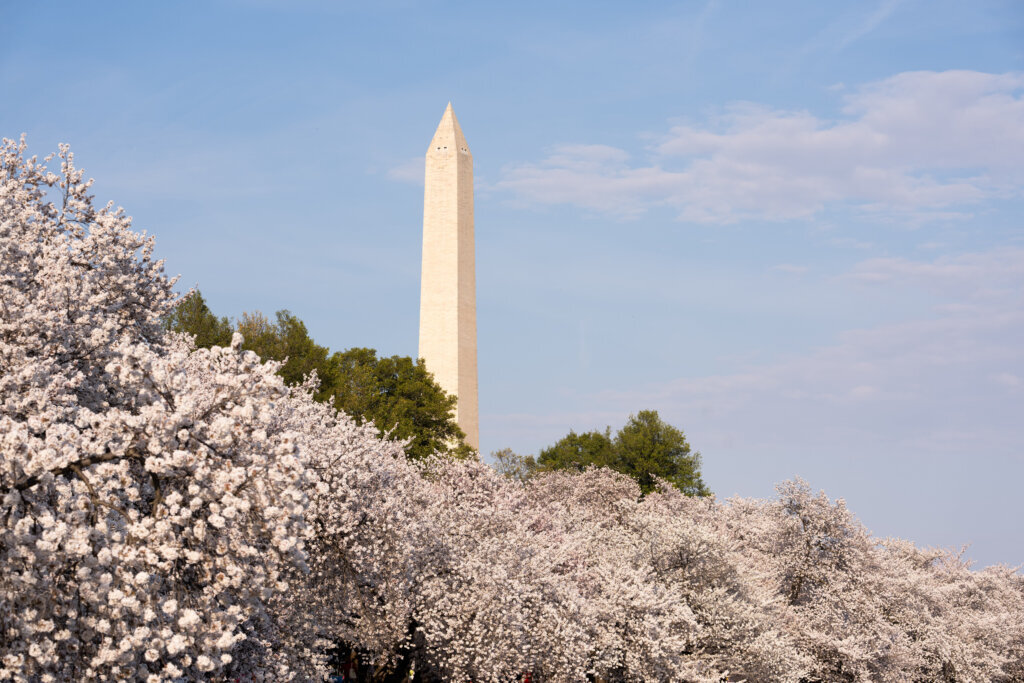
The National Park Service says the Tidal Basin portion of the sea wall restoration project will be completed by the end of April, reopening the newly rebuilt area to visitors.
If you’ve been down to the Tidal Basin lately, you may have noticed a lot has changed along the water.
The National Park Service said the Tidal Basin portion of the sea wall restoration project will be completed by the end of April, reopening the newly rebuilt area to visitors. The work addresses decades of problems with a failing sea wall that allowed tidal water to regularly spill onto walkways and soak the roots of cherry trees.
Mike Litterst, spokesman for the National Park Service, said the project was designed to protect the basin for the long term while also improving access for visitors. He said walkways around the basin have been widened, giving people more room to move around not just during cherry blossom season, but throughout the year.
While much of the sea wall is new, Litterst said visitors will still see pieces of history built into it.
“If you look closely, you’ll see that there are different colors of stone that are used in the sea wall,” Litterst said.
Some of those stones date back to the original early 20th century sea wall and were incorporated into the new structure, preserving elements of the basin’s historic design.
Along with the sea wall work, hundreds of new cherry trees are already in the ground as part of a rebuilt landscape around the basin. Many of those trees are Okame cherry trees, which are similar to the more familiar Yoshino trees but bloom about two weeks earlier, bringing color to the Tidal Basin sooner in the spring.
National Park Service urban forester Matthew Morrison, who helps oversee the trees, said many were carefully hand selected from nurseries outside the DC region.
“We were down in North Carolina hand selecting trees, and Tennessee,” Morrison said. “After walking thousands of acres and looking at thousands of trees, we selected about 400 that we brought home.”
Once planted, Morrison said care for the young trees begins almost immediately. Crews are “structurally pruning” them to help the trees better withstand storms and other harsh conditions as they mature.
“We’ve learned, the science of arbor culture has advanced itself far enough, that we know the structure of the trees that survive in adverse weather conditions,” Morrison said.
Over time, Morrison said the cherry trees planted close together around the basin will begin to function as a connected system underground.
“Their roots are going to graft together, their canopies are going to overlap,” he said.
When that happens, he said the trees will work together at times, helping to provide nutrients to the least healthy trees.
“That grove of individual trees is going to become one superorganism, and it’s going to work as one,” he said.
Even a cherry tree that was removed for the project remains part of the restoration. The tree known as “Stumpy,” which became a favorite among visitors, still plays a role in caring for the new plantings.
“When Stumpy met its demise, we ground it up and made wood chips,” Morrison said. “The wood chips are integral to conditioning the soil and adding nutrients, macro and micronutrients, into the soil.”
Those wood chips are now part of the mulch around the new cherry trees, helping nourish the next generation growing along the Tidal Basin.
Get breaking news and daily headlines delivered to your email inbox by signing up here.
© 2026 WTOP. All Rights Reserved. This website is not intended for users located within the European Economic Area.