Curry resists the baronial impulse. He may clearly relish such period details as the vaulted ceilings, with their original Moroccan Art Deco–and Art Nouveau–style stencils, and plans to restore the fleurs-de-lis to the eaves, but he has no intention of installing the few grand pieces one might have found there three-quarters of a century ago. Rather, he has surrounded himself with the more-is-more aesthetic diary he’s been composing for decades.
Curry has amassed Stickley furniture—found streetside in the ’70s, before it was fashionable—and lots of 18th-century English antiques. “That’s what I like, really—making contradiction work,” he once said, explaining his fascination for playing complex characters.
The drawings and oils, nearly all of them portraits, are hung in the spirit of an earlier transatlantic traveler. “I’ve always loved photographs of Gertrude Stein’s apartment on the rue de Fleurus. It was crammed with extraordinary pictures that nobody else wanted to buy. Who hung them? I imagine that Gertrude sat there and said, ‘Now left a bit, Alice.’”
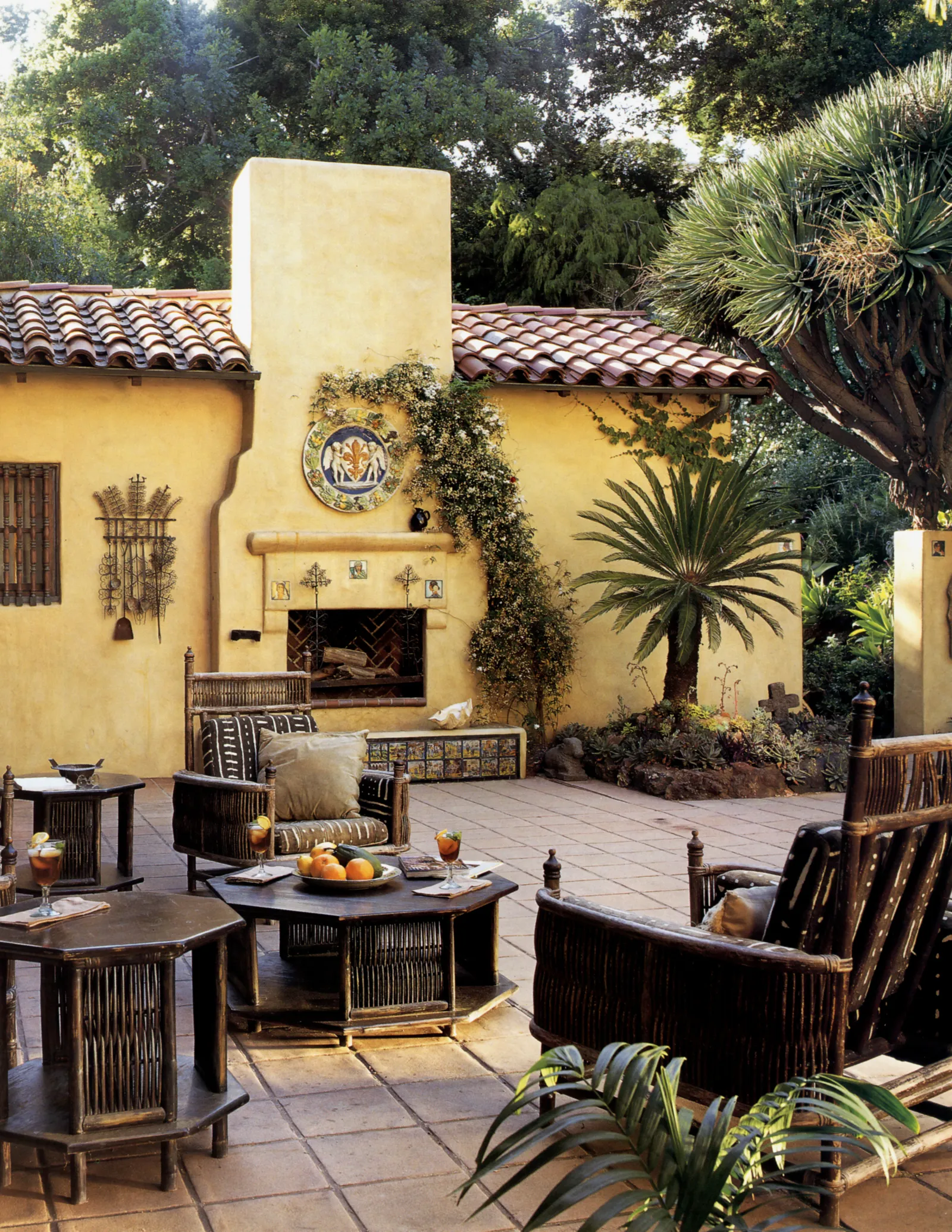
In Curry’s case, assistance was provided by the late designer Jim Lassiter, who advised him on textiles and color. Lassiter even fabricated a long-held Curry vision: an ottoman large enough for man, tray, and dog. The palette, determined by Curry, Lassiter, and decorative painter Richard Martin, grew from the few paint fragments that survived on a relief of the Madonna and child outdoors. The dark persimmon dining room is, in part, an homage to the Guinness house. “I do think,” Curry notes, “that red encourages the appetite.” And soft green? “A great color to think in, which is why it’s in the guest bedrooms.”
“It’s rather like designing a set for the life you wish to pursue. When I truly had a place that I wished to call home, I wanted it to be equally marvelous for my great friends, the other ‘cast members.’” Tim Curry breaks into his Mephistophelian laugh. “Once I stopped rushing about the world, trying to colonize London and New York and Los Angeles, I realized there were more important things in life than a marquee.”
Source: www.architecturaldigest.com
Source link