

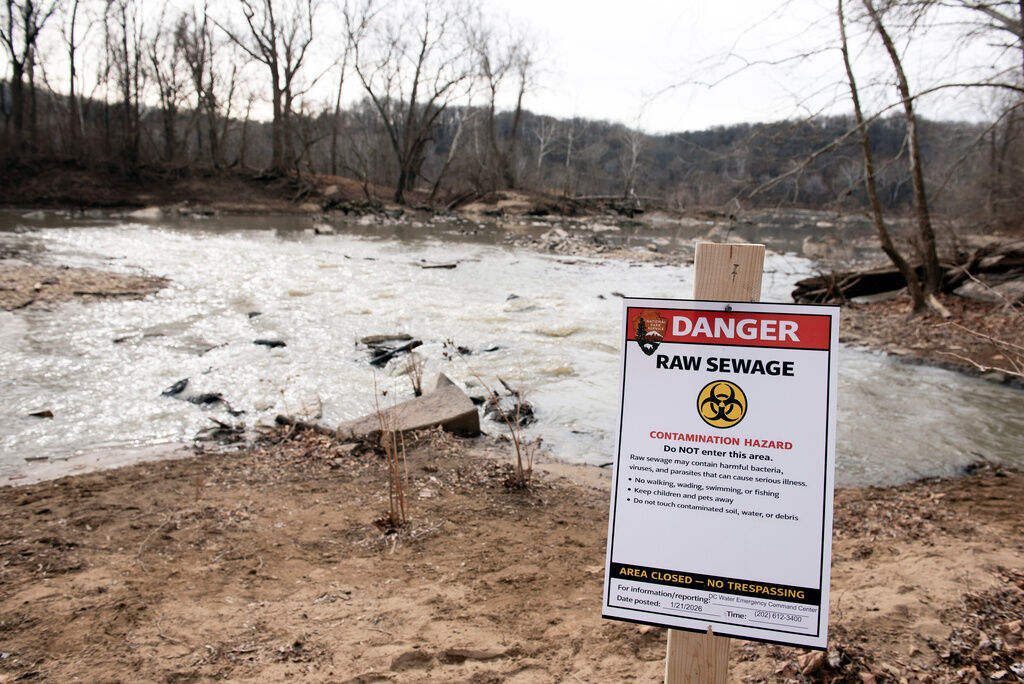
The president of the Potomac Riverkeeper Network said the raw sewage spill at the Potomac River could take several weeks to clean up, and she cautions against walking your pet or fishing near the area.
DC Water said it could take over a month to repair the large pipe that ruptured and sent millions of gallons of wastewater into the Potomac River last month.
While local organizations have assured the public that drinking water is still safe, some Maryland counties have released health advisories urging people to stay away from the sites of the spill near the C&O Canal National Historical Park.
The delay in repairs is apparently due to an unexpected blockage. So how is all of this affecting the health of the Potomac River?
Betsy Nicholas, president of the Potomac Riverkeeper Network, told WTOP anchors Anne Kramer and Shawn Anderson on Monday that the sewage spill was worse than the 1989 Exxon Valdez oil spill and the 2010 BP Deepwater Horizon oil spill when it comes to size.
Betsy Nicholas with the Potomac Riverkeeper Network gives WTOP an update on the state of the Potomac Interchange pipe rupture
- Anne Kramer:
If you could please, I’d like you to start out by first characterizing so people understand how bad of a spill this actually is and has been.
- Betsy Nicholas:
It’s a big, bad one. In comparison to things like the Exxon Valdez or the BP Deepwater Horizon, just in terms of volume, because that was obviously oil — this dwarfs them.
So it’s a really significant volume of sewage, but it’s also happening when we are in drought conditions. Despite all the snow and the ice on the ground, it hasn’t rained here in a really long time, so the flow in the river was already very low when this came in, meaning pretty much in that area around and for multiple miles downstream, it was just raw sewage flowing in there.
- Shawn Anderson:
D.C. Water now says it’ll take four to six weeks to fix all of this. So what does this delay mean for the river at this point?
- Betsy Nicholas:
The bypass that they have put in using the canal will still help take the load off of that pipe while they’re trying to fix it, but as they showed today and yesterday, they’re still having some raw sewage pouring out from it.
So until that situation gets fixed, which could be now months, we want to make sure that people are not fishing in that area. Don’t walk your dogs near there because there could still be releases of untreated sewage.
- Anne Kramer:
Betsy, talk to us about the water samples that your organization and University of Maryland took. What did they find? If you can reiterate that to people and then let us know about these health advisories — looks like the state of Maryland’s Health Department, as well as Montgomery and Prince George’s counties have stepped up to put advisories out.
- Betsy Nicholas:
That was a lot of the reason we were doing the sampling — trying to get out there as soon as possible to keep the community safe. And what we found with the University of Maryland researchers on this is that we saw not only high things like E.coli and fecal coliform — so just basic bacteria that could be very harmful — but also things like staph and MRSA infections.
So when you just have this kind of untreated sewage, there’s all kinds of nasty things in there that could make you really sick. So we want to keep people away from that, and that’s why we’re glad to see those health advisories come out. We, of course, hate to see people not being able to enjoy this beautiful resource in our area, but first step is to make sure people stay safe and don’t get in the water, but also don’t do things like fish right in the areas where the spill happened or walk right next to it, until this situation is fully resolved in a few months.
Get breaking news and daily headlines delivered to your email inbox by signing up here.
© 2026 WTOP. All Rights Reserved. This website is not intended for users located within the European Economic Area.