


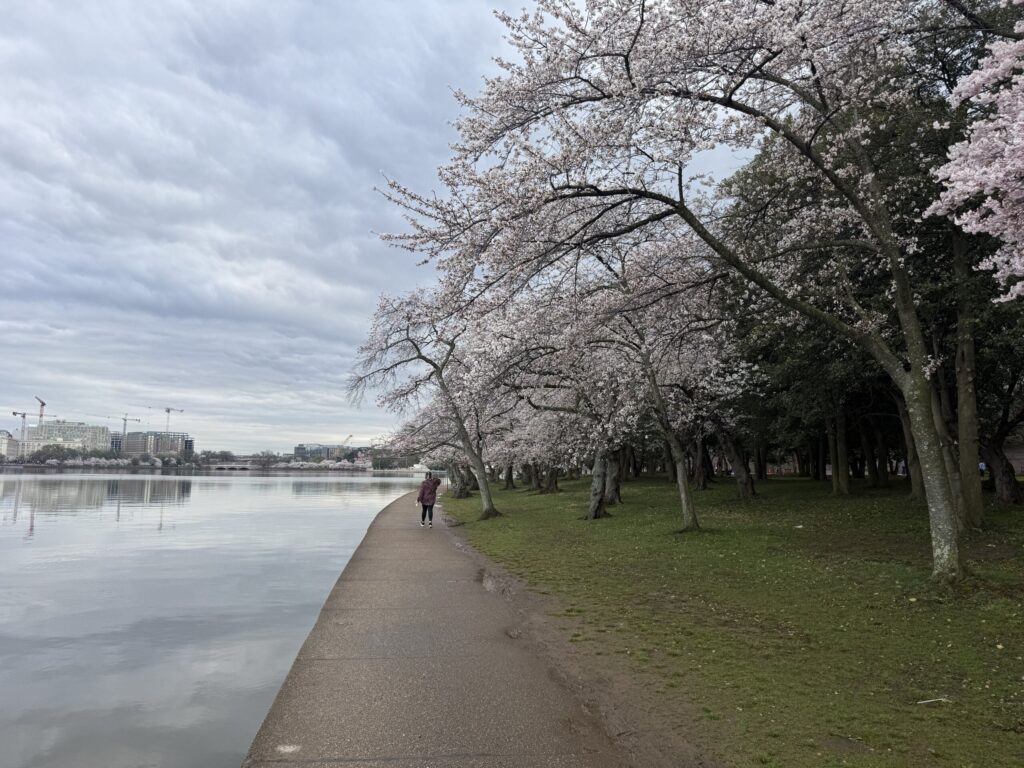
Eliza Scidmore, a world traveler, diplomat and writer, first began advocating for the Japanese cherry trees to come to D.C. in 1885.
This page contains a video which is being blocked by your ad blocker.
In order to view the video you must disable your ad blocker.
One woman made it her mission to get cherry trees at the Tidal Basin
Throughout March, WTOP is celebrating Women’s History Month. Join us on-air and online as we honor the achievements of women in the D.C. region.
Many in the D.C. region are aware the beautiful cherry blossoms that attract thousands to the Tidal Basin and National Mall were originally a gift from Japan in 1912 to celebrate friendship between the two countries. But for decades, one woman worked tirelessly to see the iconic trees planted in the nation’s capital.
Eliza Scidmore, a world traveler, diplomat and writer, first began advocating for the Japanese cherry trees to come to D.C. in 1885. Her brother worked in the consular service and Scidmore visited him in Japan.
“She recognized that these trees could thrive, perhaps in the nation’s capital,” said Rebecca Grawl, the vice president of education for A Tour of Her Own.
She thought a perfect place for them was the newly-reclaimed land from the Potomac River that became the Potomac Park.
Several decades after their planting, she wrote in the Washington Sunday Star, “they had to plant something in that great stretch of raw, reclaimed ground by the river bank, since they had to hide those old dump heaps with something, they might as well plant the most beautiful thing in the world — the Japanese cherry tree.”
For 24 years she presented her idea to various public building and grounds superintendents, one even chastised the idea that the cherry trees she proposed would not even bear edible cherries — only blossoms, according to the National Park Service.
“It took years and years and years of advocacy. She tried to get support from the State Department, from the USDA, from the White House,” Grawl told WTOP.
She eventually teamed up with Department of Agriculture Plant Explorer David Fairchild who had experimented with the trees at his Chevy Chase, Maryland, home. He also thought the cherry blossoms would be a wonderful addition to the District.
“It wasn’t until first lady Helen Nellie Taft was in the White House and received Eliza Scidmore’s letter that she finally had an ally who really helped her open up the diplomatic channels to get that gift that finally arrived officially in 1912,” Grawl said.
Taft had undertaken a project to beautify the city and immediately made arrangements to purchase the trees. Taft too, had spent time in Japan and knew how beautiful the trees can be in springtime.
A visiting Japanese chemist and diplomat learned about the plan and asked if the first lady would accept a gift of 2,000 trees from Japan.
Those trees had to be burned due to pests, but a second gift of over 3,000 trees were later sent pest-free.
“She was really sort of this one-woman parade for getting cherry blossoms here to Washington, D.C.” Grawl said of Scidmore. “She knew how beautiful they are and they have become such an iconic part of the Washington experience.”
Get breaking news and daily headlines delivered to your email inbox by signing up here.
© 2026 WTOP. All Rights Reserved. This website is not intended for users located within the European Economic Area.