

You likely know that regular exercise is one of the most important things you can do for your health, but life gets busy, and finding time to hit the gym can be tricky. But if you have a set of resistance bands at the ready, it’s much easier to squeeze in a workout whenever you find yourself with 15 or 20 minutes to spare. These convenient, lightweight tools are easy to keep next to your couch, in your car or stored in your luggage, so you always have a way to strength train, even when you’re not able to get to the gym. The key is knowing how to use resistance bands effectively — opting for exercises that target your major muscle groups and can be paired with other bodyweight moves throughout the week for well-balanced and consistent training.
That last part — the gift of consistent training — is where resistance bands truly shine. “I believe consistency is a bit more important than intensity,” says Melyssa Allen, double board-certified lifestyle medicine coach and size-inclusive fitness specialist. And if you perform resistance band exercises at an intensity that takes you close to failure, gradually progressing them over time, you can build strength at a level comparable to that achieved with more conventional weights. So, even if you can’t fit in your usual lifting session, you’ll still get a great workout with resistance bands, without needing to leave the house.
As a personal trainer and strength coach, I program these movements for my clients frequently because they’re easy to learn, joint-friendly, and can be performed practically anywhere. The five exercises below fit into a balanced weekly workout routine with a clear starting point for any ability level and simple progressions, allowing you to feel stronger in everyday life without a complicated setup.
Spanish squat
_(8).gif)
Work your glutes, hamstrings and quads with this squat variation. (Rachel MacPherson)
If you have cranky knees, strengthening your quads can help ease the pain, but many of the same moves that strengthen your quads can also aggravate knee pain. The Spanish squat is easier on the patellar tendon and helps reduce excess strain on the knees because you must keep your chest tall and your knees gliding straight ahead. Don’t let your heels lift or your knees collapse inward as you squat, and avoid losing band tension at the bottom of the movement.
How to do it
-
Stand facing a sturdy anchor with a long band looped behind both knees, the opposite end fixed by the anchor.
-
Step back until the band is taut and set your feet shoulder-width apart.
-
Brace your core and keep your chest up.
-
Sit straight down, your knees traveling over your mid-foot while your heels stay heavy and fixed to the floor.
-
Pause briefly, then drive through your whole foot to stand tall, keeping tension on the band.
-
Make sure your knees track in line with your toes throughout the movement.
-
Start with a shallow squat, if needed, and add depth as your strength and control improves.
To make it easier: Use a thicker band with more resistance to help offset your weight as you squat or use a smaller range of motion.
To make it harder: Add a kettlebell or dumbbell for extra load, slow the tempo to 3-1-1 (three counts down, one count hold at the bottom, one count to return to standing) or use wedges to elevate your heels.
Pallof press
_(5).gif)
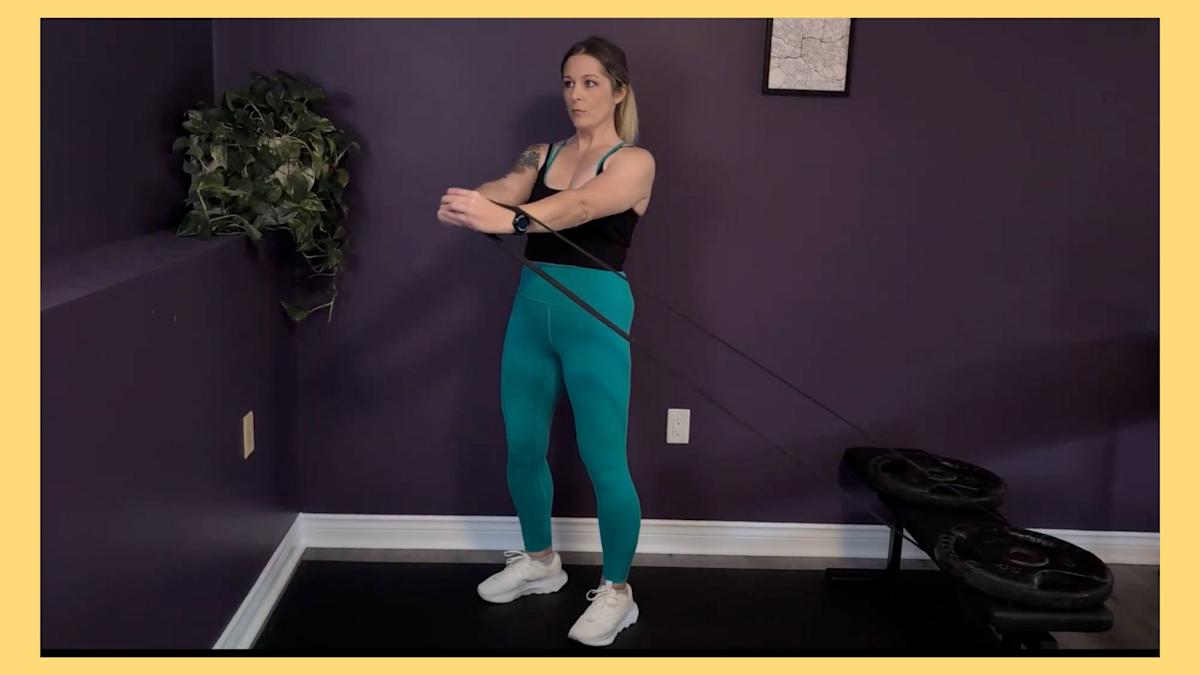
You might be surprised at the challenge your core feels when doing this seemingly-straightforward exercise. (Rachel MacPherson)
The Pallof press (PP) is a straightforward core exercise that teaches your trunk to resist twisting, helping you build deeper abdominal muscle strength for improved trunk control. This pays off for everything from squats and pressing exercises to daily tasks , says Melissa Wogahn, Certified Strength and Conditioning Specialist and National Board-Certified Health and Wellness Coach. “Learning the skill in the PP transfers to activities of daily living including getting in and out of a car, taking clothes out of the washer and dryer, vacuuming and reaching under a cabinet.” While these tasks seem easy enough to perform, if you lack trunk control, you’re more likely to move awkwardly or lose your balance, and you could even end up with an injury. Avoid flaring your ribs or leaning toward the anchor as you perform the exercise, and don’t press too fast.
How to do it
-
Set a band at chest height and stand sideways to the anchor
-
Hold the band at your sternum with both hands, feet positioned hip-width apart.
-
Brace your core lightly, ribs stacked over your hips.
-
Press your hands straight out in front of your chest without allowing your torso to rotate toward the anchor as the tension increases.
-
Hold for a beat, then bring your hands back to your chest, keeping the movement under control.
-
Check to make sure your shoulders don’t rise and that your pelvis remains level.
-
Progress by moving farther from the anchor to increase the band’s tension or switching to a split- or half-kneeling stance.
-
Try 3 sets of 10-15 reps per side or 10-20-second holds.
To make it easier: Stand closer to the anchor point or use a lighter band.
To make it harder: Use a thicker band, stand further away from the anchor or hold the press for longer.
Banded overhead triceps extension
_(9).gif)
You don’t need dumbbells to perform this classic triceps-strengthening move. (Rachel MacPherson)
Not all arm exercises work as well with bands as they do with weights, but triceps extensions are a strong exception. The bands provide resistance at the peak contraction and help you feel a deep stretch at the bottom of the move. Don’t let your elbows drift apart as your press upward and avoid arching your back.
How to do it
-
Anchor the band low, close to your feet, and sit down on a bench or sturdy chair.
-
Grip the band behind your shoulders at your spine, making sure the band is taut, but not tight.
-
Pin your elbows near your temples.
-
Extend your elbows up to straighten the arms, squeezing your triceps at lockout.
-
Lower the band back to the starting position, keeping the movement under control without letting your elbows drift apart.
-
Keep your neck neutral and avoid arching your lower back.
-
Use a smooth tempo and a full range of motion you can control.
-
Try 2-4 sets of 10-15 reps.
To make it easier: Use a lighter band.
To make it harder: Perform the move with one arm at a time and/or slow down the eccentric (lowering) phase.
Band pull-apart
_(7).gif)
Target the major muscles of your upper back with the banded pull apart. (Rachel MacPherson)
Pull-aparts help “open through the front of the chest, which is where a lot of us feel some tension if we’re sitting hunched over our desks with poor posture,” says Allen. They also build rear-shoulder endurance and work the upper back muscles that help improve your posture. Avoid shrugging, flaring your ribs or bending your elbows as you perform the exercise.
How to do it
-
Stand tall and hold a light band at chest height with straight elbows, palms facing up.
-
Set your ribs down and relax your shoulders away from your ears.
-
Pull the band apart by moving your shoulder blades back and slightly down as your arms reach out toward the sides.
-
Pause 1-2 seconds at end range, feeling the mid-back squeeze.
-
Return slowly, keeping your elbows mostly straight and ribs quiet
-
Start with a lighter band so you can “feel” the scapula glide as you perform the exercise.
-
Try 3 sets of 12-20 reps.
To make it easier: Use a lighter band.
To make it harder: Use a thicker band or slow the tempo to 2-2-2 (2 counts to pull apart, 2 counts to hold, 2 counts to return to start)
Banded good morning
_(6).gif)
You’ll really “wake up” your hamstrings and glutes when you try this banded good mornings exercise. (Rachel MacPherson)
Resistance band good mornings help you practice the hip hinge pattern required for deadlifts while strengthening your hamstrings and lower back. Your core will also get a workout with solid bracing against the pull of the band. With bands, the resistance will be lighter at the bottom of the movement with extra “bite” up top to really feel the squeeze. That added top-range tension also helps you punch through lockout and boost bar speed on deadlifts. You don’t want to let your spine round as you hinge forward, but a little extra arching is ok. Avoid “bouncing” at the bottom when the band’s tension eases.
How to do it
-
Stand on the band with feet hip-width apart and loop it across your upper back and shoulders (not on your neck).
-
Soften your knees and brace your core lightly.
-
Press your hips back while keeping a long, neutral spine and your shins nearly vertical (little to no forward angle).
-
Stop when you feel a stretch along your hamstrings — make sure your back remains straight and steady.
-
Squeeze your glutes and drive your hips forward to stand tall.
-
Keep the band’s path close to your body and avoid locking your knees at the top of the movement.
-
Start with a small range of motion and build depth as your control improves.
To make it easier: Use a lighter band or shorter range of motion.
To make it harder: Slow down the eccentric (lowering) phase or use a thicker band.
How to Use This Program
If you want to go beyond a single living room resistance band workout session, you can alternate the 5 exercises in this program with other exercises to balance your training. Here’s an example program:
-
Day A: Spanish squat, Pallof press, push‑up, split squat, plank taps
-
Day B: Banded good morning, banded row, banded pull‑apart, banded overhead triceps extension, deadbug
Our favorite resistance bands
Here are two of our top picks. See our full list for the best resistance bands here.
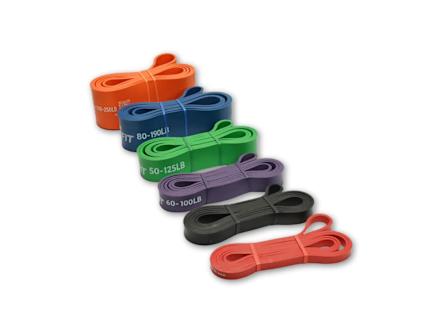
Living Fit
Living.Fit’s Resistance Bands come as a six-band long-loop set ranging from 5 to 200 pounds. If you need even higher levels of resistance, you can use two or three at the same time to add to the intensity for everything from mobility warm-ups to assisted pull-ups or barbell work. Using them with a door anchor makes it possible to add push/pull options (like rows or chest presses). The bands feel comfortably grippy without feeling sticky or sticking to themselves, and the portable kit is backed by a lifetime warranty (based on the expected lifetime of the product).
$80 at Living.Fit
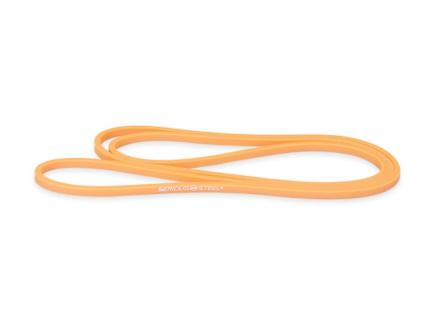
Serious Steel
Serious Steel Fitness’ 32-inch resistance bands use 15-layer latex for durable snap and are sold individually or in a color-coded set (2-150 pounds of resistance in the set; 2-200 pounds available individually). The shorter 32″ provides more resistance early in each exercise’s range of motion (there’s less length to work with before the band is pulled taut and stretched) for less slack and smoother progressive overload during upper- and lower-body work. That said, if you’re 5’10” or taller, the 41″ version may be a better choice, particularly for exercises where greater length is needed, like when performing banded pullups or doing barbell squats with resistance bands.
$12+ at Serious Steel Fitness
FAQs
What resistance-band moves are best for desk workers?
Coach John Lindala, MS, PES, suggests 1 minute of hip-band squats with alternating lateral leg lift, then a 1-minute wall sit with a light band around the wrists while you press the forearms forward and gently “pull apart” the band. You’ll wake up the glutes and mid-back without much space or sweat. Research in office workers indicates that adding short, daily elastic-band movements may help reduce neck and shoulder pain and improve posture.
Can resistance bands help beginners build muscle?
Resistance bands can help beginners build muscle if used in conjunction with the right exercises and programming. If sets feel challenging (you stop with about 1-3 reps “left in the tank”) and you make the exercises a little harder over time, bands can build strength and muscle mass much like free weights. Plan simple progressions by using thicker bands, increasing the distance from the anchor or slowing the eccentric phase of the movement. Keep in mind that bands can give you the opposite force curve of free weights (the exercise is more challenging when the band is fully stretched, but easier as the band loses tension) which can make them less effective for building muscle mass with certain exercises as you progress.
How do I choose the right band tension?
Pick a band that lets you perform 10-15 controlled reps with good form, finishing the set with 1-3 reps in reserve. If you breeze past 15, select a band with stronger resistance or move farther from the anchor; if you can’t hit 8 with control, go lighter or move closer. Variable resistance (the type of resistance provided by bands) isn’t automatically “better” than constant resistance (the type of resistance provided by dumbbells or other free weights), so focus on a creating a level of tension that helps you train consistently and progress gradually over time.
Are bands safer for joints than weights?
Bands provide smooth resistance and often feel more forgiving at the end range of a movement, which many beginners appreciate. That said, joint comfort still depends on form, range of motion and appropriate loading. Choose variations that feel comfortable, keep your reps controlled and stop a rep or two before your form falters. Research indicates that using bands can offer comparable results to traditional strength training when effort and progression are matched.
Should I combine bands with dumbbells or a weighted vest?
It’s a good idea to combine bands with other weights for the greatest level of benefits. For instance, pairing bands with a dumbbell when performing Romanian deadlifts or hip hinges covers the full spectrum of the strength curve since bands add more tension near the top of the movement while free weights load the stretch at the bottom of the movement, which is ideal for muscle growth. A lightly weighted vest works well for squats, split squats and step-ups, while bands are sufficient for handle pulls and core exercises. Bands complement traditional loading rather than totally replace it.
How often should I use resistance bands?
If you’re trying to gain muscle or strength, aim to work each muscle group at least twice a week. If your goal is to break up sedentary periods or counteract poor work posture, Lindala recommends sprinkling micro-sessions (2–5 minutes) one to three times per day, focusing on the glutes, hamstrings, and mid-back (rhomboids/lower traps) to counteract the effects of prolonged sitting. Start light, keep reps smooth and progress by stepping farther from the anchor or moving to a slightly thicker band.
Meet the Experts
-
Melissa Wogahn, MA, is a Certified Strength & Conditioning Specialist, National Board-Certified Health & Wellness Coach.
-
Melyssa Allen, double-board-certified lifestyle medicine coach and size-inclusive fitness specialist
-
John Lindala, MS, a performance enhancement and injury prevention expert
Our health content is for informational purposes only and is not intended as professional medical advice. Consult a medical professional on questions about your health.