

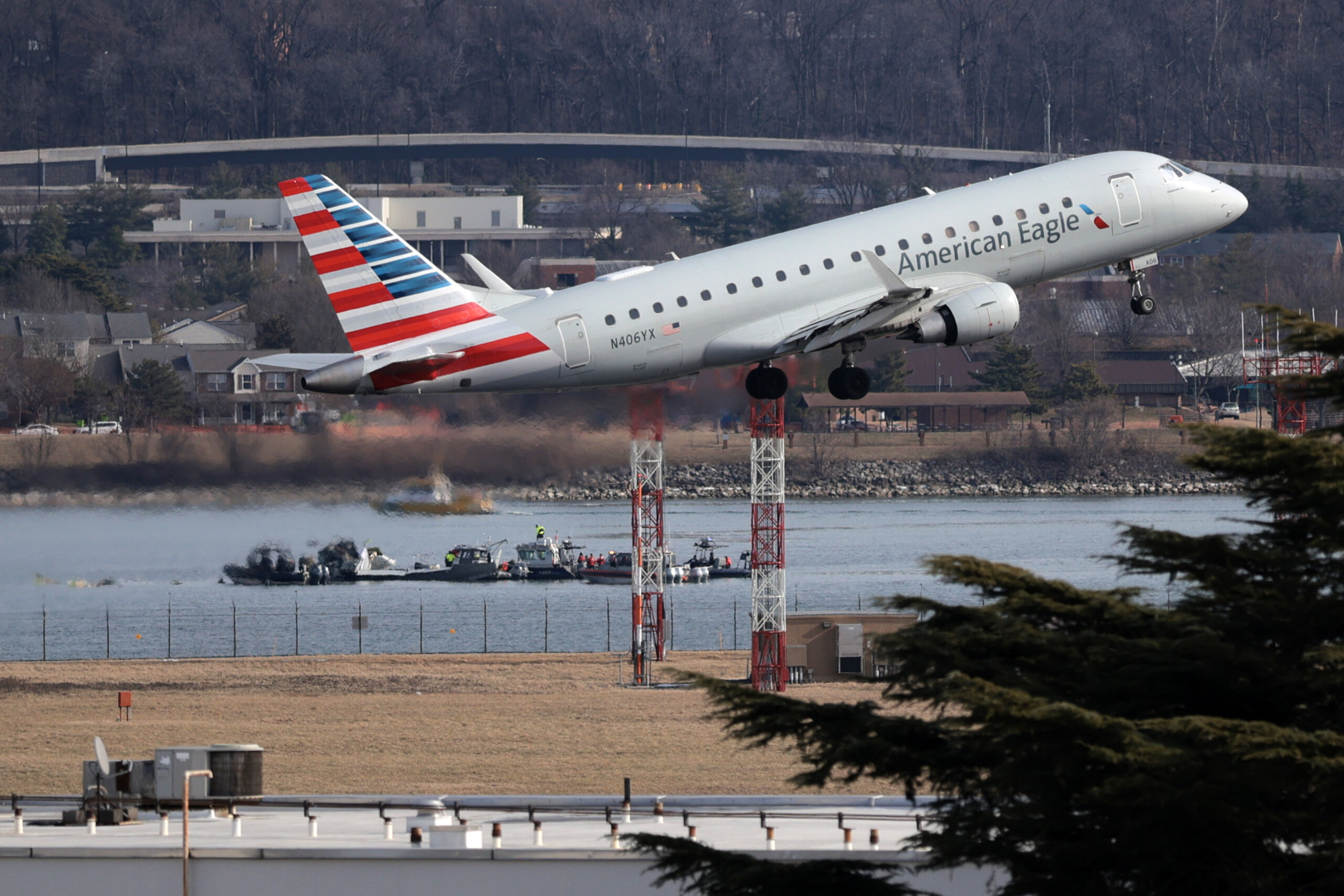
An aviation expert believes that the new flight rules will make flying safer and give pilots and air traffic controllers more information to avoid crashes.
The FAA this week announced new regulations that immediately suspend the use of visual separation between airplanes and helicopters around an estimated 500 of the nation’s busiest airports and airspaces.
It includes the airspace around Reagan National Airport and the D.C. region’s two other commercial airports: BWI Thurgood Marshall and Dulles International.
The rules are a direct result of the Jan. 29, 2025, midair collision near Reagan National Airport when an Army Black Hawk helicopter collided with American Airlines flight 5342, which led to the death of 67 people on the two aircraft.
D.C.-area aviation expert Jeff Guzzetti, who worked for both the NTSB and FAA as a safety investigator and now runs his own aviation consulting business, believes the changes will make flying safer and give pilots and air traffic controllers more information to avoid crashes.
“I think it makes things safer because now the helicopter pilots have help. They have a team of controllers who are monitoring them and giving them specific instructions,” Guzzetti said. “No more ‘see and avoid.’ That’s the philosophy that came into play on the night of the midair collision. Now all helicopters will have to be under radar control, and I think that is going to make things safer.”
Instead, now air traffic controllers will actively manage and monitor on radar all of the airspace and interactions between pilots and helicopters around the busiest airports.
The FAA scrapped an older practice called ‘seek and avoid’ where pilots looked for other aircraft and stayed away from them. That was the case on the night of the DCA midair.
“The tragedy over the Potomac one year ago revealed a startling truth: years of warning signs were missed, and the FAA needed dire reform. Since then, we’ve implemented numerous changes to protect the skies over our capital and keep the traveling public safe,” U.S. Transportation Secretary Sean Duffy said in a statement.
“But the job isn’t done. Using innovative data analysis, the safety team at the FAA has identified the need for enhanced protocols at all airports across the National Airspace System.”
On the night of the DCA crash, both the American regional jet and the Army helicopter pilots were using the procedure where a controller would provide them information about other nearby aircraft, and it is the pilot’s responsibility to look out their cockpit windows and find the aircraft in the sky.
But in crowded airspace with numerous planes landing and taking off at night, the lights from a nearby city can be distracting and it can be difficult to spot a plane or helicopter that may be close by.
The NTSB’s final report on the DCA crash said the Black Hawk pilots may have mistaken another jet that had just gotten airborne from a different runway at Reagan National from American Flight 5332.
The report also said controllers had relied on visual separation of aircraft, putting more responsibility on pilots as a way to reduce what controllers say is a high workload at DCA.
The NTSB has also been highly critical of Congress and the FAA for not passing aviation safety legislation it has endorsed, that put into law many of its recommendations to improve safety around airports.
The legislation has the support of surviving family members of those people who died in the collision.
“We conducted a yearlong investigation, published over 19,000 pages of evidence in our public docket, and issued 74 findings and 50 recommendations aimed at preventing another tragedy and saving lives,” Tim LeBaron, director of NTSB’s office of aviation safety, said in a statement.
“Efforts to now water-down our evidence-based recommendations are counter to safety and dishonor the lives of 67 people who died on Jan. 29, 2025.”
Get breaking news and daily headlines delivered to your email inbox by signing up here.
© 2026 WTOP. All Rights Reserved. This website is not intended for users located within the European Economic Area.